유화 원작 구매
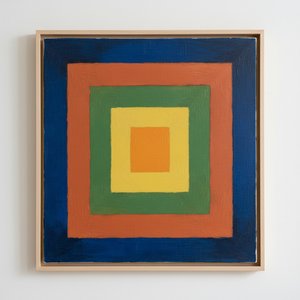
 Multiplex D에 관한 모든 것







































 가로 또는 세로 중 어느 한 면이라도 105cm(약 41인치)를 초과하는 작품이나 복제화의 경우, 프레임은 분해된 키트 형태로 배송됩니다. 이는 안전한 배송을 보장하고 운송 중 발생할 수 있는 손상을 방지하기 위함입니다.


Josef Albers’s Geometric Exploration of Color and Perception
Josef Albers's "Multiplex D," created in 1948, stands as a cornerstone of American Abstract Expressionism while simultaneously embodying the principles of Bauhaus design—a testament to his multifaceted artistic vision. This deceptively simple woodcut print showcases nine squares meticulously arranged on a rectangular canvas, each square subtly offset from its neighbors, creating an illusion of depth and movement that transcends mere visual representation. Albers’s masterful manipulation of tonal variations within the squares contributes significantly to this perceptual experience, prompting viewers to contemplate how color interacts with form and how individual perception shapes our understanding of reality.- Artist: Josef Albers (American (born Germany), Bottrop 1888–1976 New Haven, Connecticut)
- Medium: Woodcut on Paper
- Dimensions: Sheet: 9 × 12 1/16 in
- Date: 1948
The Bauhaus Influence and Geometric Precision
Albers’s formative years were deeply rooted in the Bauhaus school of art and design, where he absorbed the revolutionary ideas championed by Walter Gropius regarding functionalism and the unification of art and craft. This influence is palpable in “Multiplex D,” which rejects representational imagery in favor of geometric abstraction—a deliberate choice to prioritize form over content and to explore the fundamental properties of visual perception. The repetition of squares, a motif prevalent throughout Bauhaus aesthetics, underscores the school’s belief that simplified shapes could convey complex ideas effectively.Color Theory and Illusionistic Depth
“Multiplex D” exemplifies Albers's pioneering contributions to color theory—specifically his concept of simultaneous contrast. He understood that adjacent squares emit hues that appear differently depending on the surrounding colors, generating a dynamic interplay between perception and reality. This technique isn’t merely decorative; it serves as a conduit for investigating how our eyes perceive color and how these perceptions are influenced by context. The subtle gradations of tone within each square amplify this illusionistic depth, inviting contemplation about the nature of visual experience.Symbolism Beyond Surface Appearance
While seemingly devoid of narrative content, “Multiplex D” possesses a profound symbolic resonance. The squares themselves can be interpreted as representing stability and order—characteristics aligned with Bauhaus ideals—yet their overlapping positions suggest interconnectedness and the complexities inherent in human experience. Albers’s deliberate use of monochrome reinforces this notion, stripping away extraneous details to focus on the essential relationship between color and form. It encourages viewers to consider how visual elements communicate ideas beyond literal depiction.A Legacy of Influence
“Multiplex D” solidified Josef Albers's reputation as a visionary artist who reshaped the landscape of modern art. His meticulous attention to detail, coupled with his groundbreaking exploration of color perception, continues to inspire artists and designers globally. The print’s enduring appeal lies in its ability to provoke intellectual curiosity while simultaneously conveying an understated elegance—a reflection of Albers's unwavering commitment to artistic integrity and his profound understanding of the transformative power of visual art. Its inclusion in museums like The Metropolitan Museum of Art demonstrates its significance as a pivotal piece within American art history.질의응답
Multiplex D은(는) 수작업으로 그린 작품인가요, 아니면 프린트된 작품인가요?
수작업 제작: 숙련된 화가가 Multiplex D을(를) 리넨 캔버스 위에 유화로 재현합니다.
Multiplex D의 사이즈는 어떤 것을 선택해야 하나요?
원작의 크기는 22 x 30 cm입니다. 사이즈는 27.5 x 36.4 cm (₩271076)부터 182.9 x 242.5 cm (₩2222826)까지 있으며, 이 페이지의 표에 주요 단계별 가격이 안내되어 있습니다.
배송은 얼마나 걸리나요?
배송은 전 세계 무료 특송으로 4~5주가 소요되며, 본 페이지에서 긴급 제작 옵션을 선택하실 수 있습니다. 제품은 조건 없이 100일 이내에 반품하여 전액 환불받으실 수 있습니다.
Multiplex D 원본은 어디에 있나요?
원본은 샌프란시스코에 위치한 드 영 미술관 소장품입니다.
요제프 알버스 작가는 Multiplex D 작품에 어떤 재료를 사용했나요?
Acrylic On Canvas
 미리보기

 공유하기
 공유하기
 상세 정보
 학습용 요약본


 다운로드
 유사 작품 더 보기
 X-레이
 슬라이드 쇼 보기
 질의응답

 통계 정보