
 실제 크기로 보기
 보내기
보내기 공유하기
공유하기
 상세 보기
상세 보기 가이드 보기

 이미지 다운로드
 유사 작품 더 보기
 X-레이
X-레이 슬라이드 쇼 보기
 통계 정보
통계 정보Inferno
 Engraving
- WallArt
- Neoclassical Style
 1793
1793- 19th Century
 160.0 x 270.0 cm
 국립 도서관 (Bibliothèque Nationale)
 상세 보기
상세 보기
핸드메이드 유화 복제화
작가가 직접 캔버스에 손으로 그린 유화 작품으로, 원하는 크기와 액자로 맞춤 제작해 드립니다. ( 프린트 판매로 전환 디지털 이미지 판매 채널로 전환)




P118B ₩10

P118H ₩10

P118W ₩10

P438Z ₩10

P508JH ₩12

P508YH ₩12

P805H ₩10

P805Z ₩10

P919BZ ₩10

P919G ₩10

P919XJ ₩10

P959ZH ₩10

P968JZ ₩12

W106C ₩8

W218G ₩10

W218JH ₩8

W218Y ₩10

W307PJ ₩10

W316G ₩10

W316PJ ₩8

W316Y ₩10

W398PJ ₩8

W4111J ₩10

W500HY ₩15

W500JH ₩15

W692G ₩12

W849H ₩8

W940BG ₩15

W953PJ ₩8




작품의 원본 비율을 그대로 유지하는 프리셋 사이즈 중에서 선택해 보세요.

액자나 벽면 크기에 맞춰 필요한 가로와 세로 길이를 입력해 주세요. 본 작품은 수작업으로 제작되므로, 요청하신 비율에 따라 작가가 그림의 가장자리를 조금 더 넓게 그리거나 일부를 조정하여 작업할 수 있습니다. 작업 시작 전, 최종 확인을 위해 디지털 목업 이미지를 보내드립니다. 이 페이지에 표시된 이미지는 실제 결과물과 다를 수 있으며, 오직 목업 이미지만이 정확한 결과물을 보여줍니다.
주문 완료 후 OriginalUniqueArt.com 팀에서 상세 안내를 위해 고객님께 이메일을 보내드리며, 미리보기 시안을 함께 제공해 드립니다.


 유리 옵션은 110cm 미만 크기에서만 선택 가능합니다.

Inferno
재현 매체
복제본 규격
-


총 결제 금액
₩ 609120
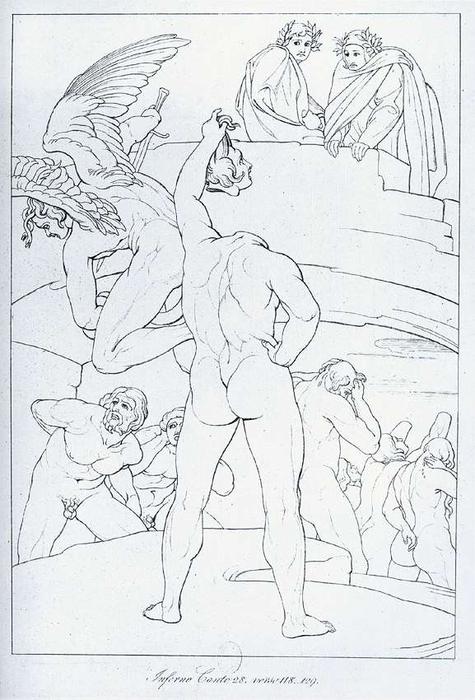
A Descent Into Darkness: Exploring John Flaxman’s Inferno
John Flaxman's engraving of Dante Alighieri’s *Inferno*, completed in 1793, stands as a monumental achievement of neoclassical illustration—a testament to both artistic skill and intellectual fervor. More than just a depiction of Dante’s harrowing journey through Hell, it embodies the spirit of Enlightenment thought, grappling with themes of morality, judgment, and divine retribution within a meticulously crafted visual language. Flaxman's work transcends mere representation; it strives to convey the profound psychological drama inherent in Dante’s poetic vision.- Composition & Perspective: Flaxman employs a complex pyramidal arrangement, guiding the viewer’s eye upwards towards a radiant angelic figure—a beacon of hope amidst the pervasive gloom. The flattened perspective characteristic of engraving techniques reinforces the sense of timelessness and universality, emphasizing the enduring relevance of Dante's narrative.
- Line Technique & Texture: Flaxman’s mastery lies in his masterful use of line engraving. Delicate lines delineate musculature and facial expressions with astonishing precision, capturing the agony etched upon the tormented souls depicted. Simultaneously, bolder lines define architectural elements and create a palpable textural illusion—the rough surface of Hell contrasted against the smooth contours of angelic forms.
- Color Palette & Lighting: The absence of color is deliberate; Flaxman eschews pigment to focus on tonal variation—a technique favored by neoclassical artists who sought clarity and restraint. Dramatic lighting casts long shadows, intensifying the emotional impact of the scene and highlighting the psychological torment experienced by the figures.
Symbolism & Narrative Depth
The winged creature dominating the upper portion of the engraving serves as a potent symbol—representing divine grace attempting to penetrate the impenetrable darkness of Hell. Its outstretched wings suggest aspiration, redemption, and the promise of salvation for those who persevere through suffering. The anguished expressions on the faces of Dante’s companions convey the visceral horror of their predicament, mirroring the psychological exploration central to Dante's poem. Flaxman doesn’t merely illustrate Dante; he embodies its philosophical core—a confrontation with inescapable moral responsibility.Historical Context & Influence
Flaxman’s engraving emerged during a period of significant artistic and intellectual upheaval in Britain, coinciding with the rise of Neoclassicism as a reaction against Rococo excess. Inspired by classical sculpture and literature, Flaxman sought to recapture the grandeur and moral seriousness of antiquity—values championed by thinkers like Rousseau and Voltaire. His work profoundly impacted subsequent generations of illustrators and artists, establishing a precedent for conveying complex narratives through stylized visual representations. Flaxman’s *Inferno* remains an iconic image of Enlightenment idealism—a timeless depiction of human suffering illuminated by divine compassion.Conclusion: An Enduring Legacy
John Flaxman's *Inferno* endures not merely as a beautiful engraving but as a powerful distillation of Dante’s poetic genius and the intellectual currents of its time. Its meticulous craftsmanship, symbolic richness, and emotive impact continue to inspire admiration and provoke contemplation—a testament to Flaxman’s enduring contribution to British art history and his ability to transform literature into unforgettable visual experience.질의응답
"Inferno"의 작가는 누구인가요?
"Inferno"은(는) John Flaxman의 작품입니다. 이 페이지의 정보는 John Flaxman의 원작에 대해 설명합니다.
"Inferno"의 Neoclassical Style 양식에는 어떤 정서적 어조가 담겨 있나요?
"Inferno"의 Dramatic한 감정은 그 Neoclassical Style 양식과 함께 어우러집니다.
John Flaxman의 "Inferno"의 색감은 채도가 높은 편인가요, 아니면 차분한 편인가요?
"Inferno"의 색조는 채도가 Muted입니다.
작가 소개
A Life Etched in Stone and Line
John Flaxman, born in York in 1755, emerged as a pivotal figure bridging the gap between the waning Rococo era and the ascendant Neoclassical movement in Britain. His story is one of remarkable artistic evolution, fueled by both innate talent and diligent study. From humble beginnings assisting his father, a moulder of plaster casts, young John absorbed an early appreciation for form and texture. This practical grounding, coupled with a voracious appetite for classical literature – pursued largely through self-education – laid the foundation for a career that would redefine British sculpture and illustration. His childhood was marked by illness and loss; his mother’s death when he was nine years old profoundly shaped his introspective nature. Yet, even in these early years, his artistic promise shone brightly, winning him accolades from the Society of Arts at just twelve years old. This initial success propelled him into the orbit of London's burgeoning art scene, where friendships with William Blake and Thomas Stothard would prove formative, fostering a lifelong exchange of ideas and creative energy.Wedgwood and the Classical Ideal
Flaxman’s artistic trajectory took a significant turn with his employment by Josiah Wedgwood in 1775. This association wasn't merely a source of income; it was an immersive apprenticeship in translating classical motifs into commercially viable art forms. Modeling reliefs for Wedgwood’s renowned jasperware and basaltware demanded precision, economy of line, and a deep understanding of antique design. The influence of d’Hancarville’s engravings of Greek vases proved particularly potent, shaping Flaxman's aesthetic sensibility towards streamlined elegance and narrative clarity. Designs like the *Apotheosis of Homer* and the *Dancing Hours* weren’t simply decorative elements; they were distillations of classical mythology and allegory, rendered with a newfound emphasis on linear grace. This period honed his skills in relief sculpture, a medium he would masterfully employ throughout his career, particularly in his funerary monuments. It was during this time that Flaxman began to cultivate the style for which he became celebrated – a delicate balance between classical purity and emotional resonance.Roman Reveries and Illustrative Triumph
A transformative journey to Rome in 1787 marked a turning point in Flaxman’s artistic development. Funded partly by Wedgwood, this extended sojourn allowed him to immerse himself directly in the heart of antiquity. He studied not only classical sculpture but also medieval and Renaissance art, broadening his understanding of artistic traditions. More importantly, it was in Rome that he began producing the book illustrations that would secure his lasting fame. Commissions followed for editions of Homer’s *Iliad* and *Odyssey*, Dante’s *Divine Comedy*, and Aeschylus' tragedies. These weren’t mere accompaniments to the text; they were independent works of art, characterized by their stark simplicity, dynamic compositions, and masterful use of line. The illustrations, engraved by figures like Tommaso Piroli, resonated deeply with European audiences, earning Flaxman widespread acclaim – Goethe famously hailed him as “the idol of all dilettanti.” His designs for Dante’s *Divine Comedy*, in particular, proved profoundly influential, inspiring artists such as Goya and Ingres and serving as a crucial resource for art students throughout the 19th century.Monuments to Memory and Lasting Legacy
Upon his return to England, Flaxman established himself as a leading sculptor of funerary monuments. He approached these commissions with a unique sensitivity, eschewing ostentation in favor of restrained elegance and heartfelt emotion. His memorials – found in churches across England, including those dedicated to Thomas Chatterton, Mrs. Morley, and the Rev. Thomas Ball – are characterized by their simplicity, pathos, and rhythmic design. The monument to George Stevens, now housed in the Fitzwilliam Museum, exemplifies his ability to convey profound grief and enduring remembrance through subtle yet powerful forms. While he achieved recognition as a professor of sculpture at the Royal Academy in 1810, it is perhaps his illustrations that cemented his place in art history. John Flaxman’s work represents a synthesis of classical ideals, technical mastery, and emotional depth. He left an indelible mark on British art, influencing generations of artists with his elegant style and unwavering commitment to the power of line. His legacy continues to inspire, reminding us of the enduring beauty and profound meaning that can be found in both stone and ink. He remains a testament to the transformative power of artistic vision.
John Flaxman
1755 - 1826 , United States of America
작가 정보 요약
- Full Name: John Flaxman
- Nationality: British
- Date Of Birth: 1755
- Date Of Death: 1826
- Place Of Birth: York, United States of America
- Notable Artworks:
- Saint Michael Overcoming Satan
- The Fight for Body of Patroclus
- Apotheosis of Homer
- Dante's Divine Comedy
- Artistic Movement Or Style: Neoclassicism
- Artists Who Influenced This Artist:
- George Romney
- William Blake
- Artists Or Movements Influenced By This Artist:
- Goya
- Ingres
관련 기사

Giclée Prints: Archival Quality & Aesthetic Nuances for the Discerning Collector
Explore the world of giclée prints with OriginalUniqueArt. Learn about archival quality, aesthetic nuances & investment potential. Expert guidance for discerning art collectors seeking museum-quality reproductions and lasting value.

The Intricate World of Engraving: A Historical Survey of Technique, Artistic Expression & Enduring Legacy
Explore the rich history of engraving with OriginalUniqueArt. Discover techniques, iconic artists like Dürer & Callot, collecting tips, and expert guidance for preserving your art investment. Learn about intaglio printing & more!

Engraving's Golden Age: 10 Masterpieces That Redefined Art | OriginalUniqueArt
Journey through art history with our Top 10 Legendary Engravings! Explore masterpieces by Dürer, Rembrandt & Goya. Discover the stories behind these iconic prints and find museum-quality reproductions for your home at OriginalUniqueArt.com.

단테 가브리엘 로세티의 걸작 25선: 아름다움과 상징으로 물든 예술 세계 | OriginalUniqueArt
단테 가브리엘 로세티의 시대를 초월하는 걸작 25선을 만나보세요. 프레라파엘리트 운동의 정수를 담은 그림 속 아름다움과 상징을 탐험하고, OriginalUniqueArt에서 고품질 미술 작품으로 공간에 예술적인 감성을 더하세요. 지금 바로 컬렉션을 확인하세요!

Engraving: A Historical Survey of Technique, Artistic Expression & Enduring Legacy
Explore the rich history of engraving with OriginalUniqueArt. Discover techniques, iconic artists like Dürer & Callot, collecting tips, and expert guidance for preserving your art investment. Learn about intaglio printing & more!
