프린트 판매로 전환
 상세 보기
상세 보기







































 가로 또는 세로 중 어느 한 면이라도 105cm(약 41인치)를 초과하는 작품이나 복제화의 경우, 프레임은 분해된 키트 형태로 배송됩니다. 이는 안전한 배송을 보장하고 운송 중 발생할 수 있는 손상을 방지하기 위함입니다.


A Portrait of Dreams and Catalan Identity
Joan Miró’s “Mujer y perro cara a la luna” (“Woman and Dog Facing the Moon”) transcends mere visual representation; it embodies the spirit of Surrealism and delves into the subconscious depths of Catalan culture. Painted in 1936, during a period marked by political upheaval and artistic experimentation—specifically coinciding with the Spanish Civil War—the artwork serves as a poignant reflection on anxieties surrounding conflict and an affirmation of resilience.
Born in Barcelona in 1893, Miró’s formative years were steeped in the vibrant atmosphere of Gaudí’s architectural legacy. This fascination for organic forms would permeate his artistic endeavors, shaping his distinctive style characterized by biomorphic shapes, simplified lines, and a palette dominated by earthy hues punctuated with bursts of color.
Stylistic Innovation: Abstract Expressionism Meets Catalan Folklore
Miró’s approach to painting defied conventional realism. He embraced abstraction as a vehicle for conveying emotion and exploring inner landscapes—a technique that aligns seamlessly with the burgeoning movement of Abstract Expressionism in America. However, unlike many of his contemporaries who sought purely formal explorations, Miró infused his work with elements rooted in Catalan folklore and mythology.
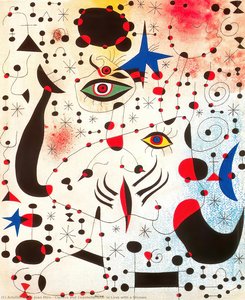
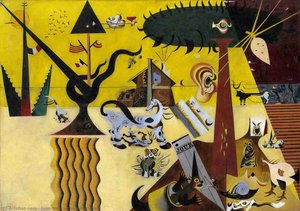
The composition itself is deliberately unsettling yet captivating. A woman’s figure—a recurring motif in Miró's oeuvre—is positioned alongside a dog’s head, which rests upon her shoulder. The dog’s open mouth suggests a gesture of repose or perhaps even yearning, creating an interplay between stillness and vulnerability.
Symbolism Under Moonlight
The moon dominates the canvas, serving as both a visual focal point and a symbolic representation of contemplation and transformation. Miró's use of color—primarily ochre and crimson—further amplifies the artwork’s emotional resonance. These hues evoke feelings of warmth, passion, and primal instinct.
Adding to the surrealist atmosphere are subtle details: two birds scattered across the background—one on the left and another near the top right corner—represent freedom and aspiration. A solitary cat nestled in the lower left quadrant embodies quiet observation and resilience. Collectively, these elements contribute to a tapestry of imagery that invites viewers to contemplate themes of solitude, vulnerability, and the enduring power of nature.
Technical Mastery: Pochoir Printing
“Mujer y perro cara a la luna” was executed using oil on canvas—a medium favored by Miró for its ability to capture nuanced tonal variations. However, what distinguishes this particular reproduction is its printing technique: pochoir. This method involves transferring ink onto paper through stencils, resulting in exceptionally precise and luminous prints that faithfully reproduce the artist’s original vision.
The Museo Nacional Centro de Arte Reina Sofía houses a stunning example of this artwork, offering visitors an opportunity to experience Miró's distinctive style firsthand. Its enduring appeal lies not only in its aesthetic beauty but also in its profound exploration of human emotion and the subconscious—a testament to Miró’s genius as one of the most influential artists of the 20th century.
질의응답
"Mujer y perro cara a la luna"에 대한 가이드는 어디에서 확인할 수 있나요?
호안 미로의 "Mujer y perro cara a la luna"에 대한 가이드 페이지를 이용하실 수 있습니다. 이 페이지는 학생들과 수업용으로 제작된, 인쇄 가능한 작품 정보 시트를 제공합니다.
주문하기 전에 호안 미로의 "Mujer y perro cara a la luna"를 미리 볼 수 있나요?
호안 미로의 "Mujer y perro cara a la luna"의 복제본을 미리 보려면 작품의 미리보기 페이지를 열어주세요.
호안 미로의 "Mujer y perro cara a la luna"의 방문객들은 어디에서 오나요?
호안 미로의 "Mujer y perro cara a la luna"에 관한 통계 정보는 작품의 통계 페이지에서 확인하실 수 있습니다: 해당 작품의 월간 방문 횟수, 작가 작품의 방문 횟수, 그리고 최근 방문자의 국가 및 언어별 상세 현황을 제공합니다.
More about this painting
 실제 크기로 보기
 보내기
보내기 공유하기
공유하기
 상세 보기
상세 보기 가이드 보기

 이미지 다운로드
 유사 작품 더 보기
 X-레이
X-레이 슬라이드 쇼 보기
 Q&A
Q&A 통계 정보
통계 정보