프린트 판매로 전환
 상세 보기
상세 보기







































 가로 또는 세로 중 어느 한 면이라도 105cm(약 41인치)를 초과하는 작품이나 복제화의 경우, 프레임은 분해된 키트 형태로 배송됩니다. 이는 안전한 배송을 보장하고 운송 중 발생할 수 있는 손상을 방지하기 위함입니다.


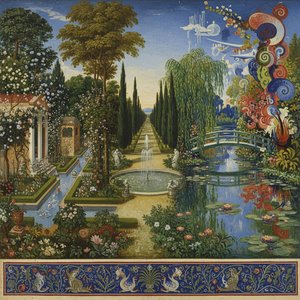
James Ensor’s “Le Jardin de Rousseau”: A Window into the Artist's Psyche
James Ensor’s “Le Jardin de Rousseau,” painted in 1885, isn’t merely a depiction of a pleasant garden scene; it’s a carefully constructed exploration of isolation, social observation, and the artist’s own complex inner world. Born in Ostend, Belgium, to an English father and a Belgian mother – a lineage that profoundly shaped his artistic identity – Ensor spent much of his life immersed in the vibrant, often unsettling atmosphere of coastal resorts. This experience, coupled with his early exposure to carnival masks and curiosities within his parents’ souvenir shop, instilled in him a fascination with disguise, performance, and the hidden layers beneath everyday appearances—themes that would become central to his oeuvre.
The painting itself presents a serene yet subtly unnerving tableau. A wagon or carriage sits prominently before a mature tree, suggesting a leisurely outing or perhaps a clandestine rendezvous. Two figures are visible: one standing slightly off-center on the left, and another closer to the center, their identities deliberately obscured, contributing to the overall sense of detachment. A bicycle hints at the burgeoning modernity encroaching upon this idyllic setting, while clouds drift across the daytime sky, adding a touch of melancholy to the scene. The composition is carefully balanced, yet there’s an underlying tension—a feeling that something unspoken hangs in the air.
The Influence of Henri Rousseau and the Naïve Style
“Le Jardin de Rousseau” reveals Ensor's engagement with the burgeoning artistic movement known as “Naïve Art,” largely influenced by artists like Henri Rousseau. While Ensor’s work is more complex and psychologically driven than Rousseau’s often fantastical jungle scenes, both shared a rejection of academic conventions and a focus on direct observation and emotional expression. Rousseau's influence can be seen in Ensor’s bold use of color—a vibrant palette that feels slightly heightened—and his somewhat simplified forms. However, unlike Rousseau’s dreamlike landscapes, Ensor imbues his garden with a distinctly European sensibility, capturing the social dynamics and subtle anxieties of his time.
Ensor's technique is characterized by broken brushstrokes and a deliberate lack of detail. He doesn’t attempt to render the scene with photographic accuracy; instead, he prioritizes conveying mood and atmosphere. The trees are rendered with thick, expressive strokes, while the grass appears almost aggressively green. This approach reflects Ensor’s interest in capturing not just what he *saw*, but how he *felt* about what he saw—a key element of Expressionism that would later define his work.
Symbolic Layers and Psychological Depth
Beyond its surface appearance, “Le Jardin de Rousseau” is rich with symbolic meaning. The isolated figures suggest a sense of alienation and social disconnect – a recurring theme in Ensor’s art. The wagon, a symbol of leisure and travel, could represent an escape from the constraints of society, or perhaps a yearning for connection that remains unfulfilled. The bicycle, a relatively new invention at the time, symbolizes progress and modernity, yet its presence within this tranquil setting creates a subtle dissonance.
Furthermore, the painting’s overall mood is tinged with melancholy. The cloudy sky, the obscured figures, and the slightly unsettling composition all contribute to a sense of quiet sadness—a reflection of Ensor's own complex emotional life. The garden itself can be interpreted as a metaphor for the human psyche: beautiful on the surface, but harboring hidden depths and unresolved tensions.
A Reproduction Worth Cherishing
OriginalUniqueArt offers meticulously hand-painted reproductions of James Ensor’s “Le Jardin de Rousseau,” capturing the artist's unique style and emotional intensity with remarkable fidelity. Each reproduction is created by skilled artisans using traditional techniques, ensuring that every brushstroke and color nuance faithfully replicates the original painting. Whether you are an art collector, a design enthusiast, or simply someone seeking to bring a touch of artistic beauty into your home, a OriginalUniqueArt reproduction of “Le Jardin de Rousseau” is a stunning addition to any collection—a window into the mind of one of Belgium’s most enigmatic and influential artists.
질의응답
"Le jardin de Rousseau"은(는) 제임스 엔서의 평소 작업 스타일을 잘 보여주는 작품인가요?
"Le jardin de Rousseau"은(는) garden, rousseau, carnival, masks, bicycle, wagon, daytime, leisure을(를) 묘사하고 있는 반면, 제임스 엔서의 기존 주제들은 masks, disguise, social critique, belgian seaside, carnival life, psychological alienation, isolation, symbolic dreamscape입니다. 이 두 가지를 비교해 보면 해당 작품이 작가의 통상적인 소재와 어떻게 연관되는지 알 수 있습니다.
제임스 엔서의 "Le jardin de Rousseau"의 디지털 이미지는 어디에서 구매할 수 있나요?
"Le jardin de Rousseau"은(는) 디지털 이미지 페이지에서 직접 구매 가능한 고해상도 디지털 이미지 다운로드 형태로 제공됩니다.
제임스 엔서의 "Le jardin de Rousseau"은(는) 어떤 공간에 추천하시나요?
제임스 엔서의 "Le jardin de Rousseau" 작품에 추천하는 공간은 Living Room입니다. 물론 이 제안은 고객님의 인테리어에 맞춰 자유롭게 조정하실 수 있습니다.
More about this painting
 실제 크기로 보기
 보내기
보내기 공유하기
공유하기
 상세 보기
상세 보기 가이드 보기

 이미지 다운로드
 유사 작품 더 보기
 X-레이
X-레이 슬라이드 쇼 보기
 Q&A
Q&A 통계 정보
통계 정보