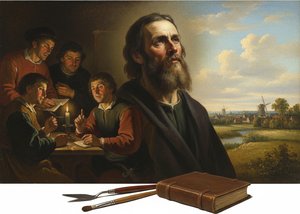
프린트 판매로 전환
 더 보기
더 보기







































 가로 또는 세로 중 어느 한 면이라도 105cm(약 41인치)를 초과하는 작품이나 복제화의 경우, 프레임은 분해된 키트 형태로 배송됩니다. 이는 안전한 배송을 보장하고 운송 중 발생할 수 있는 손상을 방지하기 위함입니다.


Hendrick Terbrugghen: A Baroque Vision of Faith and Emotion
Hendrick Jansz ter Brugghen (1588 – 1 November 1629) stands as one of the most prominent figures in Dutch Golden Age painting, a testament to Caravaggio’s enduring influence on his artistic sensibilities. Born in Overijssel, Netherlands, Ter Brugghen's formative years were steeped in the intellectual fervor of Utrecht under Prince William the Silent, an environment that fostered his early fascination with art and propelled him toward a distinguished career as a genre painter and devout religious artist. His legacy resides not merely in his impressive output but also in his pioneering role within the Utrecht Caravaggisti group—a collective dedicated to capturing the dramatic essence of Caravaggio’s revolutionary style.- Early Influences & Training: Ter Brugghen's artistic journey commenced with a rigorous apprenticeship under Abraham Bloemaert, a Mannerist painter whose stylistic explorations provided crucial groundwork for his subsequent endeavors. This formative period instilled in him an appreciation for compositional balance and refined draughtsmanship—elements that would permeate his oeuvre throughout his life.
- The Utrecht Caravaggisti: Ter Brugghen’s affiliation with the Utrecht Caravaggisti group cemented his position as a vanguard of Dutch Baroque art. Alongside Gerrit van Hondhorst and Dirck van Baburen, he championed Caravaggio's groundbreaking technique—characterized by tenebrism, or dramatic chiaroscuro—which sought to illuminate subjects through stark contrasts between light and shadow. This stylistic approach aimed to evoke profound emotional responses in the viewer, mirroring Caravaggio’s own ambition to convey spiritual fervor and psychological depth.
Notable Works & Artistic Style
Ter Brugghen's artistic output is marked by a remarkable consistency in style—a hallmark of his unwavering commitment to Caravaggio’s principles. His paintings frequently depict biblical narratives with meticulous realism, infused with palpable emotion and imbued with symbolic resonance. Consider “The Singing Lute Player,” housed in The Kremer Collection in Amsterdam; this autograph replica exemplifies Ter Brugghen's masterful handling of color and texture, capturing the contemplative gaze of the lute player against a backdrop of subdued hues—a deliberate choice designed to heighten the scene’s solemn atmosphere. Similarly, "Th," which resides at Alte Pinakothek in Munich, showcases his ability to convey spiritual contemplation through nuanced shading and expressive brushstrokes.- Technique: Ter Brugghen's technique involved layering oil paint—a painstaking process that allowed him to build up texture and achieve luminous effects—reflecting Caravaggio’s meticulous attention to detail.
- Materials: His canvases were prepared with linen, stretched taut and primed with gesso, ensuring optimal adhesion of the pigment and maximizing visual impact.
Symbolism & Emotional Resonance
Beyond mere representation, Ter Brugghen’s paintings strive to communicate profound spiritual truths—a testament to the humanist ideals prevalent during his time. Recurring motifs—such as illuminated books symbolizing divine knowledge—underscore the artist's preoccupation with theological concepts and reinforce the emotional core of his compositions. The dramatic lighting employed in “The Singing Boy” serves not only to delineate form but also to evoke a sense of awe and vulnerability, mirroring Caravaggio’s masterful manipulation of light and shadow to convey psychological complexity. Ter Brugghen’s work continues to captivate audiences today with its enduring beauty and its ability to inspire contemplation on themes of faith, emotion, and human experience—a legacy firmly rooted in the transformative influence of Caravaggio's artistic vision.Legacy & Rediscovery
Despite his tragically premature death at age 42, Ter Brugghen’s contribution to Dutch Baroque art remains substantial. His son Richard tirelessly championed his father’s reputation as a painter, securing a laudatory letter from Gerard Houbraken—a testament to the esteem accorded to Ter Brugghen by fellow artists of his era. The Utrecht Caravaggisti's influence extended beyond stylistic imitation; it fostered a broader artistic ethos centered on capturing human emotion and conveying spiritual depth—a legacy that resonates powerfully within contemporary art discourse. Today, reproductions of Ter Brugghen’s masterpieces adorn galleries and homes worldwide, ensuring that his visionary artistry continues to inspire generations of artists and admirers alike.질의응답
헨드릭 테르브루겐의 "Singing Boy"은(는) 회화인가요, 드로잉인가요, 아니면 판화인가요?
헨드릭 테르브루겐의 "Singing Boy"은(는) WallArt로 분류됩니다. 이 카테고리는 해당 작품의 예술적 형식을 나타냅니다.
"Singing Boy"의 조회수는 어떻게 되나요?
헨드릭 테르브루겐의 "Singing Boy"의 방문 통계 페이지에서는 해당 작품의 월간 방문 수, 작가의 최고 조회 작품과의 비교, 그리고 방문자 유입 경로 등 공개된 방문 통계를 제공합니다.
헨드릭 테르브루겐의 "Singing Boy"은(는) 대중적으로 잘 알려진 작품인가요?
"Singing Boy"은(는) Recognized 등급의 작품입니다.
이 작품에 대해 더 알아보기
 미리보기
미리보기
 공유하기
공유하기 공유하기
공유하기
 상세 정보
상세 정보 가이드 보기

 다운로드
다운로드
 유사 작품 더 보기
 X-레이
X-레이 슬라이드 쇼 보기
 질의응답
질의응답 통계 정보
통계 정보