프린트 판매로 전환
 상세 보기
상세 보기







































 가로 또는 세로 중 어느 한 면이라도 105cm(약 41인치)를 초과하는 작품이나 복제화의 경우, 프레임은 분해된 키트 형태로 배송됩니다. 이는 안전한 배송을 보장하고 운송 중 발생할 수 있는 손상을 방지하기 위함입니다.


Giuseppe Arcimboldo’s “Self-Portrait on Paper”: A Renaissance Riddle
Giuseppe Arcimboldo (1527-1593), a Milanese Mannerist artist, stands apart from his contemporaries not merely for his innovative technique but for the sheer audacity of his artistic vision. While many painters of the era meticulously replicated classical ideals of beauty and proportion—a pursuit driven by humanist scholarship and papal patronage—Arcimboldo dared to challenge convention with a singular preoccupation: transforming recognizable human forms into fantastical assemblages of natural objects.
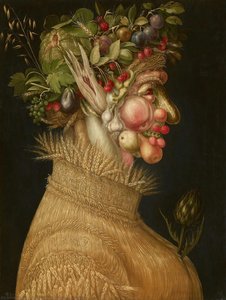
His “Self-Portrait on Paper,” created in 1587, exemplifies this approach perfectly. Executed in brown ink on paper, the drawing is deceptively simple at first glance. However, upon closer inspection, it reveals a masterful manipulation of perspective and detail that underscores Arcimboldo’s profound understanding of artistic principles.
- Style & Technique: Arcimboldo's style is undeniably Mannerist—characterized by exaggerated forms, stylized drapery, and an emphasis on decorative effects. He employs meticulous hatching and cross-hatching to create textures that convincingly mimic the surfaces of his chosen materials – fruits, vegetables, flowers, books, and musical instruments. The artist’s skill lies in seamlessly blending these disparate elements into a unified composition.
- Historical Context: Arcimboldo's work emerged during a period of intense intellectual debate concerning humanism versus scholasticism. He responded to this challenge by elevating the natural world—a cornerstone of Renaissance thought—to the forefront of artistic representation. The portrait served as a commentary on the artist’s own identity and, symbolically, on the broader humanist preoccupation with integrating disparate disciplines into a cohesive whole.
- Symbolism & Composition: The arrangement itself is laden with symbolic significance. Arcimboldo meticulously crafted each component to mirror facial features—the lips represented by cherries, the nose by apples, the eyes by plums, and the ear by a trumpet mouthpiece. The drapery of robes mimics folds of fabric, while rolled-up paper strips evoke the ruff worn by noblemen.
- Emotional Impact: Beyond its technical brilliance, “Self-Portrait on Paper” possesses an undeniable emotional resonance. Arcimboldo’s deliberate distortion of form invites contemplation about perception and illusion—forcing viewers to actively engage in decoding the visual language of his artwork. The resulting image is both unsettling and captivating, prompting reflection on themes of metamorphosis and self-awareness.
Displayed prominently in Palazzo Rosso (Genoa), Italy, Arcimboldo’s “Self-Portrait on Paper” continues to inspire admiration for its inventive artistry and intellectual depth. It stands as a testament to the Renaissance spirit—a willingness to embrace paradoxes and explore uncharted artistic territories.
질의응답
"Self-Portrait on Paper"은(는) 주세페 아르침볼도의 반복되는 주제들 사이에서 어떤 위치를 차지하고 있나요?
주세페 아르침볼도의 기록된 주제들인 botanical symbolism & illusion, human form transfiguration, renaissance intellectual debate, arcimboldo’s surreal vision, iconic portrait mastery 중에서도, "Self-Portrait on Paper"은 composite head, fruit arrangement, renaissance art, portrait painting, symbolism, italian renaissance, arcimboldo style에 독자적인 초점을 맞추고 있습니다.
"Self-Portrait on Paper"을(를) 더 자세히 살펴볼 수 있을까요?
주세페 아르침볼도의 "Self-Portrait on Paper"의 X선 분석 페이지는 엑스레이 스타일의 뷰를 포함하여 작품 이미지의 11개 광학 레이어를 슬라이드하며 살펴볼 수 있는 인터랙티브 뷰어를 제공합니다.
주세페 아르침볼도의 "Self-Portrait on Paper"은(는) 퍼블릭 도메인인가요?
주세페 아르침볼도의 "Self-Portrait on Paper"의 저작권 정보: 해당 작품은 퍼블릭 도메인 - 저작권 보호 기간이 만료되었습니다 상태입니다. 이는 이미지 복제 가능 여부를 결정하는 기준이 됩니다.
More about this painting
 실제 크기로 보기
 보내기
보내기 공유하기
공유하기
 상세 보기
상세 보기 가이드 보기

 이미지 다운로드
 유사 작품 더 보기
 X-레이
X-레이 슬라이드 쇼 보기
 Q&A
Q&A 통계 정보
통계 정보