프린트 판매로 전환
 더 보기
더 보기







































 가로 또는 세로 중 어느 한 면이라도 105cm(약 41인치)를 초과하는 작품이나 복제화의 경우, 프레임은 분해된 키트 형태로 배송됩니다. 이는 안전한 배송을 보장하고 운송 중 발생할 수 있는 손상을 방지하기 위함입니다.


A Soulful Encounter with Haitian Tradition
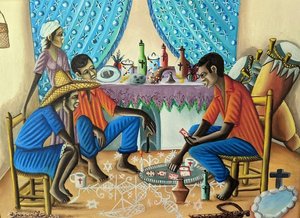
In the evocative masterpiece Papa Zaca, created in 1969 by the renowned Haitian master Gerard Valcin, we are invited into a deeply intimate moment of reflection and cultural storytelling. The painting presents a poignant scene of a man seated upon the earth, his posture heavy with emotion as he rests his head within his hands. This central figure, draped in a vibrant blue shirt and crowned with a simple hat, serves as the emotional anchor for a composition that is as much about atmosphere as it is about subject matter. Surrounded by the humble artifacts of daily life—scattered bottles, weathered bowls, and a solitary cup—the man exists within a space that feels both cluttered and profoundly quiet. The presence of two cats, wandering through the periphery of the scene, adds a layer of domestic realism, grounding the spiritual weight of the piece in the tangible, lived experience of rural Haiti.
The technique employed by Valcin is a testament to his unique background as a tile setter, a craft that gifted him with an extraordinary eye for symmetry and meticulous placement. In Papa Zaca, this manifests as a rhythmic arrangement of objects that guides the viewer's eye across the canvas in a gentle, undulating motion. His use of color is nothing short of luminous; despite the somber mood suggested by the man's posture, the palette is rich and saturated, breathing life into every corner of the frame. The interplay of light and shadow across the various vessels and the textures of the ground creates a sense of three-dimensional depth, making the scene feel like a window into another world—one where the mundane and the mystical are inextricably linked.
The Symbology of Resilience and Ritual
To understand Papa Zaca is to understand the profound connection between the Haitian landscape and the spiritual rhythms of Vodou life. Valcin, a self-taught visionary, had an unparalleled ability to translate the essence of folklore into visual form. The objects surrounding the man—the bottles and bowls—are not merely debris; they are symbols of ritual, sustenance, and the cyclical nature of existence. There is a heavy, contemplative symbolism in the man's isolation, suggesting a moment of spiritual communion or perhaps the weight of communal memory. The painting captures a sense of "l'esprit" (the spirit), where the physical environment is charged with an unseen energy, making the artwork a powerful meditation on the human condition and the endurance of cultural identity.
For the discerning collector or interior designer, this piece offers much more than mere decoration. It provides a profound emotional resonance that can transform a space, offering a focal point of deep narrative and historical significance. A high-quality reproduction of Papa Zaca allows the warmth and complexity of Valcin's vision to inhabit modern interiors, bridging the gap between contemporary aesthetics and the timeless, soulful traditions of Haiti. It is an invitation to contemplate resilience, to find beauty in the humble, and to surround oneself with art that speaks to the very heart of human experience.
질의응답
Gerard Valcin의 "Papa Zaca"은 강렬한 대비를 사용하나요, 아니면 부드러운 조화를 이루고 있나요?
"Papa Zaca"에서는 Bold 대비와 Discordant Palette 조화가 어우러져 있습니다.
"Papa Zaca"의 작가는 누구이며 어떤 화풍인가요?
Gerard Valcin은(는) Haitian Naive Art 운동의 흐름 속에서 "Papa Zaca"을(를) 제작했습니다.
Gerard Valcin의 "Papa Zaca"은 미술사에서 어떤 위치를 차지하나요?
Gerard Valcin의 "Papa Zaca"의 미술사적 분류는 Modern 시대의 Haitian Naive Art입니다.
이 작품에 대해 더 알아보기
 미리보기
미리보기
 공유하기
공유하기 공유하기
공유하기
 상세 정보
상세 정보 가이드 보기

 다운로드
다운로드
 유사 작품 더 보기
 X-레이
X-레이 슬라이드 쇼 보기
 질의응답
질의응답 통계 정보
통계 정보