프린트 판매로 전환
 상세 보기
상세 보기







































 가로 또는 세로 중 어느 한 면이라도 105cm(약 41인치)를 초과하는 작품이나 복제화의 경우, 프레임은 분해된 키트 형태로 배송됩니다. 이는 안전한 배송을 보장하고 운송 중 발생할 수 있는 손상을 방지하기 위함입니다.


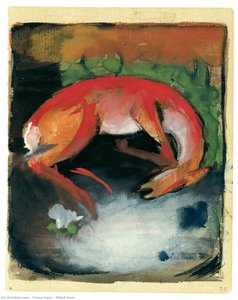
A Moment of Tranquility Captured in Color: Exploring Franz Marc’s “Sleeping Deer”
Franz Marc’s “Sleeping Deer,” painted in 1913, stands as a cornerstone of German Expressionism—a movement that sought to convey inner emotions and spiritual truths through bold artistic expression. More than just a depiction of an animal resting peacefully, this artwork embodies Marc's profound belief that art could serve as a conduit for accessing the sacred, reflecting his formative engagement with theology alongside his burgeoning fascination with the natural world.
The Style of Cubism – A Revolutionary Approach
- Cubist Influence: Marc’s stylistic choices align closely with the principles of Cubism, pioneered by Pablo Picasso and Georges Braque. Unlike traditional representational art that strives for accurate depiction, Cubism fragments objects into geometric planes, presenting multiple perspectives simultaneously.
- Simplified Forms: Observe how Marc reduces the deer's form to simplified shapes—primarily rectangular and triangular—emphasizing its essence rather than meticulous detail. This deliberate distortion contributes to the artwork’s expressive power.
Technique and Color Palette – Expressions of Emotion
Marc employed a tempera technique, known for its luminosity and durability. The vibrant hues he utilized—primarily reds, yellows, and blues—were not merely decorative; they functioned as symbolic representations of inner states. Red signifies passion and vitality, yellow embodies optimism and enlightenment, while blue evokes serenity and contemplation. These colors intertwine to create a harmonious yet dynamic visual experience.
Historical Context – The Blaue Reiter Circle and Spiritual Quest
“Sleeping Deer” emerged from the influential Blaue Reiter (“Blue Rider”) circle—a group of artists who championed abstraction as a means of conveying spiritual ideas. Marc, along with Wassily Kandinsky and Alexej von Jawlensky, believed that art could transcend materialism and connect directly to the divine. This conviction fueled their experimentation with color and form, aiming for an emotional resonance that surpassed mere visual representation.
Symbolism – Deer as Embodiment of Innocence and Spiritual Harmony
The deer itself holds significant symbolic weight within Marc’s oeuvre. Often interpreted as representing innocence, purity, and spiritual harmony—themes central to Christian iconography—the animal embodies Marc's desire to depict the sublime beauty of nature imbued with divine presence. Its posture—resting calmly on its paws—further reinforces this notion of tranquility and repose.
Emotional Impact – A Window into Inner Reflection
"Sleeping Deer" invites viewers into a meditative state, prompting contemplation on themes of peace, vulnerability, and the interconnectedness of life. Marc’s masterful use of color and form transcends mere visual observation, tapping into deeper emotional currents—a testament to his enduring legacy as one of Expressionism's most visionary artists.
질의응답
"Sleeping Deer"은(는) 몇 년도에, 어떤 사조의 작품인가요?
프란츠 마크의 "Sleeping Deer"은(는) 1912년에 제작되었으며 German Expressionism에 속합니다.
프란츠 마크의 "Sleeping Deer"의 색채 정체성은 무엇인가요?
프란츠 마크의 "Sleeping Deer"은(는) Earthy 색조의 팔레트를 사용하며, Rosy Brown (#cdb286)이(가) 주된 색상을 이룹니다.
프란츠 마크의 "Sleeping Deer"에 대한 가이드가 있나요?
프란츠 마크의 "Sleeping Deer"의 가이드 페이지에서는 인쇄 가능한 두 장 분량의 학습용 팩트시트를 제공합니다. 여기에는 작품과 작품 정보표, 작가의 생애 속 시기를 보여주는 연대기, 해당 작가의 다른 작품들, 측정된 컬러 팔레트, 그리고 네 가지 스타일로 바로 복사하여 사용할 수 있는 인용 문구가 포함되어 있습니다.
More about this painting
 실제 크기로 보기
 보내기
보내기 공유하기
공유하기
 상세 보기
상세 보기 가이드 보기

 이미지 다운로드
 유사 작품 더 보기
 X-레이
X-레이 슬라이드 쇼 보기
 Q&A
Q&A 통계 정보
통계 정보