프린트 판매로 전환
 더 보기
더 보기







































 가로 또는 세로 중 어느 한 면이라도 105cm(약 41인치)를 초과하는 작품이나 복제화의 경우, 프레임은 분해된 키트 형태로 배송됩니다. 이는 안전한 배송을 보장하고 운송 중 발생할 수 있는 손상을 방지하기 위함입니다.


A Moment of Serene Intensity: Franz Marc’s “Lying Bull”
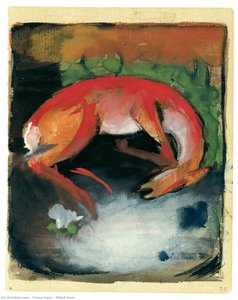
Franz Marc's "Lying Bull," painted in 1913, isn’t merely a depiction of an animal; it’s a profound distillation of the Expressionist spirit—a yearning for connection with nature and a glimpse into the soul. This arresting work, rendered in vibrant blues and reds, immediately commands attention, drawing the viewer into a world where form and color coalesce to evoke a powerful emotional response. Marc, deeply influenced by his spiritual explorations and his fascination with the animal kingdom as symbols of primal instinct and innocence, sought to capture not just what he *saw*, but what he *felt*—a sentiment powerfully realized in this iconic piece.
The Language of Color and Form: Expressionist Technique
“Lying Bull” exemplifies Marc’s signature style. He abandoned traditional representational techniques, opting instead for a bold simplification of shapes and an intense use of color to convey emotion. The bull itself is rendered with broad, almost childlike strokes, its form dissolving into the surrounding space. The checkered pattern in the background isn't merely decorative; it creates a sense of disorientation and movement, mirroring the internal turmoil often associated with the Expressionist movement. Marc’s deliberate flattening of perspective and his rejection of realistic detail were revolutionary for his time, prioritizing the expression of inner experience over objective observation. Notice how the blue dominates, suggesting tranquility and perhaps even melancholy, while the strategic bursts of red inject a vital energy into the composition – a life force struggling to be expressed.
Symbolism in the Primal Image: The Bull’s Significance
The bull holds immense symbolic weight within Marc's oeuvre and, more broadly, within Western art. Often associated with strength, fertility, and virility, it also represents a connection to the earth and the ancient world. Here, however, the bull is not depicted as a powerful predator but rather in a state of repose—lying down, almost vulnerable. This posture suggests introspection, contemplation, or perhaps even surrender. The two apples nestled within the composition further amplify this symbolism. Apples are universally associated with knowledge, temptation, and the fall from grace – elements that resonate deeply within Marc’s spiritual quest for understanding. They introduce a layer of complexity to the scene, hinting at the duality inherent in human existence.
A Window into 1913: Context and Emotional Resonance
“Lying Bull” was created during a period of immense social and political upheaval—the cusp of World War I. The Expressionist movement, with its focus on subjective experience and emotional intensity, served as a powerful response to the anxieties and uncertainties of the era. Marc’s work reflects this climate, capturing a sense of unease and longing for something beyond the immediate reality. The painting's quietude, despite the vibrant colors, speaks volumes about the artist’s desire for peace and spiritual renewal—a sentiment tragically cut short by his untimely death in 1916. The reproduction offered by OriginalUniqueArt.com allows you to bring this powerful piece into your own space, experiencing its emotional depth firsthand.
- Artist: Franz Marc
- Year: 1913
- Style: Expressionism
- Medium: Oil on Canvas (Hand-Painted Reproduction Available)
- Dimensions: (Available in various sizes – inquire for details)
Explore the captivating world of Franz Marc and acquire a stunning, hand-painted reproduction of “Lying Bull” today. Browse our collection now.
질의응답
German Expressionism 양식의 작품 "Lying Bull"은 어느 나라에서 유래되었나요?
"Lying Bull"은 작가의 탄생지를 통해 German Expressionism 사조와 독일를 연결합니다.
프란츠 마크 작가의 다른 활동명이나 알려진 이름이 있나요?
프란츠 마크은(는) 프란츠 모리츠 빌헬름 마크라는 이름으로도 활동하고 있습니다.
"Lying Bull"의 색상들은 빛을 어느 정도나 반사하는 것처럼 보이나요?
"Lying Bull"의 색상은 Gentle Luminance 정도의 휘도를 나타냅니다.
이 작품에 대해 더 알아보기
 미리보기
미리보기
 공유하기
공유하기 공유하기
공유하기
 상세 정보
상세 정보 가이드 보기

 다운로드
다운로드
 유사 작품 더 보기
 X-레이
X-레이 슬라이드 쇼 보기
 질의응답
질의응답 통계 정보
통계 정보