유화 원작 구매
 Gustave Doré에 관한 모든 것







































 가로 또는 세로 중 어느 한 면이라도 105cm(약 41인치)를 초과하는 작품이나 복제화의 경우, 프레임은 분해된 키트 형태로 배송됩니다. 이는 안전한 배송을 보장하고 운송 중 발생할 수 있는 손상을 방지하기 위함입니다.


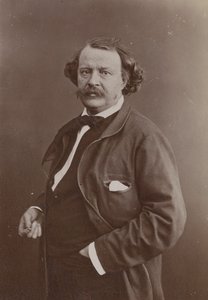
Portrait of Gustave Doré by Nadar
This photograph presents a portrait of the artist Gustave Doré, captured by Félix Nadar. The image, dated 1855, focuses on the subject in a three-quarter view. Doré is positioned centrally within the frame, occupying most of the available space. His gaze is directed toward the left side of the image, away from the camera lens. The background remains blurred and indistinct, which maintains a singular focus on the sitter.
The portrait depicts the prominent artist Gustave Doré in a moment of stillness. The subject's facial features are illuminated by a strong light source from the front-left, which casts deep shadows across the right side of his face. This lighting creates a high level of contrast between the light and dark areas of the composition. The subject's hair appears slightly tousled, and the texture of his coat is visible under the light. The overall presentation is a monochromatic study in shades of gray, ranging from deep blacks to bright whites.
Composition and Visual Elements
This black and white photograph presents a three-quarter view of Gustave Doré. The subject is positioned centrally within the frame, occupying most of the available space. His gaze is directed toward the left side of the image, away from the camera lens. The background remains blurred and indistinct, which maintains a sharp focus on the subject's features and the texture of his clothing.
The lighting is dramatic, utilizing a strong light source originating from the front-left. This directional light illuminates the contours of the face while casting deep shadows across the right side of the subject. These shadows create a high level of contrast between the bright highlights on the forehead and nose and the dark areas of the cheek and neck. The interplay of light and shadow emphasizes the organic shapes of the human form and the tactile quality of the hair and coat fabric.
Technique and Photographic Materials
This portrait was produced using the wet collodion process, a method central to mid-19th-century photography. The technique requires coating a glass plate with a light-sensitive emulsion immediately before the exposure occurs. Because the chemical layer must remain moist to react to light, the plate is developed while still wet. This specific procedural requirement necessitates a rapid workflow between the preparation of the plate and the final development of the image.
The resulting image is a carbon print mounted on double paper. This printing method provides a stable and permanent way to transfer the image from the glass negative onto the paper substrate. The monochromatic tones range from deep blacks to bright whites, achieved through the varying density of the carbon particles within the paper fibers. The physical object is a carbon print on double paper mount.
Related Works by Nadar
Nadar's photographic output includes several portraits of prominent figures from the mid-nineteenth century. In 1850, the photographer captured Gustave Courbet. This work is part of a series of portraits produced by the studio, which also includes another portrait of Gustave Courbet. These images reflect the subject-focused approach utilized during the early years of the studio's operation.
The locations of the studio changed as the practice expanded. In 1854, the studio was situated at 113 rue St. Lazare. Later, in 1860, the workspace moved to 35 Boulevard des Capucines. These physical settings provided the environment for the development of the various photographic portraits and studies produced by the artist throughout his career.
질의응답
Gustave Doré은(는) 수작업으로 그린 작품인가요, 아니면 프린트된 작품인가요?
수작업 제작: 숙련된 화가가 Gustave Doré을(를) 리넨 캔버스 위에 유화로 재현합니다.
Gustave Doré의 사이즈는 어떤 것을 선택해야 하나요?
사이즈는 35.9 x 27.8 cm (₩269539)부터 249.8 x 193.5 cm (₩2388115)까지 있으며, 이 페이지의 표에 주요 단계별 가격이 안내되어 있습니다.
배송은 얼마나 걸리나요?
배송은 전 세계 무료 특송으로 4~5주가 소요되며, 본 페이지에서 긴급 제작 옵션을 선택하실 수 있습니다. 제품은 조건 없이 100일 이내에 반품하여 전액 환불받으실 수 있습니다.
나다르 작가는 Gustave Doré 작품에 어떤 재료를 사용했나요?
Black and White Photography
 공유하기
 공유하기
 상세 정보
 학습용 요약본


 다운로드
 유사 작품 더 보기
 슬라이드 쇼 보기
 질의응답

 통계 정보