프린트 판매로 전환
 더 보기
더 보기







































 가로 또는 세로 중 어느 한 면이라도 105cm(약 41인치)를 초과하는 작품이나 복제화의 경우, 프레임은 분해된 키트 형태로 배송됩니다. 이는 안전한 배송을 보장하고 운송 중 발생할 수 있는 손상을 방지하기 위함입니다.


A Breathless Reverie: The Luminous Soul of Delft
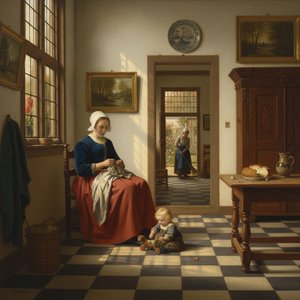
In the quiet corners of the Dutch Golden Age, where light performs its most delicate dances, Emanuel de Witte captured something far more profound than mere architecture. His masterpiece, Old Church in Delft, is not simply a record of stone and mortar; it is an invitation into a sacred stillness. While his contemporaries like Pieter Saenredam sought the rigorous precision of architectural truth, De Wiente embarked on a different journey—one of atmosphere and emotion. To stand before this canvas is to enter a world where the boundaries between the physical structure of the Oude Kerk and the spiritual essence of prayer begin to dissolve. The painting breathes with a palpable sense of peace, inviting the viewer to lose themselves in the soft, filtered light that spills through the Gothic windows, illuminating the dust motes of history.
The composition serves as a masterclass in the art of illusionism, a hallmark of De Witte’s unparalleled skill. Through the masterful application of chiaroscuro, he sculpts the vast interior space using nothing but the interplay of deep shadow and brilliant highlights. The eye is drawn through the expansive nave, guided by the rhythmic placement of light that catches the edges of white pillars and the subtle textures of the floor. De Witte does not merely depict a room; he constructs a three-dimensional experience. His brushwork, though remarkably subtle, possesses a decisive strength that lends a profound realism to the scene, making the heavy weight of the Gothic arches feel as tangible as the air itself.
The Human Element and the Drama of Light
Within this grand architectural stage, De Witte introduces a delicate human narrative. Scattered throughout the vastness of the church are small, carefully placed figures—individuals caught in moments of quiet contemplation or casual movement. These figures are not mere decorations; they provide the essential scale necessary to grasp the monumental height of the cathedral's tower and the soaring reaches of its ceiling. Their presence imbues the scene with a sense of lived history, suggesting that these hallowed halls have been the silent witnesses to generations of human hope, grief, and devotion. The way the light falls upon their forms—sometimes highlighting a shoulder, sometimes leaving a face in soft shadow—adds a layer of narrative mystery that keeps the viewer’s gaze wandering through the composition.
For the discerning collector or interior designer, Old Church in Delft offers much more than aesthetic beauty; it offers an atmosphere of timelessness. The painting’s palette, dominated by muted tones, whites, and deep, resonant shadows, provides a sophisticated anchor for any high-end interior. It possesses a unique ability to command attention through its quietude rather than through loud colors. Whether placed in a sunlit gallery or a moody, library-style study, this work brings with it an aura of intellectual depth and spiritual grace. Owning a reproduction of such a piece is an opportunity to curate a space that celebrates the enduring power of light, history, and the sublime beauty of the Dutch Baroque tradition.
질의응답
"Old Church in Delft"의 작가는 누구이며, 어떤 화풍인가요?
"Old Church in Delft"은(는) 에마누엘 드 비테의 작품으로, Dutch Baroque 운동을 대표합니다.
"Old Church in Delft"은(는) 누가, 몇 년도에 제작했을까요?
에마누엘 드 비테은(는) 1642년에 "Old Church in Delft"을(를) 제작했습니다.
에마누엘 드 비테의 "Old Church in Delft"은 미술사에서 어떤 위치를 차지하고 있나요?
역사적으로 "Old Church in Delft"은(는) 더 넓은 의미의 Early Modern 시대에 속하는 Dutch Baroque 양식의 작품입니다.
이 작품에 대해 더 알아보기
 미리보기
미리보기
 공유하기
공유하기 공유하기
공유하기
 상세 정보
상세 정보 가이드 보기

 다운로드
다운로드
 유사 작품 더 보기
 X-레이
X-레이 슬라이드 쇼 보기
 질의응답
질의응답 통계 정보
통계 정보