프린트 판매로 전환
 더 보기
더 보기







































 가로 또는 세로 중 어느 한 면이라도 105cm(약 41인치)를 초과하는 작품이나 복제화의 경우, 프레임은 분해된 키트 형태로 배송됩니다. 이는 안전한 배송을 보장하고 운송 중 발생할 수 있는 손상을 방지하기 위함입니다.


The Composition of Cité
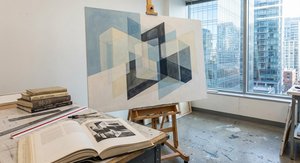
The artwork Cité consists of twenty joined panels of wood. The surface features a grid-like arrangement of rectangular shapes in black and off-white. These rectangles interlock and overlap across the wooden support. Some shapes are oriented horizontally, while others are positioned vertically. The edges of these forms are defined by straight, precise lines. The color palette is restricted to two tones: a deep black and an off-white that appears as a light beige in certain lights. There is no discernible three-dimensional illusion or perspective within the work; the surface remains flat. Subtle variations in the off-white hue suggest differences in paint application or the aging of the material. The arrangement of the shapes creates a rhythmic pattern through the repetition of geometric forms.
Process and Method
The creation of this piece involved a specific method of chance and preparation. A preparatory sketch was executed by transferring brushstrokes onto paper. This paper was then divided into twenty individual squares. These squares were shuffled randomly before being adhered to the wooden board. This technique allowed for a composition determined by random movement rather than traditional structural planning. The work reflects an interest in the principles of minimalism, reducing the visual field to essential geometric components. The use of black and off-white creates a high level of tonal contrast. The physical structure of the twenty panels contributes to the overall texture of the piece, as the edges where the wood meets create slight interruptions in the flat plane.
Historical Context and Influence
Completed in 1951, Cité emerged from a period of transition for the artist. The concept originated from a dream experienced while staying at the Cité Universitaire in Paris. This vision led to the idea of a large-scale work composed of square panels featuring black bands. The artist's earlier experiences with camouflage during military service in the 603rd Engineers Camouflage Battalion provided a foundation in spatial manipulation and visual deception. During his time in Paris, exposure to the works of artists such as Jean Arp influenced the move toward simplified forms. The piece aligns with the development of hard-edge painting and geometric abstraction. It utilizes a method that mirrors the experimental approaches found in the work of John Cage during this era.
질의응답
Ellsworth Kelly의 "Cite"에서 느껴지는 정서는 무엇인가요?
Ellsworth Kelly의 "Cite"은(는) Reflective 분위기를 자아냅니다.
"Cite"을(를) 전체 화면 슬라이드쇼로 감상할 수 있나요?
슬라이드쇼로 감상하기: Ellsworth Kelly의 "Cite"의 슬라이드쇼 페이지.
"Cite"은(는) Ellsworth Kelly의 작품 세계에서 어떤 위치를 차지하고 있나요?
"Cite"은(는) Ellsworth Kelly의 다른 작품들과 마찬가지로 Minimalist Geometric Abstraction 양식과 더불어 작가의 반복되는 주제인 audubon inspiration, chance arrangement, geometric order, minimalist aesthetic, kelly legacy를 공유합니다.
이 작품에 대해 더 알아보기
 미리보기
미리보기
 공유하기
공유하기 공유하기
공유하기
 상세 정보
상세 정보 가이드 보기

 다운로드
다운로드
 유사 작품 더 보기
 X-레이
X-레이 슬라이드 쇼 보기
 질의응답
질의응답 통계 정보
통계 정보