수작업 채색 복제본 주문하기
 더 보기







































 가로 또는 세로 중 어느 한 면이라도 105cm(약 41인치)를 초과하는 작품이나 복제화의 경우, 프레임은 분해된 키트 형태로 배송됩니다. 이는 안전한 배송을 보장하고 운송 중 발생할 수 있는 손상을 방지하기 위함입니다.


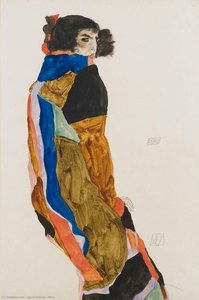
Egon Schiele’s “Moa”: A Study in Vulnerability and Expressionist Boldness
The painting "Moa" by Egon Schiele, created in 1911, stands as a haunting testament to the artist's preoccupation with mortality and his masterful manipulation of color and form. It depicts a dancer—referred to as Moa—immersed within richly patterned textiles, capturing Schiele’s distinctive Expressionist style and decisively departing from Klimt’s opulent ornamentation. This artwork immediately draws the eye with its striking contrasts: the vibrant hues of the fabric juxtaposed against the stark simplicity of the nude figure beneath, creating a visual tension that speaks volumes about the psychological landscape of the era.A Departure From Klimt's Influence
Schiele’s artistic vision was profoundly shaped by Klimt’s decorative style—particularly “The Kiss”—but he resolutely rejected its gilded surface and stylized figures. Instead, Schiele prioritized raw emotion and anatomical precision, pushing boundaries of representation to convey inner turmoil. The dancer is rendered in a manner that eschews idealized beauty; her body is painted in reds and blues, colors often associated with passion and sorrow respectively, highlighting the vulnerability inherent in the human condition—a theme central to Schiele’s oeuvre.Technique and Composition: Bold Lines and Fragmented Form
Schiele employed a meticulous technique characterized by bold lines and fragmented form. Pencil strokes delineate the contours of the dancer's body with unwavering certainty, emphasizing her physicality while simultaneously conveying a sense of instability. The drapery—a dominant element in the composition—is rendered in geometric patterns that serve to obscure the nude figure beneath, creating an illusionistic depth that amplifies the painting’s emotional impact. This deliberate fragmentation reflects Schiele’s exploration of psychological states and his rejection of traditional artistic conventions.Symbolism: Facing Mortality
“Moa” embodies a powerful symbolic resonance rooted in Schiele's fascination with death and decay—themes recurrent throughout his work. The dancer’s gaze, directed upwards and slightly off-center, suggests defiance yet simultaneously conveys a profound awareness of mortality. This subtle gesture underscores Schiele’s belief that art should confront uncomfortable truths about human existence. The artist’s use of color – particularly the reds and blues – reinforces this symbolic dimension, representing passion and sorrow—the fundamental emotions underpinning the experience of life and death.Emotional Impact: A Portrait of Anxiety
Ultimately, “Moa” succeeds in capturing a palpable sense of anxiety and vulnerability. Schiele's masterful rendering of human anatomy combined with his expressive use of color creates an image that lingers in the viewer’s mind long after encountering it. It is not merely a depiction of a dancer; it is a portrait of the human spirit grappling with existential questions—a timeless masterpiece that continues to resonate with audiences today. The painting invites contemplation on themes of fragility, beauty and confronting one's own mortality.- Artist: Egon Schiele
- Year Created: 1911
- Medium: Watercolor and Pencil
- Style: Expressionism
질의응답
"Moa" 작품을 증강 현실(AR)로 미리 볼 수 있나요?
호환 가능한 기기에서 증강 현실(AR) 기능을 사용하면, 작품의 AR로 미리보기 페이지를 통해 에곤 실레의 "Moa"을(를) 고객님의 벽에 미리 배치해 볼 수 있습니다.
"Moa"에 대한 가이드는 어디에서 확인할 수 있나요?
에곤 실레의 "Moa"에 대한 학습 가이드 페이지를 이용하실 수 있습니다. 이 페이지는 학생들과 수업용으로 제작된, 인쇄 가능한 작품 정보 시트를 제공합니다.
에곤 실레의 "Moa"의 복제본은 어디에 걸면 좋을까요?
Portrait 형태의 "Moa" 복제 작품은 Hotel Lobby에 배치하시기에 좋습니다.
이 작품에 대해 더 알아보기
 미리보기

 공유하기
 공유하기
 상세 정보
 가이드 보기


 다운로드
 유사 작품 더 보기
 X-레이
 슬라이드 쇼 보기
 질의응답
 통계 정보