프린트 판매로 전환
 더 보기
더 보기







































 가로 또는 세로 중 어느 한 면이라도 105cm(약 41인치)를 초과하는 작품이나 복제화의 경우, 프레임은 분해된 키트 형태로 배송됩니다. 이는 안전한 배송을 보장하고 운송 중 발생할 수 있는 손상을 방지하기 위함입니다.


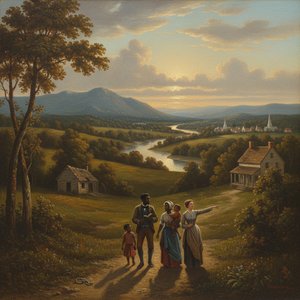
A Woodland Reverie: Exploring Edward Mitchell Bannister's "Tree Landscape"
Edward Mitchell Bannister’s “Tree Landscape,” painted in 1877, isn’t merely a depiction of a forest; it’s an immersion into a carefully constructed mood – a profound meditation on nature’s tranquility and the subtle power of light. This oil-on-canvas work, currently residing within the Smithsonian American Art Museum's collection, offers a glimpse into the tonalist movement, a style that prioritized atmospheric effects over sharp detail, mirroring the quiet introspection of the artist himself. Bannister, born in Canada and deeply rooted in both African American and European heritage, sought to capture not just what he saw, but how it *felt* – a sentiment powerfully conveyed through his masterful manipulation of color and texture.
The scene unfolds within a dense thicket of trees, predominantly dark browns and greens that immediately establish a sense of depth. These aren’t the vibrant hues of a summer forest; instead, Bannister employs a muted palette, leaning heavily on umber, sienna, and charcoal tones to create an atmosphere of subdued light and shadow. The foreground is dominated by these imposing trees, their forms rendered with broad brushstrokes that suggest both solidity and a gentle yielding to the elements. Notice how he doesn’t meticulously define each branch or leaf; rather, he uses overlapping layers of color to build volume and create a hazy, almost dreamlike quality. This deliberate ambiguity invites the viewer to step into the painting, becoming part of the woodland experience.
The Language of Tonalism: Light, Shadow, and Atmosphere
Bannister’s signature style – tonalism – is exquisitely demonstrated in “Tree Landscape.” He eschewed bright highlights and sharp contrasts, favoring instead a gradual shift between light and dark. The sunlight, filtering through the canopy above, isn't presented as a direct beam but rather as a diffused glow that casts dappled shadows across the forest floor. This subtle interplay of illumination and obscurity is crucial to the painting’s emotional impact. It evokes a sense of peace and contemplation, suggesting a timelessness and connection to something larger than oneself. The artist’s skill lies not in replicating reality with photographic accuracy but in conveying its essence – the feeling of being enveloped by nature's embrace.
The composition itself is carefully balanced, drawing the eye towards a distant clearing. This strategic use of perspective creates a sense of depth and invites the viewer to imagine what lies beyond the trees. The placement of the largest tree on the left side anchors the scene while simultaneously directing our gaze forward. Bannister’s choice of a slightly elevated vantage point further enhances this effect, offering a panoramic view of the woodland expanse.
A Legacy Rooted in Resilience and Representation
Understanding Edward Mitchell Bannister requires acknowledging the significant obstacles he faced as an African American artist in 19th-century America. Despite enduring racial prejudice and limited opportunities, he persevered, establishing himself as a respected figure within Boston’s artistic community and contributing significantly to the development of American landscape painting. “Tree Landscape” stands as a testament to his dedication and talent – a poignant reminder of his ability to capture beauty even amidst adversity. The painting's quiet dignity reflects Bannister’s own resilience, offering a powerful message about the enduring spirit of creativity in the face of societal constraints.
Furthermore, research reveals that Bannister’s work was often commissioned by members of the African American community, highlighting his role as a cultural figure and advocate for representation. The Smithsonian's collection provides valuable context to this history, ensuring that Bannister’s contributions are recognized and celebrated. The painting’s current location within the museum underscores its importance as a significant piece of American art history.
질의응답
"Tree Landscape" 작품의 권장 인쇄 방식은 무엇인가요 - 크기와 방향은 어떻게 되나요?
"Tree Landscape" 작품의 권장 인쇄 설정은 Medium 크기와 Landscape 방향입니다.
"Tree Landscape"의 재료와 화풍은 무엇인가요?
"Tree Landscape"에서 Oil On Canvas 기법은 Tonalist Landscape 사조와 만납니다.
"Tree Landscape"은(는) 어느 작가의 작품인가요?
"Tree Landscape"의 작가는 에드워드 미첼 배니스터입니다.
이 작품에 대해 더 알아보기
 미리보기
미리보기
 공유하기
공유하기 공유하기
공유하기
 상세 정보
상세 정보 가이드 보기

 다운로드
다운로드
 유사 작품 더 보기
 X-레이
X-레이 슬라이드 쇼 보기
 질의응답
질의응답 통계 정보
통계 정보