유화 원작 구매
 Spring에 관한 모든 것







































 가로 또는 세로 중 어느 한 면이라도 105cm(약 41인치)를 초과하는 작품이나 복제화의 경우, 프레임은 분해된 키트 형태로 배송됩니다. 이는 안전한 배송을 보장하고 운송 중 발생할 수 있는 손상을 방지하기 위함입니다.


Introduction
This article provides an analysis of the painting 'Spring' by Edvard Munch, a Norwegian painter known for his Expressionist style. The focus will be on the artist, title, style, date, and composition, as well as the use of light and shadow in this masterpiece.The Artist: Edvard Munch
Edvard Munch (1863-1944) was a Norwegian painter and printmaker who played a significant role in the development of Expressionism. His work, which often depicted intense emotions and psychological states, was influenced by Symbolism, Romanticism, and Realism. He is best known for his iconic painting 'The Scream' (1893), but his oeuvre includes various themes such as love, death, and anxiety.Title: Spring
'Spring' (1889) is one of Munch's early works, painted during his stay in Paris. The painting reflects the artist's fascination with nature, human emotions, and the passing of time. It also marks a transition from his earlier Naturalist style to a more expressive approach that would become characteristic of his mature work.Style: Expressionism
Expressionism is an artistic movement that emerged in the late 19th and early 20th centuries, characterized by the distortion of reality for emotional effect. Artists sought to express their inner worlds, often using bold colors, exaggerated forms, and unconventional compositions. Munch's 'Spring' exemplifies these characteristics with its vivid hues, fluid brushstrokes, and emotionally charged atmosphere.Date: 1889
The year 1889 was significant for Munch as he began to explore new artistic directions during his stay in Paris. 'Spring' reflects the artist's growing interest in capturing the essence of human emotions and the transience of life, themes that would become central to his work.Composition and Use of Light and Shadow
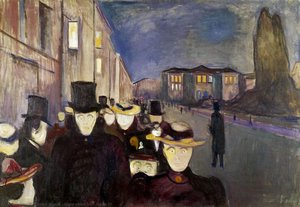
In 'Spring', Munch employs a simplified composition with two main figures: a woman in a red dress and a man in a black suit. The couple is depicted walking along a path, surrounded by lush vegetation and vibrant colors. The use of light and shadow creates depth and atmosphere, emphasizing the emotional connection between the characters and their environment. The artist masterfully employs chiaroscuro to enhance the dramatic effect of the scene. The contrast between light and dark areas adds tension and mystery, inviting viewers to explore the painting's deeper meaning. Munch also uses color symbolism to convey emotions: red represents passion and love, while black signifies melancholy and despair.Conclusion
Edvard Munch's 'Spring' (1889) is a powerful example of Expressionist art that showcases the artist's innovative approach to painting. By examining the composition, use of light and shadow, and symbolic elements, we can better understand Munch's unique vision and his contribution to modern art. OriginalUniqueArt.com offers high-quality hand-made oil paintings reproductions of 'Spring' by Edvard Munch, allowing art enthusiasts to appreciate this masterpiece in their homes or offices. Explore our collection and discover the beauty of Expressionist art.- Read more about: the Abstract Expressionism Art Movement
- Discover: Edvard Munch's 'Spring' painting
- Learn about: Muzeul K.h. Zambaccian, Bucharest, Romania, where some of Munch's works are exhibited.
질의응답
Spring은(는) 수작업으로 그린 작품인가요, 아니면 프린트된 작품인가요?
수작업 제작: 숙련된 화가가 Spring을(를) 리넨 캔버스 위에 유화로 재현합니다.
Spring의 사이즈는 어떤 것을 선택해야 하나요?
사이즈는 25.2 x 39.7 cm (₩271335)부터 153.9 x 242.4 cm (₩1911556)까지 있으며, 이 페이지의 표에 주요 단계별 가격이 안내되어 있습니다.
배송은 얼마나 걸리나요?
배송은 전 세계 무료 특송으로 4~5주가 소요되며, 본 페이지에서 긴급 제작 옵션을 선택하실 수 있습니다. 제품은 조건 없이 100일 이내에 반품하여 전액 환불받으실 수 있습니다.
에드바르 뭉크 작가는 Spring 작품에 어떤 재료를 사용했나요?
Acrylic On Canvas
 미리보기

 공유하기
 공유하기
 상세 정보
 학습용 요약본


 다운로드
 유사 작품 더 보기
 X-레이
 슬라이드 쇼 보기
 질의응답

 통계 정보