유화 원작 구매
 Composition with Figures에 관한 모든 것







































 가로 또는 세로 중 어느 한 면이라도 105cm(약 41인치)를 초과하는 작품이나 복제화의 경우, 프레임은 분해된 키트 형태로 배송됩니다. 이는 안전한 배송을 보장하고 운송 중 발생할 수 있는 손상을 방지하기 위함입니다.


David Bomberg’s Geometric Vision: Exploring ‘Composition with Figures’
David Bomberg (1890–1957), one of the celebrated ‘Whitechapel Boys,’ stands as a pivotal figure in British avant-garde art. His oeuvre embodies a restless spirit, constantly experimenting with new approaches to visual representation—a characteristic that finds its most arresting expression in ‘Composition with Figures’ (1912–1913), currently housed at The Whitworth, University of Manchester.
Born in Birmingham to Polish-Jewish immigrant parents, Bomberg initially pursued lithography before immersing himself in the burgeoning artistic milieu of London. Influenced by Walter Sickert's exploration of urban landscapes and Cézanne’s groundbreaking simplification of form, he quickly embraced Cubism alongside fellow artists like Mark Gertler and Stanley Spencer. This formative period witnessed a profound engagement with intellectual currents—particularly Futurism—which championed dynamism and speed as aesthetic ideals.
Cubist Influences and Formal Innovation
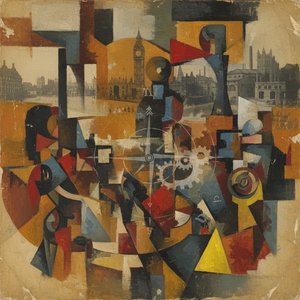
‘Composition with Figures’ exemplifies Bomberg's masterful assimilation of Cubist principles. The artwork abandons traditional perspective, presenting instead a fragmented tableau dominated by geometric shapes – predominantly rectangular and triangular – arranged in an asymmetrical composition. These forms overlap and intersect, creating a palpable sense of movement and disrupting any illusion of depth.
Bomberg’s technique is characterized by thick impastoed brushstrokes that imbue the canvas with textural richness. The palette leans heavily into warm hues—particularly orange and brown—contrasted sharply against stark white and black. This deliberate juxtaposition underscores the artwork's conceptual ambition, reflecting a broader preoccupation with exploring relationships between color and form.
Historical Context: The Dawn of Modern Art
Created during the heady days of artistic experimentation in 1912–1913, ‘Composition with Figures’ aligns itself squarely within the vanguard of early 20th-century art. It reflects the broader shift away from representational conventions toward abstraction—a movement fueled by advancements in science and technology and driven by a desire to capture the essence of experience rather than merely mirroring reality.
The painting's influence extends beyond its formal innovations; it embodies the spirit of defiance against established artistic norms. Bomberg’s work anticipates developments in Surrealism and Expressionism, signaling the emergence of new expressive languages capable of conveying profound emotional resonance.
Symbolic Resonance and Emotional Impact
'Composition with Figures' transcends mere visual aesthetics, inviting contemplation on themes of fragmentation, dynamism, and artistic liberation. The geometric forms can be interpreted as representing opposing forces—stability versus movement—while the bold color palette evokes feelings of energy and urgency. Ultimately, Bomberg’s masterpiece compels viewers to confront unsettling questions about perception and representation.
Its enduring appeal lies in its ability to inspire awe and provoke intellectual curiosity. Reproductions of ‘Composition with Figures’ serve as a testament to Bomberg's artistic legacy—a beacon illuminating the path toward groundbreaking explorations of form, color, and emotion within the realm of abstract art.
질의응답
Composition with Figures은(는) 수작업으로 그린 작품인가요, 아니면 프린트된 작품인가요?
수작업 제작: 숙련된 화가가 Composition with Figures을(를) 리넨 캔버스 위에 유화로 재현합니다.
Composition with Figures의 사이즈는 어떤 것을 선택해야 하나요?
원작의 크기는 41 x 33 cm입니다. 사이즈는 35.6 x 28.1 cm (₩269539)부터 247.5 x 195.3 cm (₩2388115)까지 있으며, 이 페이지의 표에 주요 단계별 가격이 안내되어 있습니다.
배송은 얼마나 걸리나요?
배송은 전 세계 무료 특송으로 4~5주가 소요되며, 본 페이지에서 긴급 제작 옵션을 선택하실 수 있습니다. 제품은 조건 없이 100일 이내에 반품하여 전액 환불받으실 수 있습니다.
Composition with Figures 원본은 어디에 있나요?
원본은 맨체스터에 위치한 The Whitworth 소장품입니다.
데이비드 봄버그 작가는 Composition with Figures 작품에 어떤 재료를 사용했나요?
Acrylic On Canvas
 미리보기

 공유하기
 공유하기
 상세 정보
 학습용 요약본


 다운로드
 유사 작품 더 보기
 X-레이
 슬라이드 쇼 보기
 질의응답

 통계 정보