프린트 판매로 전환
 상세 보기
상세 보기







































 가로 또는 세로 중 어느 한 면이라도 105cm(약 41인치)를 초과하는 작품이나 복제화의 경우, 프레임은 분해된 키트 형태로 배송됩니다. 이는 안전한 배송을 보장하고 운송 중 발생할 수 있는 손상을 방지하기 위함입니다.


A Vista of Majesty: Carleton Watkins’ “Castle Rock, Columbia River”
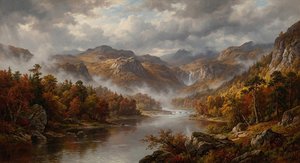
Carleton Watkins' "Castle Rock, Columbia River," painted in 1867, isn’t merely a landscape photograph; it’s a portal to the American West as it was perceived and captured during a pivotal moment of national identity. This albumen print, rendered in the muted tones characteristic of mid-19th century photographic processes, transports us to the heart of the Columbia River Valley – a region simultaneously rugged and profoundly beautiful. The scene unfolds with an almost overwhelming sense of scale; towering basalt cliffs, sculpted by millennia of glacial activity and relentless river currents, dominate the horizon, their jagged edges softened by atmospheric haze. Below, the broad expanse of the Columbia River snakes its way through a verdant valley, reflecting the sky in shimmering bands of light and shadow. It’s a vista that speaks to both the grandeur of nature and the nascent spirit of exploration that defined America at the time.
Watkins, a pioneer of American landscape photography, wasn't simply documenting scenery; he was actively shaping how Americans understood their vast territory. His work, particularly his images of Yosemite Valley, played a crucial role in galvanizing support for its preservation as a national park – a testament to the power of visual representation to influence public opinion and policy. “Castle Rock” embodies this mission, presenting a carefully composed scene that emphasizes the sublime qualities of the wilderness, aligning with the tenets of the American Romantic movement. The composition itself is deliberate: the strong horizontal format underscores the breadth of the landscape, while the prominent tree on the right acts as a grounding vertical element, drawing the eye into the immense depth of the image.
The Alchemy of Wet Plate Collodion
To truly appreciate “Castle Rock,” one must understand the technical process behind its creation. Watkins utilized the wet plate collodion method – a demanding and intricate photographic technique that required immediate execution. The photographer had to coat a glass plate with a light-sensitive emulsion, expose it within minutes, and develop it while the plate was still wet, all before the chemicals dried. This meant working outdoors in challenging conditions, often battling inclement weather and limited time. The resulting image is characterized by its fine grain, subtle tonal variations, and a remarkable level of detail – qualities that are particularly evident in the textures of the rock formations and the foliage along the riverbank.
The albumen printing process further contributes to the photograph’s distinctive aesthetic. Albumen prints utilize egg whites as a binder for silver salts, creating a richly textured surface with deep blacks and luminous whites. This technique lends a painterly quality to Watkins' work, enhancing the sense of depth and atmosphere. The sepia tones – achieved through the addition of iron salts during development – add a layer of nostalgia and timelessness, evoking the spirit of the American frontier.
Symbolism in Stone and Water
Beyond its technical brilliance, “Castle Rock” is rich in symbolic meaning. The imposing basalt cliffs represent both strength and resilience—a visual metaphor for the enduring power of nature. Their sheer scale dwarfs the human presence within the frame, reminding us of our relative insignificance in the face of geological time. The Columbia River itself symbolizes movement, change, and the relentless forces that shape the landscape. Its winding course reflects the journey of westward expansion, connecting disparate communities and cultures.
The lone tree on the right side of the composition adds a subtle element of human presence—a reminder of the settlers who were beginning to stake their claims in this wild land. However, it’s positioned at the edge of the frame, suggesting a respectful distance from the overwhelming power of nature. The photograph doesn't depict conquest or domination; instead, it celebrates the beauty and majesty of the wilderness – inviting contemplation and fostering a sense of awe.
A Legacy in Reproduction
Reproductions of “Castle Rock” capture much of the original’s evocative quality, offering a tangible connection to this pivotal moment in American art history. OriginalUniqueArt's meticulous hand-painted reproductions strive to faithfully recreate Watkins’ masterful composition and tonal range, ensuring that the photograph’s emotional impact is preserved for contemporary audiences. The choice of materials – archival paper and pigments – guarantees the longevity of these reproductions, allowing them to be enjoyed for generations to come. “Castle Rock” isn't just a beautiful image; it’s a window into the past—a testament to the power of photography to shape our understanding of America’s wild spaces.
질의응답
"Castle Rock, Columbia River" 작품은 어떤 사이즈로 출력하는 것을 추천하시나요?
"Castle Rock, Columbia River" 작품은 Medium 인쇄 크기를 권장합니다. 동일한 비율의 다른 사이즈로도 제작 가능합니다.
"Castle Rock, Columbia River"의 색상들은 빛을 어느 정도나 반사하는 것처럼 보이나요?
칼러튼 왓킨스의 "Castle Rock, Columbia River"의 기록된 휘도는 Gentle Luminance입니다.
칼러튼 왓킨스의 "Castle Rock, Columbia River"의 형태와 크기는 어떻게 되나요?
칼러튼 왓킨스의 "Castle Rock, Columbia River"은(는) 원작 기준 39 x 52 cm 크기의 Landscape 구성입니다.
More about this painting
 실제 크기로 보기
 보내기
보내기 공유하기
공유하기
 상세 보기
상세 보기 가이드 보기

 이미지 다운로드
 유사 작품 더 보기
 X-레이
X-레이 슬라이드 쇼 보기
 Q&A
Q&A 통계 정보
통계 정보