프린트 판매로 전환
 상세 보기
상세 보기







































 가로 또는 세로 중 어느 한 면이라도 105cm(약 41인치)를 초과하는 작품이나 복제화의 경우, 프레임은 분해된 키트 형태로 배송됩니다. 이는 안전한 배송을 보장하고 운송 중 발생할 수 있는 손상을 방지하기 위함입니다.


The Genesis of a Fragmented World
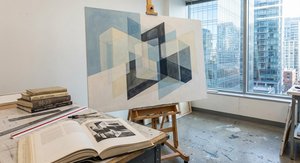
Ben Nicholson’s ‘1934 (relief)’ isn't merely a painting; it’s a distilled moment, a carefully constructed fragment of a world viewed through the lens of geometric abstraction. Created in the tumultuous years following the 1934 Nepal–India earthquake – an event that profoundly impacted British artists and their perspectives – this small yet potent work embodies a shift towards pure form and a quiet contemplation of space. Nicholson, deeply influenced by European avant-garde movements like Cubism and Constructivism, sought to move beyond representational imagery, exploring the inherent beauty within simplified shapes and textures. The piece’s genesis lies in a period of intense experimentation, marked by visits to influential artists like Piet Mondrian and a growing fascination with the interplay between physical layering and abstract language.

(Image of Ben Nicholson's '1934 (relief)')
A Symphony of Grey and White
The work itself is deceptively simple in its composition. Dominated by a palette of muted greys, punctuated by stark white circles and rectangles, ‘1934 (relief)’ immediately draws the eye into its carefully orchestrated arrangement. Nicholson employed oil paint on a composite board, layering it with deliberate roughness – visible scrapes and uneven surfaces speak to a process of controlled destruction and reconstruction. The lower third of the piece was deliberately cut away, revealing the underlying wood grain and creating an intriguing sense of depth. The two larger circles, painted white, are strategically placed to create visual balance against the darker, textured background, while the smaller circle in the upper left corner offers a subtle point of contrast and focalization.
- Technique: Layered oil paint on composite board.
- Color Palette: Primarily grey with stark white accents.
- Texture: Rough, layered, and deliberately distressed.
Echoes of Mondrian and the Poetics of Relief
Nicholson’s exploration of relief – a technique involving creating raised surfaces on a flat plane – was deeply influenced by his encounter with Piet Mondrian in Paris. Mondrian's emphasis on primary colors, straight lines, and geometric forms provided a crucial framework for Nicholson’s own abstract explorations. However, unlike Mondrian’s rigorously structured compositions, Nicholson embraced a more intuitive approach, allowing the inherent qualities of the materials – wood grain, paint texture – to contribute to the overall aesthetic. The work also reflects the influence of Alfred Wallis, a Cornish fisherman-painter whose simple, geometric forms resonated with Nicholson's desire to strip away unnecessary detail and focus on essential shapes.
A Moment of Quiet Contemplation
‘1934 (relief)’ is more than just an exercise in abstraction; it’s a meditation on form, space, and the relationship between the visible and the implied. The fragmented composition evokes a sense of instability and uncertainty, mirroring the emotional landscape of a nation grappling with the aftermath of a devastating earthquake. Yet, within this apparent chaos lies a profound sense of balance and harmony. The work invites viewers to slow down, to consider the subtle nuances of color and texture, and to find their own meaning within its carefully constructed geometry. It’s a testament to Nicholson's ability to transform personal experience – in this case, the seismic event of 1934 – into a timeless exploration of abstract form.
질의응답
벤 니콜슨의 "1934 (relief)"의 디지털 이미지는 어디에서 구매할 수 있나요?
"1934 (relief)"은(는) 디지털 이미지 페이지에서 직접 구매 가능한 고해상도 디지털 이미지 다운로드 형태로 제공됩니다.
"1934 (relief)"은 언제, 어떤 재료로 제작되었나요?
"1934 (relief)"은(는) 1934년에 Acrylic On Canvas 기법으로 제작되었습니다. 재료와 제작 연도는 원작이 어떤 방식으로 언제 만들어졌는지를 설명합니다.
"1934 (relief)"의 전체적인 밝기는 어느 정도인가요?
시각적 밝기 측면에서 볼 때, 벤 니콜슨의 "1934 (relief)"은(는) brilliant 수준입니다.
More about this painting
 실제 크기로 보기
 보내기
보내기 공유하기
공유하기
 상세 보기
상세 보기 가이드 보기

 이미지 다운로드
 유사 작품 더 보기
 X-레이
X-레이 슬라이드 쇼 보기
 Q&A
Q&A 통계 정보
통계 정보