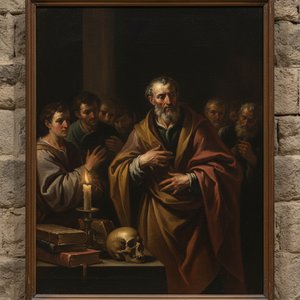
프린트 판매로 전환
 더 보기
더 보기







































 가로 또는 세로 중 어느 한 면이라도 105cm(약 41인치)를 초과하는 작품이나 복제화의 경우, 프레임은 분해된 키트 형태로 배송됩니다. 이는 안전한 배송을 보장하고 운송 중 발생할 수 있는 손상을 방지하기 위함입니다.


Bartolomé Esteban Murillo: A Master of Andalusian Light
Bartolomé Esteban Murillo (1617–1682) stands as one of the most celebrated figures in Spanish Baroque painting, a testament to Seville’s artistic flourishing during its golden age. His life unfolded amidst personal hardship—the premature loss of his parents instilled within him an early understanding of vulnerability—yet he transformed this sorrow into an extraordinary creative vocation. Guided by Juan del Castillo and later influenced by the stylistic innovations of Francisco de Zurbarán, Murillo established a distinctive visual language that would resonate powerfully through centuries. Unlike Velázquez and El Greco, whose reputations gained prominence in the late nineteenth century, Murillo enjoyed sustained admiration throughout Europe until then, securing his place as an icon of Spanish artistic excellence.- Subject Matter: Murillo’s genius lay in capturing everyday life with remarkable sensitivity—particularly scenes depicting women and children—a departure from the grand narratives favored by many contemporaries. *Four Figures on a Step*, for instance, eschews theatrical grandeur, presenting instead a quiet tableau of four individuals engaged in an intimate interaction within a darkened interior.
- Style & Technique: Murillo’s style is characterized by luminous tonal painting—a technique he honed through meticulous observation and masterful manipulation of light—resulting in canvases imbued with an ethereal quality that distinguishes them from the darker palettes prevalent during his time. His use of chiaroscuro, combined with subtle modeling, creates a palpable sense of depth and realism, mirroring the influence of Dutch masters whom Murillo knew through prints.
- Historical Context: Murillo’s work emerged during a period marked by fervent religious devotion and societal transformation in Spain—the Counter-Reformation actively promoted artistic endeavors aimed at bolstering faith and moral instruction. Consequently, his genre scenes often carry implicit didactic messages, prompting contemplation on themes of piety, compassion, and familial bonds.
- Symbolism: The enigmatic gaze of Murillo’s figures—particularly the woman in *Four Figures on a Step*—suggests a profound engagement with psychological nuance. Scholars debate whether her gesture signifies marital fidelity or merely openness to connection, reflecting broader anxieties surrounding social propriety during the seventeenth century. Furthermore, the depiction of a child undergoing delousing serves as a potent metaphor for spiritual purification, echoing the humanist ideals championed by artists like Rembrandt and Rubens.
- Emotional Impact: Murillo’s paintings evoke a palpable sense of warmth and tenderness—a hallmark of his oeuvre—capturing fleeting moments of human emotion with astonishing accuracy. *Four Figures on a Step*, in particular, invites viewers to consider the complexities of interpersonal relationships and the subtle gestures that convey unspoken feelings. Its enduring appeal testifies to Murillo's ability to transcend mere representation, forging connections between art and human experience.
Provenance & Restoration Efforts
The journey of *Four Figures on a Step* began in 1830 with Charles Berners Plestow, who acquired it before bequeathing it to his son Sir Charles Henry Coote. Subsequent owners included the Coote family and later prominent collectors like Richard Abraham and Arthur L. Nicholson. A significant restoration undertaken in 1984 revealed that earlier interventions had obscured portions of the painting’s original composition—namely, a canvas strip added to the left side and repainting covering a damaged area on the child's trousers. This meticulous process ensured that Murillo’s artistic vision remained faithfully preserved, sparking ongoing scholarly debate about its interpretation.Influence & Legacy
Murillo’s influence extended far beyond his lifetime, shaping the aesthetic sensibilities of subsequent generations of artists and inspiring collectors worldwide. His pioneering exploration of genre painting—particularly scenes depicting women and children—established a precedent for realism in Spanish art that would endure into the twentieth century. Today, reproductions of *Four Figures on a Step* continue to captivate audiences with their luminous beauty and psychological depth—a testament to Murillo’s enduring artistic legacy as one of Spain's greatest masters.질의응답
바르톨로메 에스테반 무리요의 "Four Figures on a Step"의 구도는 세로형, 가로형 또는 정사각형 중 무엇인가요?
바르톨로메 에스테반 무리요의 "Four Figures on a Step"은(는) Landscape 구도로 이루어져 있습니다. 프린트 크기를 결정하시기 전에 비율을 확인해 보시는 것이 좋습니다.
바르톨로메 에스테반 무리요의 "Four Figures on a Step"의 어떤 프린트 사이즈가 추천된 공간에 잘 어울릴까요?
바르톨로메 에스테반 무리요의 "Four Figures on a Step"을(를) 위한 추천 조합: Living Room 공간에 어울리는 Large 사이즈 프린트입니다.
바르톨로메 에스테반 무리요의 "Four Figures on a Step"에는 어떤 소재가 등장하나요?
"Four Figures on a Step"에 담긴 소재는 genre scene, seville, religion, domesticity, childhood, moralizing, delousing, baroque art입니다.
이 작품에 대해 더 알아보기
 미리보기
미리보기
 공유하기
공유하기 공유하기
공유하기
 상세 정보
상세 정보 가이드 보기

 다운로드
다운로드
 유사 작품 더 보기
 X-레이
X-레이 슬라이드 쇼 보기
 질의응답
질의응답 통계 정보
통계 정보