프린트 판매로 전환
 더 보기
더 보기







































 가로 또는 세로 중 어느 한 면이라도 105cm(약 41인치)를 초과하는 작품이나 복제화의 경우, 프레임은 분해된 키트 형태로 배송됩니다. 이는 안전한 배송을 보장하고 운송 중 발생할 수 있는 손상을 방지하기 위함입니다.


André Masson’s “The Earth”: A Descent Into Surrealist Automatism
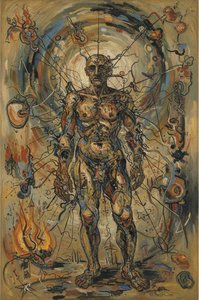
André Masson's "The Earth," painted in 1939, stands as a quintessential example of Surrealist automatism—a technique championed by Masson and fellow artists to bypass conscious thought and tap into the subconscious realm. More than just an aesthetically striking composition, it’s a profound exploration of primal anxieties and a visual manifestation of the artist's confrontation with existential uncertainties during the turbulent years leading up to World War II.Composition and Visual Language
The artwork immediately captivates with its central oval form—a dominant presence that evokes imagery of amniotic sacs or embryonic beginnings. This organic shape isn’t merely decorative; it serves as a focal point for a dynamic network of radiating lines in shades of red, black, and white. These lines aren't meticulously drawn; rather, they erupt outwards from the center with an impulsive energy, creating a chaotic visual field that defies conventional perspective. The deliberate lack of spatial coherence underscores Masson’s rejection of rational representation, prioritizing instead the expressive power of gesture and emotion. It feels like witnessing a geological upheaval—a violent birth of form from amorphous darkness.Technique and Material Considerations
Masson employed oil paint on canvas – a medium chosen for its ability to capture subtle tonal variations and facilitate layering techniques. The artist’s approach leaned heavily into automatism, utilizing spontaneous brushstrokes and washes of color to generate the artwork's textural surface. Evidence suggests considerable reworking—a process characteristic of Surrealist practice where artists strive to liberate their creative impulses from intellectual constraints. The canvas itself appears to be lightly primed, allowing for a rich interplay between pigment and substrate, contributing to the overall impression of immediacy and visceral impact.Symbolism and Contextual Significance
Painted during the height of Surrealist fervor, “The Earth” reflects the movement’s preoccupation with Freudian psychoanalysis and its desire to delve into the unconscious mind. The oval form symbolizes fertility and rebirth—themes central to Surrealist mythology—but also carries a darker connotation of vulnerability and impending doom. The radiating lines represent forces of destruction and creation simultaneously, mirroring anxieties about societal upheaval and the looming threat of war. Masson’s work aligns with broader artistic explorations of primal instincts and fears, reflecting a collective apprehension regarding humanity's precarious position in the face of cosmic indifference.Emotional Resonance
Ultimately, “The Earth” succeeds in conveying a palpable sense of unease and mystery. The artwork doesn’t offer comforting illusions; instead, it confronts viewers with an unsettling depiction of chaos and ambiguity. It invites contemplation on themes of genesis, destruction, and the inherent instability of existence—questions that resonated deeply within Masson's own artistic vision and continue to captivate audiences today. Its raw energy and evocative imagery solidify its place as a cornerstone of Surrealist art history.질의응답
앙드레 마송의 "The Earth"의 이미지는 어떻게 다운로드하나요?
"The Earth"을(를) 다운로드하실 수 있습니다: 작품의 디지털 이미지 다운로드 페이지에서 고해상도 디지털 이미지 다운로드 이용이 가능합니다.
"The Earth"은(는) 어떤 화풍에 속하나요?
앙드레 마송의 "The Earth"과(와) 관련된 미술 사조는 Surrealist입니다. 이러한 분류를 통해 해당 작품을 관련 작가 및 예술 작품들과 함께 파악할 수 있습니다.
"The Earth"은(는) 앙드레 마송의 다른 작품들과 어떤 공통점을 지니고 있나요?
"The Earth"은(는) 앙드레 마송의 다른 작품들과 마찬가지로 Surrealist 양식과 더불어 작가의 반복되는 주제인 cubist roots, automatism exploration, surrealist vision, nature symbolism, artistic expression를 공유합니다.
이 작품에 대해 더 알아보기
 미리보기
미리보기
 공유하기
공유하기 공유하기
공유하기
 상세 정보
상세 정보 가이드 보기

 다운로드
다운로드
 유사 작품 더 보기
 X-레이
X-레이 슬라이드 쇼 보기
 질의응답
질의응답 통계 정보
통계 정보