프린트 판매로 전환
 더 보기
더 보기







































 가로 또는 세로 중 어느 한 면이라도 105cm(약 41인치)를 초과하는 작품이나 복제화의 경우, 프레임은 분해된 키트 형태로 배송됩니다. 이는 안전한 배송을 보장하고 운송 중 발생할 수 있는 손상을 방지하기 위함입니다.


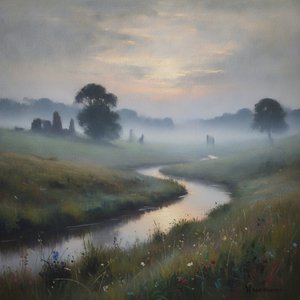
A Pastoral Reverie: Alphonse Legros’s “Hilly Landscape”
Alphonse Legros's "Hilly Landscape," painted in 1876, isn’t merely a depiction of a rural scene; it’s a carefully constructed meditation on light, atmosphere, and the quiet beauty of the English countryside. This evocative work, now housed within the Victoria and Albert Museum’s collection, offers a glimpse into the artist's evolving style—a synthesis of Realist observation with a subtle Impressionistic sensibility—and speaks volumes about his time as an expatriate in London. Legros, having moved from France to England in 1863, found himself immersed in a landscape that both mirrored and subtly diverged from his native French vistas, leading him to develop a unique perspective on the English pastoral.
The painting immediately draws the eye with its harmonious blend of greens and blues. The rolling hills, rendered with loose, confident brushstrokes, are bathed in a soft, diffused light—a characteristic of Legros’s approach that suggests an outdoor setting, painted *en plein air*. Notice how he avoids sharp outlines or dramatic contrasts; instead, he employs subtle gradations of color to create a sense of depth and atmospheric perspective. The distant spire of Hampstead church provides a grounding element, anchoring the scene within a recognizable location while simultaneously contributing to the overall feeling of serene distance.
The Influence of Realism and Impressionism
Legros’s artistic journey is defined by his engagement with two significant movements: Realism and Impressionism. Initially trained in traditional academic styles, he was profoundly influenced by Gustave Courbet's rejection of idealized representation and his commitment to depicting the world as it truly appeared. This influence is evident in Legros’s meticulous observation of natural details—the texture of the grass, the subtle variations in the foliage—and his avoidance of overtly sentimental or romanticized imagery. However, he also embraced the Impressionists' focus on capturing fleeting moments and the subjective experience of light and color. The loose brushwork and emphasis on atmospheric effects demonstrate this dual influence, creating a painting that is both grounded in observation and imbued with a sense of immediacy.
Furthermore, Legros’s background as a house decorator and wall-painter—a profession demanding an understanding of materials and spatial relationships—contributed to his ability to create convincing landscapes. He wasn't simply sketching from memory; he was translating three-dimensional space onto a two-dimensional surface with remarkable skill. The composition itself is carefully balanced, guiding the viewer’s eye through the scene and establishing a sense of harmonious unity.
Symbolism and Emotional Resonance
Beyond its technical merits, “Hilly Landscape” resonates with a quiet emotional depth. It evokes a feeling of tranquility and contemplation—a welcome respite from the bustle of urban life. The painting’s muted palette and soft light contribute to this sense of serenity, while the distant church spire suggests a connection to faith and tradition. The scene feels timeless, inviting the viewer to lose themselves in the simple pleasures of nature.
Interestingly, Legros's work often reflected his personal experiences as an expatriate artist. The English countryside, with its rolling hills and picturesque villages, became a source of inspiration for him, offering a contrast to the landscapes of his native France. “Hilly Landscape” can be interpreted as a celebration of this new environment—a testament to the beauty and charm he discovered in England.
A Legacy of British Art
Alphonse Legros’s contribution to British art extends beyond this single painting. He played a pivotal role in establishing etching as a respected medium, teaching at the Slade School of Fine Art and fostering a new generation of artists. His influence can be seen in the work of his students, including Jessie Mothersole and Elinor Hallé, who went on to become prominent figures in the British art world. “Hilly Landscape” stands as a testament to Legros’s artistic versatility and enduring legacy—a beautiful example of a painter who seamlessly blended Realist observation with Impressionistic techniques to create works that continue to captivate viewers today.
질의응답
알퐁스 레그로의 다른 이름이나 별칭에는 무엇이 있나요?
"Hilly Landscape"의 작가인 알퐁스 레그로는 Alphons Legros, 알폰스 레그로스 등의 다른 이름으로도 알려져 있습니다.
"Hilly Landscape"의 작가는 누구이며, 어떤 화풍인가요?
"Hilly Landscape"은(는) 알퐁스 레그로가 Contemporary Realism 양식으로 제작한 작품입니다. 작가와 미술 사조를 통해 해당 작품의 예술적 전통을 확인할 수 있습니다.
알퐁스 레그로의 "Hilly Landscape"은(는) 언제 제작되었나요?
알퐁스 레그로의 "Hilly Landscape"은(는) 1876년에 제작되었습니다.
이 작품에 대해 더 알아보기
 미리보기
미리보기
 공유하기
공유하기 공유하기
공유하기
 상세 정보
상세 정보 가이드 보기

 다운로드
다운로드
 유사 작품 더 보기
 X-레이
X-레이 슬라이드 쇼 보기
 질의응답
질의응답 통계 정보
통계 정보