Romanticism
Alpine Landscape (알렉상드르 칼람)
알렉상드르 칼람 (1810–1864) 작가의 Alpine Landscape Romanticism 운동에 속합니다. Oil On Canvas(으)로 제작되었습니다. 크기는 45 × 31 cm입니다.
- Oil On Canvas
- 45 × 31 cm

 미리보기

 수작업 유화 작품
 공유하기
 공유하기
 학습용 요약본


 다운로드
 유사 작품 더 보기
 X-레이
 슬라이드 쇼 보기
 질의응답

 통계 정보
Alpine Landscape 요약
- 제목
- Alpine Landscape
- 작가
- 알렉상드르 칼람 (1810–1864)
- 작가 출생지
- 브베, 스위스
- 매체
- Oil On Canvas
- 크기
- 45 × 31 cm
- 운동성
- Romanticism
- 제작 시기
- 19th Century
- 주제
- alpine landscape, mountain scenery, swiss alps view, river valley scene, atmospheric perspective, landscape painting
Alpine Landscape은(는) 무엇을 묘사하고 있나요?
Identification of the Alpine Landscape
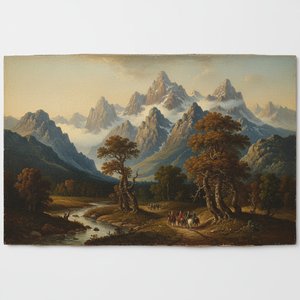
Alpine Landscape is an oil painting by the Swiss artist Alexandre Calame. The canvas captures a mountainous valley where a river winds through the terrain. A rocky outcrop anchors the left side of the scene, leading the eye toward distant, receding peaks. This work reflects the artist's lifelong preoccupation with the rugged topography of his homeland.
Alexandre Calame was born in 1810 in Vevey, Switzerland. He spent much of his life observing the textures of the Alps, from the weight of granite to the movement of mountain streams. The artist eventually passed away in 1864 in Menton, France. In this specific composition, the light remains diffused, as if filtered through an overcast sky or the soft glow of early morning.
The scene focuses on the scale of the natural world. Trees and shrubs ground the foreground, providing a sense of texture against the vastness of the background. The mountains rise in geometric triangles, their forms softening as they vanish into the atmospheric distance. A quiet stillness settles over the valley.
Composition and Visual Elements
A rocky outcrop anchors the left side of the frame, its jagged edges catching the light to pull the eye into the scene. From this stone threshold, the gaze follows a river as it winds through a mountainous valley. In the foreground, the earth is textured with the presence of shrubs and trees, grounding the viewer amidst the wild vegetation. These small, detailed forms provide a tactile entry point before the eye moves toward the vastness of the background.
The composition relies on a steady use of perspective to carve out a sense of immense depth. The mountains recede into the distance, their scale dwarfing the river and the greenery below. This arrangement emphasizes the sheer magnitude of the alpine terrain. The verticality of the peaks meets the horizontal flow of the water, creating a structured balance within the natural chaos. The light remains diffused, casting soft shadows across the mountain slopes and the valley floor. A quiet stillness settles over the stone and the stream.
Technique and Artistic Materials
Oil paint meets canvas in this landscape. The artist applied thin, translucent washes of pigment, layering them one after another in a sequence of glazes. This meticulous process builds a luminous depth, allowing light to settle within the layers. It is a slow accumulation of color. The surface holds the weight of the mountain and the softness of the air.
The brushwork captures the physical reality of the terrain. Roughness defines the stone of the rocky outcrop, while the texture of the foliage is rendered with precise, tactile strokes. Light enters the scene as a diffused glow, suggesting the quiet of an overcast day or the pale clarity of early morning. Shadows settle into the mountain crevices, creating a sense of immense scale through tonal modulation. The atmosphere feels heavy with moisture, as if the light itself is filtered through a mountain mist.
The Artistic Style of Calame
A sense of the sublime anchors this work, a hallmark of the Romanticism movement. Calame was a pivotal figure within the Düsseldorf School of Painting, bringing a disciplined eye to the untamed wilderness. He treats the mountains not as static stone, but as living, breathing entities. Through a mastery of atmospheric perspective, the distant peaks recede into a soft, hazy light, creating a profound sense of depth. This tonal modulation allows the viewer to feel the weight of the air between the rocky foreground and the far horizon.
The brushwork is expressive, capturing the rugged textures of the landscape. He uses these strokes to convey the emotional impact of nature, translating the scale of the valley into a felt experience. There is a palpable emotion in the way light hits the river and the cliffs, suggesting the solitude of the high Alps. His connection to these mountains is evident in the precise, almost tactile rendering of the terrain. The scene remains quiet, held in a delicate balance of light and shadow.
Related Works by Alexandre Calame
The artist’s hand often returned to the weight of the mountains and the movement of the air. In 1838, he captured the tension of a storm at Handeck, where the sky meets the jagged rock. This energy persists in his 1856 work, Storm in the Alps, a scene of chaotic weather and turbulent clouds. He also documented the specific topography of the Valley of Lauterbrunnen in 1856, rendering the deep clefts of the Swiss terrain. These works reflect a lifelong preoccupation with the raw power of the high passes.
Water remains a constant presence in his compositions, shifting from the violent to the still. He painted the Lake of the Four Cantons, near Brunnen, in 1853, finding a different rhythm in the alpine waters. His vision extended beyond the peaks to the warmth of the south, seen in Pozzuoli and the Bay of Naples, 1844. Even in more quiet studies, such as Landscape with Oaks, about 1859, the meticulous observation of nature remains central. The light continues to shift across the stone.
Alpine Landscape의 고해상도 이미지
알렉상드르 칼람, Alpine Landscape.
알렉상드르 칼람 (1810–1864), Alpine Landscape, oil on canvas. 퍼블릭 도메인 이미지: OriginalUniqueArt.com
Alpine Landscape에 관한 질문과 답변
"Alpine Landscape"은 어떤 기법으로 제작되었나요?
"Alpine Landscape"은(는) Oil On Canvas 기법으로 제작되었습니다.
알렉상드르 칼람의 "Alpine Landscape"의 실제 크기는 어떻게 되나요?
"Alpine Landscape" 원작의 크기는 45 x 31 cm입니다. 원작의 규격은 복제본 사이즈를 선택하실 때 유용한 참고 자료가 됩니다.
알렉상드르 칼람의 "Alpine Landscape"에는 어떤 모습이 담겨 있나요?
알렉상드르 칼람의 "Alpine Landscape"에 나타난 주제로는 alpine landscape, mountain scenery, swiss alps view, river valley scene, atmospheric perspective, landscape painting, nature’s grandeur” 등이 있습니다. 이들은 모여 작품의 소재를 요약해 보여줍니다.
"Alpine Landscape"은(는) 저작권으로부터 자유로운가요?
알렉상드르 칼람의 "Alpine Landscape"은(는) 퍼블릭 도메인 - 저작권 보호 기간이 만료되었습니다 상태입니다. 이 상태에 따라 해당 작품 이미지의 복제 가능 여부가 결정됩니다.
"Alpine Landscape"을(를) 만든 작가는 누구인가요?
"Alpine Landscape"의 작가는 알렉상드르 칼람입니다. 이 작품은 알렉상드르 칼람의 이름으로 등록되어 있습니다.
알렉상드르 칼람의 "Alpine Landscape"은(는) 어떤 미술 사조에 속하나요?
"Alpine Landscape"은(는) Romanticism 양식의 작품입니다. 이 사조는 해당 작품이 속한 예술적 전통을 나타냅니다.
Alpine Landscape은(는) 알렉상드르 칼람의 예술적 여정 중 어느 시기의 작품인가요?
알렉상드르 칼람의 작품 세계에서 "Alpine Landscape"은(는) Mature Period 시기의 작품입니다. 이 시기는 작가의 다른 작품들과 비교해 보는 데 유용한 지표가 됩니다.
알렉상드르 칼람의 "Alpine Landscape"은(는) 퍼블릭 도메인에 해당하나요? 그 이유는 무엇인가요?
알렉상드르 칼람의 "Alpine Landscape"은(는) 퍼블릭 도메인 - 저작권 보호 기간이 만료되었습니다 상태입니다. 저작권 보호 기간은 작가 사후를 기준으로 산정되며, 알렉상드르 칼람은(는) 1864년에 작고하였습니다.
"Alpine Landscape"은(는) 알렉상드르 칼람의 다른 작품들과 어떤 공통점을 지니고 있나요?
"Alpine Landscape"은(는) 알렉상드르 칼람의 Romanticism 시기 작품으로, 작가의 주요 주제로는 romantic nature's beauty, düsseldorf school influence, swiss landscape focus", alpine sublime ideal, detailed observation, calame's signature style, nature as spiritual space 등이 있습니다.
아티스트 알렉상드르 칼람 소개

1810–1864, 스위스
알렉상드르 칼람
알렉상드르 칼람 (1810 – 1864): 알프스의 웅장함을 담아내다 1810년 스위스 아라비(오늘날의 베베)에서 태어난 알렉상드르 칼람은 낭만주의 시대에 상당한 명성을 얻은 스위스의 풍경 화가로, 뒤셀도르프 학파의 핵심적인 인물로 평가받습니다. 그의 예술적 여정은 역경 속에서 시작되었습니다. 아버지의 경제적 파산으로 인해 정규 교육을 받을 기회를 놓친 그는 청소년기부터 은행원으로 일해야 하는 현실에 직면했습니다. 하지만 이러한 실용적인 필요성은 오히려 예술에 대한 열정에 불을 지피는 계기가 되었습니다.
알렉상드르 칼람의 다른 작품들
 Torrent in the Alps1849
 Valley of Lauterbrunnen1856
 The Mythen1861
 Landscape1837
Alpine Landscape 관련 에세이
 Apertures of Perspective: The Window as a Compositional Device in Landscape ArtExplore how masters use windows to frame landscapes and depth. Master the art of composition now.
 19th century Swiss paintersLouis Buvelot left Switzerland for Melbourne in 1864 to become the father of Australian landscape painting. How did his Swiss training chan…
 Majestic Peaks on Canvas: A Historical & Artistic Exploration of Mountains in Fine ArtExplore the history of mountain painting! Discover Romantic masterpieces & key artists like Dahl & Calame. Learn about the Sublime & Pictur…