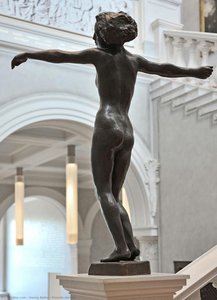
The Sculptural Journey of Georg Kolbe
Georg Kolbe was a German sculptor, painter, draftsperson, etcher, and graphic artist. Born in Waldheim, Germany, his artistic training took him through Dresden, Munich, and Paris. During a stay in Rome, he began sculpting under the technical guidance of Louis Tuaillon. His career saw him join the Berliner Secession in 1905, later departing in 1913 to join the Freie Secession.
A significant breakthrough occurred in 1912 with his sculpture Die Tänzerin. Kolbe also demonstrated a fascination for Asian faces, which led to the creation of a bust and a torso from D. N. Mazumdar. His work was featured in the sculpture event at the 1928 Summer Olympics. Throughout his career, he produced ninety-nine prints, including lithographs and drypoints of dancers and nudes in motion.
Legacy and Recognition
Kolbe's work is held in various international collections, including the Museum of Modern Art in New York, the Moderna Museet in Stockholm, and the Alte Nationalgalerie in Berlin. His studio and sculpture garden in Berlin-Westend now serves as the Georg Kolbe Museum.
His notable works include:
アーティストへのQ&A
Georg Kolbeには他にどのような名で知られているものがありますか?
Georg Kolbeは、George Kolbe, G. Kolbe, Kolbe, جورج كولبي, ゲオルク・コルベという別名でも表記されます。
Georg Kolbeの作品を展示したバーチャルミュージアムを訪れることはできますか?
Georg Kolbeの作品は、アーティストの3Dギャラリーページにある3Dギャラリーでご覧いただけます。
Georg Kolbeの作品を技法別に閲覧することはできますか?
技法別一覧では、Georg Kolbeの作品を技法別にまとめています。