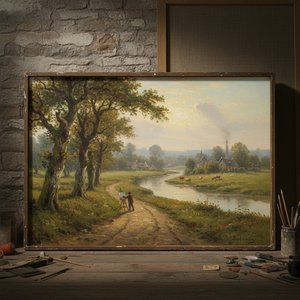
A Life Captured in Landscape
Charles Auty moved through the landscapes of Britain with the quiet precision of a man observing a world on the cusp of change. Born in Liverpool, he was the son of a stone mason, raised in an environment that shared a creative thread with his brother, Frank. While some accounts place his beginnings in Dewsbury, Yorkshire, his life was defined by a series of shifts between urban centers and the rugged edges of the coast. He lived and worked in London, but it was the Isle of Man that provided much of his most enduring subject matter. In the early twentieth century, he established himself at The Studio in Bradda, Port Erin, a location that allowed him to witness the raw, unadorned textures of the sea and stone.
His career, active and exhibiting between 1881 and 1919, was marked by a devotion to the realistic details of his surroundings. He did not seek to alter the natural world but rather to document its stillness. His work often focused on the English countryside and the coastal geography of the Isle of Man, capturing scenes that reflected a pre-industrial era. Whether rendering the heavy layers of green in a valley or the misty atmosphere of a distant mountain, his approach remained grounded in direct observation.
Technique and Observation
Auty worked primarily with oil and watercolour, utilizing techniques that emphasized the physical presence of his subjects. In his oil paintings, such as those depicting Bispham Village, he employed a deliberate layering of paint to create a tactile surface. This method allowed him to render the grit of a dirt road or the organic weight of foliage with a sense of realism. He possessed a particular skill for atmospheric perspective, using light and shadow to build depth, making distant elements appear lighter and less defined to suggest the presence of air and moisture.
His watercolours often shared this same commitment to truth. In works like Creg Malin, Peel, he captured the moody, rugged cliffs with a focused economy of line and tone. His palette was frequently restrained, favoring the muted colors of an overcast afternoon or the soft, diffused light of the British landscape. This choice of color helped him avoid harsh shadows, focusing instead on the subtle transitions of tone that define a quiet moment in nature.
Exhibition and Legacy
Though he may be considered a little-known painter by some, Auty’s presence was felt in several significant artistic circles. He exhibited his work at the Royal Academy and the Royal Hibernian Academy, as well as at various venues in Liverpool and the Yorkshire Union of Artists. His paintings have found homes in notable collections, including the Manx National Heritage and the Grundy Art Gallery in Blackpool.
The breadth of his subject matter included:
- Coastal scenes and sea cliffs of the Isle of Man
- Rural village life and agricultural landscapes of England
- Quiet, wooded valleys and mountain terrains
- Marine studies and seascape compositions
By the time of his death in 1936, Auty had left behind a body of work that serves as a record of a specific, tranquil era. His paintings remain focused on the intersection of man-made paths and the untamed elements of the earth, preserving the stillness of the landscapes he once walked.
アーティストへのQ&A
Charles Autyの作品を年代順に辿るには、どうすればよいですか?
アーティストの作品の年表ページでは、Charles Autyの作品を制作年順に並べてご覧いただけます。
Charles Autyは、どの芸術運動に属していましたか?
Charles Autyが属する各ムーブメント(芸術運動)は、作品をムーブメント別に分類したアーティストの全ムーブメントページでご覧いただけます。
Charles Autyの作品を技法別に閲覧することはできますか?
Charles Autyの作品は、技法別一覧にて技法別に閲覧いただけます。
Charles Autyの作品を鑑賞できる3Dバーチャルツアーはありますか?
Charles Autyの3Dギャラリーでは、アーティストの作品をバーチャルな3Dギャラリーで鑑賞いただけます。