

 プレビュー
プレビュー
 シェアする
シェアする シェアする
シェアする
 詳細を見る
詳細を見る

 ダウンロード
 似ている作品
 X線調査
X線調査 スライドショー
LANDSCAPE
 25.0 x 438.0 cm
 詳細を見る
詳細を見る
ジークレー/アートプリント
迅速な制作と多彩な仕上げオプションを備えた、ミュージアムクオリティのジークレーまたはキャンバスプリント。 ( 手描きの絵画を購入 画像を購入)




































作品のオリジナル比率に合わせた、当店の規定サイズからお選びください。

特定のフレームやスペースに合わせて、ご自身でサイズを指定することも可能です。選択されたサイズが元の画像の比率と一致しない場合、作品をトリミングするか、鏡面反射または単色での塗りつぶしによって画像を拡張いたします。制作を開始する前に、ご確認用のデジタルモックアップをお送りいたします。
画面上のプレビューには、実際のトリミングや拡張は反映されませんのでご注意ください。最終的な構図を正確に確認できるのは、モックアップのみとなります。
カスタムサイズも承っておりますが、元の比率を維持するためには、あらかじめ用意されたリストからサイズを選択することをお勧めいたします。


 ガラスオプションは、110cm未満のサイズでのみご利用いただけます。

LANDSCAPE
ジークレー/アートプリント
複製画のサイズ
-


合計金額
$ 80
アーティストの略歴
Xiao Yuncong: Pioneer of Dry Brushstrokes and Ming Loyalty
Xiao Yuncong (蕭雲從), born around 1596 in Wuhu, Anhui Province, stands as a singular figure in Qing dynasty art history—a master whose stylistic independence cemented his place as the founder of the Gushu school (姑孰派) and profoundly shaped the landscape tradition. Unlike many artists of his era who diligently imitated established styles, Xiao Yuncong forged his own path, prioritizing direct observation of nature and employing a distinctive technique characterized by “gui shu pai” – dry brushstrokes—that continues to inspire admiration today.Early Life and Artistic Formation
Xiao Yuncong’s upbringing instilled in him a deep appreciation for Confucian ideals and scholarly pursuits. His family belonged to the Hanlin Academy, providing him with access to elite education and fostering an environment conducive to artistic development. Although biographical details remain scarce, records indicate he traveled extensively during his lifetime, absorbing influences from various artistic centers within China—particularly Nanjing and Yangzhou—where he engaged in dialogues with fellow luminaries of the Ming dynasty. These encounters undoubtedly broadened his understanding of artistic principles and fueled his commitment to capturing the essence of the natural world.The Gushu Style: A Revolutionary Approach
Xiao Yuncong’s contribution to Chinese painting lies primarily in his pioneering adoption of “gui shu pai,” a technique that eschewed lavish color palettes and intricate ornamentation for simplicity and directness. This method involved applying brushstrokes with minimal pigment, allowing the texture of the paper itself to contribute significantly to the visual impact of the artwork. Unlike preceding generations who meticulously blended colors to achieve idealized representations of landscapes, Xiao Yuncong sought to convey a sense of immediacy and spontaneity—a reflection of his belief that true beauty resided in capturing the subtle nuances of natural phenomena. His monumental landscape painting “Taiping Shanshui Tu Hua” (太平山水圖畫), spanning over 23 feet, exemplifies this approach perfectly, demonstrating remarkable compositional balance and masterful execution.Notable Works and Legacy
Xiao Yuncong produced a prolific body of work encompassing landscapes, calligraphy, and poetry—all united by his unwavering devotion to the Ming dynasty’s artistic heritage. His landscape paintings are celebrated for their serene compositions, evocative tonal harmonies, and unparalleled sensitivity to atmospheric conditions. Particularly noteworthy is “Pure Tones Among Hills and Waters,” which showcases Xiao Yuncong's ability to distill complex visual information into a harmonious whole—a testament to his mastery of the gui shu pai technique. Furthermore, his posthumous manuscript (“Mei Hua Tang Yu Gai”) – a collection of calligraphy pieces – stands as an enduring symbol of artistic integrity and unwavering commitment to tradition.Historical Significance and Influence
Xiao Yuncong’s legacy extends far beyond his individual achievements; he fundamentally altered the trajectory of Chinese landscape painting. By rejecting stylistic conventions and prioritizing natural observation, he established a precedent for future generations of artists—inspiring them to embrace simplicity and authenticity as guiding principles. His influence can be discerned in the works of numerous painters who followed him, solidifying his position as one of the most important figures in Qing dynasty art and ensuring that his distinctive style continues to resonate with audiences worldwide. He remains an exemplar of artistic innovation rooted in profound respect for tradition.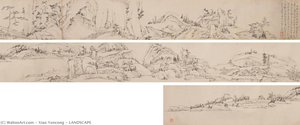
xiao yuncong
1596 - 1673
基本情報
- Artistic Movement Or Style: Gushu School
- Date Of Death: 1673
- Full Name: Xiao Yuncong
- Nationality: Chinese
- Notable Artworks: ['Taiping Shanshui Tu Hua']
- Place Of Birth: Wuhu, Anhui Province

