プリント版に切り替え
 詳細を表示
詳細を表示







































 いずれかの辺が105 cm(約41インチ)を超えるアートワークまたは複製画の場合、フレームは分解されたキットの状態でお届けいたします。この方法は、輸送中の破損を防ぎ、安全に配送するために採用しております。


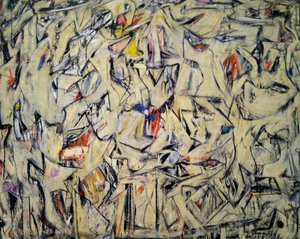
Willem de Kooning’s “Untitled (21)” – A Symphony of Emotion and Bold Gesture
“Untitled (21),” painted in 1955 by Willem de Kooning, stands as a cornerstone of Abstract Expressionism, embodying the movement's core tenets: spontaneity, emotional intensity, and a rejection of representational conventions. This monumental canvas—measuring approximately 200.7 cm x 175.3 cm—immediately commands attention with its vibrant palette dominated by fiery reds and oranges, punctuated by subtle greens that contribute to an overall sense of dynamism.
- Subject Matter: The painting depicts a woman cradling a child, capturing a tender moment of maternal care amidst turbulent artistic energy. Unlike De Kooning’s earlier depictions of women—often portrayed as fragmented and psychologically complex—here the figures are presented with a palpable warmth and intimacy.
- Style & Technique: De Kooning's signature “action painting” technique is evident in every brushstroke. Thick impasto – applying paint thickly onto the canvas – creates textured surfaces that pulsate with movement, mirroring the artist’s emotional state. The painting eschews precise lines and forms, favoring gestural marks that convey feeling rather than visual accuracy.
- Influence of Franz Kline: Notably, De Kooning cites Franz Kline as a significant inspiration, adopting Kline's bold black-and-white linear abstractions to explore the expressive potential of simplified shapes. This stylistic convergence underscores the broader artistic dialogue occurring during the period.
Historical Context – The Rise of Abstract Expressionism
“Untitled (21)” emerged against a backdrop of postwar anxieties and intellectual ferment. Following World War II, American artists sought to grapple with trauma and disillusionment through art that prioritized emotion over rational thought. De Kooning’s work aligns perfectly with this ethos, reflecting the psychological complexities inherent in navigating a world scarred by conflict.
As Nicholas Mirzoeff eloquently observes in “How to See the World,” the woman's gaze—implied but not explicitly rendered—suggests an inward focus, mirroring the broader preoccupation with subjectivity during the era. This subtle detail speaks volumes about De Kooning’s artistic ambition: to convey profound emotional resonance without resorting to conventional visual representations.
Symbolism & Emotional Resonance
The color choices – red and orange – are deliberately assertive, conveying passion and vitality. Simultaneously, the green hues introduce a counterpoint of tranquility and growth, hinting at themes of nurturing and resilience. The woman’s embrace of the child symbolizes protection and unconditional love—powerful concepts that resonate across cultures and generations.
A Legacy of Bold Expression
"Untitled (21)" continues to captivate viewers with its visceral energy and uncompromising honesty. It stands as a testament to Willem de Kooning’s mastery of abstraction, demonstrating how artistic innovation can transcend mere visual aesthetics to communicate profound emotional truths. Its enduring appeal lies in its ability to provoke contemplation and inspire awe—qualities that define the very essence of great art.
Q&A
「Untitled (21)」はパブリックドメインですか?
ウィレム・デ・クーニング作「Untitled (21)」は著作権の保護対象ですです。このステータスは、作品画像の複製に関する規定を定めたものです。
「Untitled (21)」の色同士は、どのように調和していますか?
ウィレム・デ・クーニング作「Untitled (21)」は、Strong Color Unityな色彩の調和を見せています。
ウィレム・デ・クーニング作「Untitled (21)」は、どの芸術運動に属していますか?
ウィレム・デ・クーニング作「Untitled (21)」はAbstract Expressionismに属しています。このムーブメントは、本作の様式的な背景を形作るものです。
この絵画の詳細を見る
 設置イメージを表示
 シェアする
シェアする シェアする
シェアする
 詳細を見る
詳細を見る ガイドを表示

 ダウンロード
 似ている作品
 X線調査
X線調査 スライドショーを表示
 Q&A
Q&A 統計情報
統計情報