プリント版に切り替え
 詳細を表示
詳細を表示







































 いずれかの辺が105 cm(約41インチ)を超えるアートワークまたは複製画の場合、フレームは分解されたキットの状態でお届けいたします。この方法は、輸送中の破損を防ぎ、安全に配送するために採用しております。


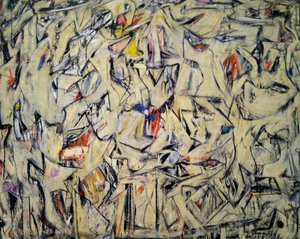
Still Life (1945): A Testament to Emotion and Form
Willem de Kooning’s “Still Life” stands as an emblem of abstract expressionism, encapsulating the movement's core tenets—a rejection of representational art in favor of spontaneous gesture and emotional resonance. Painted in 1945, amidst the turbulent aftermath of World War II, this artwork transcends mere depiction; it embodies a profound exploration of psychological states and formal experimentation.
- Subject Matter: The composition centers around a woman’s nude torso bathed in a warm pink hue—a deliberate departure from traditional still life subjects. Alongside her is another figure, partially obscured, adding to the painting's enigmatic quality.
- Style and Technique: De Kooning employed a bold, energetic brushstroke technique characterized by thick impasto—heavy application of paint—creating palpable textural surfaces. The palette utilizes vibrant yellows, greens, and oranges, juxtaposed against the dominant pink background, generating visual dynamism.
- Historical Context: “Still Life” emerged during a pivotal moment in art history, coinciding with the ascendancy of Jackson Pollock and other pioneers of action painting. It reflects the broader anxieties and aspirations of postwar America—a desire to express inner turmoil while simultaneously asserting artistic freedom.
The painting’s symbolism is multilayered. The nude figure represents vulnerability and exposure, mirroring the psychological fragility experienced by artists grappling with existential questions during wartime. Simultaneously, the fragmented forms challenge conventional notions of perspective and spatial organization—a hallmark of de Kooning's stylistic innovation.
Influenced by Cubism and Surrealism, De Kooning fused geometric abstraction with dreamlike imagery, resulting in a distinctive visual language that captivated audiences worldwide. “Still Life” remains an enduring testament to the transformative power of art—a celebration of emotion and form intertwined within a single frame.
- Notable Influences: Cubism’s fragmentation of space provided inspiration for De Kooning's exploration of visual ambiguity, while Surrealism encouraged him to tap into subconscious impulses.
- Recognition: “Still Life” garnered critical acclaim upon its debut and cemented De Kooning’s reputation as one of the foremost artists of his era—a figure whose legacy continues to inspire contemporary creatives.
For those seeking a deeper understanding of Willem de Kooning's artistic vision, exploring Willem De Kooning on Wikipedia offers invaluable insights into his life and oeuvre.
Q&A
「Still Life」の解説ページはどこにありますか?
「Still Life」のガイドは、作品の解説資料ページです。このページは印刷可能なファクトシートとなっており、作品のキャプション、クレジット、および詳細情報(作家名、制作年、技法、原寸大、所蔵)をまとめてご確認いただけます。
ヴィレム・デ・クーニング作「Still Life」のプリントサイズと向きは、どのような設定がおすすめですか?
「Still Life」の推奨プリント設定は、サイズ大判、向き縦長です。
ヴィレム・デ・クーニング作「Still Life」の色味の強さはどの程度ですか?
ヴィレム・デ・クーニング作「Still Life」は、鮮やかな色彩の強さを備えています。
この絵画の詳細を見る
 設置イメージを表示
 シェアする
シェアする シェアする
シェアする
 詳細を見る
詳細を見る ガイドを表示

 ダウンロード
 似ている作品
 X線調査
X線調査 スライドショーを表示
 Q&A
Q&A 統計情報
統計情報