- ホーム

- キャンバスプリント用
- wilfred williams ball
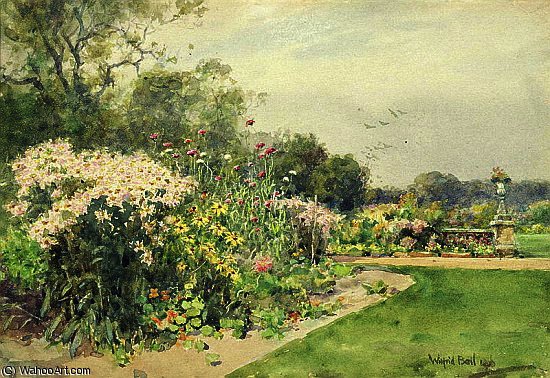
- October flowers
 Preview
 手描き複製画を注文する
 シェアする
シェアする シェアする
シェアする
 詳細を見る
詳細を見る

 ダウンロード
 似ている作品
 X線調査
X線調査 スライドショー
October flowers
 詳細を見る
詳細を見る




































作品のオリジナル比率に合わせた、当店の規定サイズからお選びください。

特定のフレームやスペースに合わせて、ご自身でサイズを指定することも可能です。選択されたサイズが元の画像の比率と一致しない場合、作品をトリミングするか、鏡面反射または単色での塗りつぶしによって画像を拡張いたします。制作を開始する前に、ご確認用のデジタルモックアップをお送りいたします。
画面上のプレビューには、実際のトリミングや拡張は反映されませんのでご注意ください。最終的な構図を正確に確認できるのは、モックアップのみとなります。
カスタムサイズも承っておりますが、元の比率を維持するためには、あらかじめ用意されたリストからサイズを選択することをお勧めいたします。


 ガラスオプションは、110cm未満のサイズでのみご利用いただけます。

October flowers
ジークレー/アートプリント
複製画のサイズ
-


合計金額
-
アーティストの略歴
The Gentle Spirit of the English Landscape: The Life of Wilfrid Williams Ball
In the golden twilight of the Victorian and Edwardian eras, few artists captured the quiet, breathing essence of the British countryside as tenderly as Wilfrid Williams Ball. Born in London on January 4th, 1853, Ball emerged from a household where intellectual and poetic pursuits were woven into the very fabric of daily life. His father, Benjamin Williams Ball, was an accountant with a profound passion for poetry, while his sister, Rosamund Ball, would later achieve her own renown as a celebrated Victorian poet. This environment, rich with literary sensitivity, undoubtedly shaped Wilfrid’s ability to perceive the poetic nuances within a landscape, allowing him to see beyond mere topography to the emotional resonance of the natural world.
Though his early years were marked by a remarkable physical prowess—he was an accomplished athlete at the London Athletic Club—the call of the visual arts proved irresistible. His formal education in art was singular and focused; he studied at the Heatherley School of Fine Art in Chelsea. Eschewing the rigid, often stifling academic dogmas of the period, Ball embraced a method rooted in direct observation. This commitment to seeing the world as it truly appeared, rather than through the lens of prescribed classical rules, became the cornerstone of his technique, allowing him to master the delicate interplay of light and atmosphere that defines his most cherished works.
A Journey from Etching to Atmospheric Mastery
The trajectory of Ball’s career was profoundly influenced by the recognition of his contemporaries. While he initially pursued a stable path in accounting, the burgeoning talent revealed in his printmaking work could not be ignored. A pivotal moment arrived when James Abbott McNeill Whistler, one of the most influential figures in 19-century art, expressed admiration for Ball’s etchings of the Thames River. This endorsement acted as a catalyst, emboldening Ball to abandon his clerical profession and commit himself entirely to the life of a professional artist. His early success was cemented by an etching accepted into the Royal Academy exhibition in 1877, signaling his arrival on the prestigious London art scene.
Ball’s mastery extended across various media, though he is perhaps most celebrated for his ability to manipulate light through different techniques:
- Etching and Printmaking: His series portraying the Isis River and Stratford-upon-Avon demonstrated a meticulous attention to detail and an uncanny ability to capture the structural beauty of riverine landscapes.
- Watercolor: In his watercolors, Ball achieved a level of translucency and softness that perfectly mirrored the fleeting qualities of English weather, capturing the misty mornings and sun-drenched afternoons of rural life.
- Oil Painting: His oil works, such as the evocative Cottage in a Rural Setting, allowed for a more robust exploration of texture and impressionistic light, bringing a nostalgic charm to his depictions of the English countryside.
Legacy and the Art of Tranquility
As his career progressed, Ball’s repertoire expanded from the intimate river scenes of the Thames and the Isis to broader coastal vistas and marine scenes. Works like Coastal Scene with a Lighthouse showcase his ability to handle the vastness of the sea and the dramatic interplay of maritime elements. Throughout his life, his work remained anchored in a sense of profound tranquility. He did not seek to shock or provoke through grand historical narratives; instead, he sought to preserve the fleeting, serene moments of a landscape that was rapidly changing due to the industrial revolution.
Today, the significance of Wilfrid Williams Ball lies in his role as a chronicler of a vanishing era. His paintings serve as windows into the peaceful, pastoral England of the late 19th and early 20th centuries. Through his precise yet soulful execution, he captured the very soul of the British landscape, leaving behind a legacy of works that continue to offer solace and beauty to those who seek a moment of quiet reflection in an increasingly turbulent world.

wilfred williams ball
1853 - 1917 , United Kingdom
基本情報
- Artistic Movement Or Style: Victorian Landscape Art
- Artists Or Movements Influenced By This Artist: ['Impressionism']
- Artists Who Influenced This Artist: ['James Abbott McNeill Whistler']
- Date Of Birth: January 4, 1853
- Date Of Death: 1917
- Full Name: Wilfrid Williams Ball
- Nationality: British
- Notable Artworks:
- Cottage in a Rural Setting
- Coastal Scene with Lighthouse
- Place Of Birth: London, United Kingdom

