Rococo
William Boyce (トマス・ハドソン)
トマス・ハドソン (1701–1779)による作品『William Boyce』 Rococo運動に属しています。 Oilで制作されています。
- Oil

 設置イメージを表示

 手描き油彩画
 シェアする
 シェアする
 解説シート


 ダウンロード
 似ている作品
 X線調査
 スライドショーを表示
 Q&A

 統計情報
William Boyceの概要
- 作品名
- William Boyce
- 作家
- トマス・ハドソン (1701–1779)
- 生年
- デヴォン, イギリス
- 技法
- Oil
- 技法
- Rococo
- 制作年代
- Early Modern
- 主題
- man, suit, wig, stairs, book, people
William Boyceには何が描かれていますか?
Identification of the Portrait of William Boyce
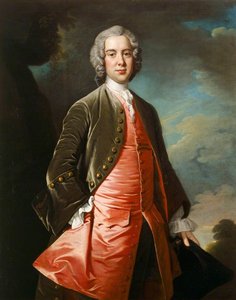
This portrait of William Boyce, executed by the English painter Thomas Hudson, offers a quiet encounter with a significant figure of the mid-eighteenth century. Created about 1745–1750, the work captures the likeness of a man who occupied a central position in the musical life of his era. Hudson, a specialist in the art of portraiture, focuses his attention on the composer, presenting him with a sense of composed dignity.
The subject, William Boyce, was a distinguished English composer and organist. In this depiction, Hudson moves beyond a mere likeness to present the man as he was understood in his professional and social context. The painting provides a visual record of a man whose musical contributions would eventually influence the liturgical and orchestral traditions of the period.
Visual Composition and Subject Matter
In this black and white painting, the subject is captured in a moment of quiet formality. He is depicted wearing a suit and a wig, positioned upon a set of stairs. In his hand, he holds a book, a detail that suggests a life of intellectual or musical pursuit. The composition places him within a structured environment, where the lines of the staircase provide a sense of depth and architectural stability.
The arrangement of the scene includes subtle secondary elements that add to the sense of a lived-in, historical setting. Two other figures are visible in the background, one situated on the left and another on the right, providing a sense of scale and social context to the primary subject. Near the center of the image, an umbrella is placed, a singular object that grounds the formal attire in a specific, perhaps transitory, moment of daily life.
The Life and Career of Thomas Hudson
Born in 1701 in Devon, United Kingdom, Thomas Hudson developed a meticulous approach to portraiture through his early training. He studied under the tutelage of Jonathan Richardson in London, a foundation that helped shape his refined style. His career reached its peak between 1740 and 1760, a period during which he became a central figure in the London art scene. Between 1745 and 1755, he was arguably the most successful portraitist in London, supported by a bustling workshop that included specialists like the drapery painter Joseph van Aken.
His artistic perspective was broadened by significant travel. In 1748, he visited the Low Countries, and in 1752, he traveled to Italy. These excursions allowed him to absorb diverse continental techniques, which he brought back to his English practice. He eventually settled at Cross Deep in Twickenham, living near the intellectual circles of the time. He remained active in his craft until his retirement toward the end of the 1750s, eventually passing away in Twickenham in 1779.
The Musical Legacy of William Boyce
Born in 1711, William Boyce occupied a significant position in the musical landscape of the late Baroque period. As an English composer and organist, his influence extended through the sacred and secular spheres, reaching a professional peak when he was appointed Master of the King's Musick in 1757. His career was marked by a profound connection to the liturgical traditions of the era, a devotion that remained steadfast even as his physical faculties changed. Despite the onset of deafness, which eventually necessitated his retirement from active organist duties, he continued to compose with a focused, internal clarity.
His contributions to the English musical canon are particularly noted in his editorial work and his symphonic output. He spent much of his later life meticulously compiling and editing collections of church music, ensuring the preservation of works by earlier composers. This dedication to the structural integrity of English cathedral music helped establish a standard for future generations of musicians. His life concluded in 1779, and he was laid to rest beneath the dome of St Paul's Cathedral.
- Solomon serenata
- Heart of Oak
- The King Shall Rejoice
Artistic Influence and Mentorship
Hudson’s influence extended far beyond his own brush, reaching into the next generation of British portraiture through a highly organized workshop. He was an influential teacher who cultivated a specific standard of elegance and technical precision. His studio functioned as a vital training ground, where he passed on the meticulous approach to detail he had first learned under Jonathan Richardson. This lineage of instruction helped shape the direction of English art for decades.
Among his most celebrated pupils were Joshua Reynolds and Joseph Wright, both of whom would go on to become leading figures in the British art scene. By mentoring such significant talents, Hudson ensured his stylistic preferences and technical rigor would persist through their own successful careers. He also provided specialized training to Peter Toms, a painter who focused specifically on the complexities of drapery, further demonstrating the breadth of expertise shared within his circle.
Historical Context and Artistic Style
Hudson’s approach to portraiture was defined by a commitment to elegance and refinement. His work reflects a classical sensibility, rooted in the foundational training he received under Jonathan Richardson. This influence is visible in the meticulous accuracy he applied to his subjects, ensuring that each sitter was presented with a sense of poise and dignity. Rather than relying on dramatic flourishes, he utilized a polished brushwork to convey the social standing and character of those who sat for him.
There is a particular focus on the tactile quality of the sitter's attire. Hudson possessed a keen eye for detail, specifically when rendering the weight and texture of various fabrics. This technical precision allows the viewer to perceive the subtle nuances of the materials, from the softness of a garment to the crispness of a formal collar. Such attention to drapery was a hallmark of his studio, often supported by specialists who helped maintain this high standard of craftsmanship.
The composition of this work, created about 1745–1750, aligns with the sophisticated aesthetic prevalent in mid-18th-century English portraiture. It avoids unnecessary ornamentation, choosing instead to emphasize the presence of the individual through controlled, deliberate execution. The result is a portrait that prioritizes clarity and the quiet dignity of the subject over theatricality.
The Artistic Legacy of William Boyce
While his name may have faded from the immediate public consciousness following his death, the music of William Boyce underwent a significant rediscovery during the 1930s. This revival was largely prompted by the publication of the first modern edition of his Eight Symphonies in 1928. Such efforts allowed a new generation of listeners to engage with his compositions, moving beyond the shadow of his contemporaries to appreciate his specific contributions to the English musical tradition.
His influence remains tangible within the liturgical fabric of the Anglican Church. His coronation anthem, The King Shall Rejoice, continues to hold a place in significant state ceremonies. Most recently, this work was performed during the coronation of Charles III in 2023. It is a rare occurrence for a composer from this era to maintain such a direct connection to contemporary royal ritual, ensuring his melodic lines continue to resonate in the most formal of settings.
William Boyceの高解像度画像

トマス・ハドソン, William Boyce. パブリックドメイン
William Boyceに関するよくあるご質問
トマス・ハドソン作「William Boyce」 の技法(画材)は何ですか?
トマス・ハドソンは、「William Boyce」においてOilの技法を用いています。この技法が、原画の素材としての性質を決定づけています。
トマス・ハドソン作「William Boyce」にはどのような主題が描かれていますか?
トマス・ハドソン作「William Boyce」に描かれているテーマには、man, suit, wig, stairs, book, people, umbrellaなどがあります。これらが合わさることで、本作の主題を構成しています。
「William Boyce」はパブリックドメインですか?
著作権について、「William Boyce」はパブリックドメイン(著作権消滅)です。
「William Boyce」の作者は誰ですか?
「William Boyce」の作者はトマス・ハドソンです。この作品はトマス・ハドソンの名でカタログに登録されています。
「William Boyce」はどの様式に属していますか?
トマス・ハドソン作「William Boyce」に関連する芸術運動はRococoです。この分類により、本作は関連する他の芸術家や作品群の中に位置づけられます。
William Boyceは、トマス・ハドソンのキャリアにおけるどの時期の作品にあたりますか?
トマス・ハドソンの画業において、「William Boyce」はPeak Yearsに制作されたものです。この時期の作品を知ることで、同アーティストの他の作品との比較検討が可能になります。
トマス・ハドソン作「William Boyce」 の著作権状況の根拠を教えてください。
「William Boyce」の著作権の状態について — パブリックドメイン(著作権消滅) — は、作者の没年である1779に基づいています。
「William Boyce」は、トマス・ハドソンのテーマやスタイルとどのように結びついているのでしょうか?
「William Boyce」はトマス・ハドソンによるRococoの作品であり、その描かれたテーマにはjonathan richardson's influence, classical approach, english portraiture, status and personality, refined eleganceが含まれます。
「William Boyce」は、トマス・ハドソンのこれまでの作風を象徴するものと言えるでしょうか?
トマス・ハドソンの作品に繰り返し現れるテーマにはjonathan richardson's influence, classical approach, english portraiture, status and personality, refined eleganceがありますが、「William Boyce」ではman, suit, wig, stairs, book, people, umbrellaに焦点を当てています。
アーティスト トマス・ハドソン について
1701–1779, イギリス
トマス・ハドソン
トーマス・ハドソンの生涯と肖像画の世界 18世紀の英国肖像画界において重要な役割を果たしたトーマス・ハドソン。彼の生い立ちは、正確な出生地は不明ながらも、1701年にデヴォン州ビデフォードで生まれたことに始まります。幼少期から芸術への強い情熱を抱き、ロンドンでジョナサン・リチャードソンの下で修行を開始しました。リチャードソンからの指導は、ハドソンに細部への徹底的なこだわりと、肖像画における確かな基礎を築かせました。しかし、その後の結婚は波乱の幕開けとなりました。1725年以前にリチャードソンの娘と結婚したのです。師であるリチャードソンの反対にもかかわらず、ハドソンは自身の信念に従い、愛する女性との人生を選びました。この出来事は、彼の芸術家としての独立心を示すエピソードとして語られています。 隆盛期とその画風 1740年代から1760年代にかけて、ハドソンはその才能を開花させ、英国肖像画家としての地位を確立しました。特に1745年から1755年の間は、ロンドンで最も成功した肖像画家の一人として知られています。彼は大規模な工房を運営し、多くの助手たちと共に数多くの依頼に応えました。その中には、専門的な布地の描写を担当したジョセフ・ヴァン・エイケンも含まれていました。ハドソンの肖像画は、優雅さと洗練された美しさが特徴です。被写体の社会的地位や個性を巧みに捉え、磨き抜かれた筆致と細部への注意深さによって、その存在感を際立たせました。特に布地の質感の表現には、彼の卓越した技術が遺憾なく発揮されています。 影響を受けた芸術家と旅 ハドソンの初期の作品には、リチャードソンの影響が色濃く見られます。正確さと古典的なアプローチを重視するスタイルは、師からの薫陶によるものでしょう。しかし、1748年に低地諸国へ、そして1752年にはイタリアへと旅立ったことが、彼の芸術的視野を大きく広げるきっかけとなりました。これらの旅行を通して、ハドソンは多様な芸術様式や技法に触れ、自身の表現力を高めていきました。1753年には、アレクサンダー・ポープの別荘の近く、トゥイッケナムに家を購入し、活気あふれる知的・芸術コミュニティの一員となりました。 後世への影響と遺産 ハドソンは優れた教育者でもありました。彼の最も有名な弟子には、ジョシュア・レイノルズやジョセフ・ライトがいます。彼らは後に英国を代表する画家として活躍し、ハドソンの芸術的精神を受け継ぎました。また、ピーター・トムスも彼の指導を受け、布地の描写を専門とする画家となりました。1750年代後半になると、ハドソンは徐々に現役から退き始めましたが、その影響力は衰えることはありませんでした。彼は1779年にトゥイッケナムで生涯を閉じました。死後、彼の膨大な私蔵コレクションは三回に分けて売却されましたが、その芸術的価値は高く評価されています。ハドソンは英国肖像画の発展に大きく貢献し、優雅さと洗練さを追求したスタイルは、後世の画家たちに多大な影響を与えました。ナショナル・ポートレートギャラリーやテート美術館をはじめとする多くの美術館で彼の作品が展示されており、オンラインプラットフォームAllPaintingsStore.comでも鑑賞することができます。
トマス・ハドソンのその他の作品
 ピーター・ウォーレン
 John Newton1757
 The Thistlethwayte Family1758
 Princess Amelia Sophia Eleonore of Great Britain1745

William Boyceに関するエッセイ
 Masterpieces of Hyacinthe Rigaud: The Top 25 Portraits of a Baroque IconExplore 25 iconic Hyacinthe Rigaud masterpieces. From Baroque portraits to royal splendor, discover the full collection on OriginalUniqueAr…
 17th century British paintersMasterpieces by William Dobson and Mary Beale define 17th century British art. Explore the full collection online at OriginalUniqueArt.com.
 Chaim Soutine: 25 Visceral Paintings That Capture His Intense StyleExplore 25 vital Chaim Soutine paintings and his raw expressionist style. Discover the full collection online at OriginalUniqueArt.com.