プリント版に切り替え
 詳細を表示
詳細を表示







































 いずれかの辺が105 cm(約41インチ)を超えるアートワークまたは複製画の場合、フレームは分解されたキットの状態でお届けいたします。この方法は、輸送中の破損を防ぎ、安全に配送するために採用しております。


Thomas Gainsborough: A Pioneer of British Landscape Painting
The Suffolk countryside holds a profound significance in the artistic legacy of Thomas Gainsborough (1727 – 1788), arguably Britain’s most celebrated painter of the Georgian era. Born into a family involved in wool trading, young Gainsborough defied convention by prioritizing artistic pursuits over the family business, recognizing and nurturing an extraordinary talent that would propel him to international acclaim.
His formative years were spent absorbing the beauty of Suffolk's rolling hills and meadows – landscapes that would become central to his oeuvre. Unlike many artists of his time who favored idealized depictions, Gainsborough approached nature with a remarkable honesty and immediacy, capturing fleeting moments of light and atmosphere with effortless grace.
Style and Technique: Lightness and Impressionistic Foreshadowing
Gainsborough’s distinctive style is characterized by a luminous palette dominated by pastel hues – greens, blues, yellows – that evoke the serenity and vibrancy of the English countryside. He employed loose brushstrokes and subtle gradations of color to create an illusion of depth and movement, anticipating the Impressionistic techniques that would emerge decades later.
His meticulous attention to detail is balanced by a willingness to forgo precise rendering in favor of capturing the essence of his subjects. This approach resulted in paintings imbued with a palpable sense of spontaneity and emotion – qualities that resonate powerfully with viewers even today.
Elizabeth Wrottesly: Symbolism Within Pastoral Beauty
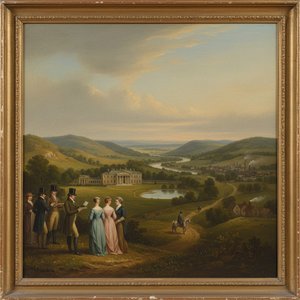
Considered Gainsborough’s masterpiece, “Elizabeth Wrottesly” exemplifies his masterful blend of landscape and portraiture. The painting depicts Elizabeth Wrottesly, a young woman known for her beauty and grace, posed amidst a meticulously rendered pastoral scene. The verdant foliage and dappled sunlight serve as a backdrop to Wrottesly's figure, symbolizing fertility and renewal.
The inclusion of a feather – delicately positioned in Wrottesly’s hand – adds another layer of symbolic meaning. Feathers have long been associated with aspiration and nobility, reflecting Wrottesly’s elevated social standing and embodying the artist’s desire to elevate his subject beyond mere physical appearance.
Historical Context: Establishing the Landscape School
Gainsborough's work emerged during a period of significant artistic innovation in Britain. He spearheaded the establishment of the Royal Academy in 1769, marking a pivotal moment in British art history and fostering a collaborative environment for artists to experiment with new ideas.
His influence extended far beyond his own lifetime, inspiring generations of painters who embraced his pioneering approach to landscape painting. Gainsborough’s legacy continues to endure as a testament to the transformative power of observation and artistic vision – qualities that remain eternally relevant in our contemporary world.
Q&A
トーマス・ゲインズバラ作「Elizabeth Wrottesly」の複製画をプレビューするにはどうすればよいですか?
「Elizabeth Wrottesly」の設置イメージページでは、ご注文前に作品をプレビューいただけます。
トーマス・ゲインズバラ作「Elizabeth Wrottesly」の色彩は、鮮やかですか、それとも落ち着いたトーンですか?
トーマス・ゲインズバラ作「Elizabeth Wrottesly」の色調は、Balanced Softな彩度を持っています。彩度とは、色の鮮やかさや落ち着きの度合いを表すものです。
トーマス・ゲインズバラ作「Elizabeth Wrottesly」 の基調となる色は何ですか?
「Elizabeth Wrottesly」の中で最も際立っている色はPhthalo Green (#201c07)です。作品の主色(メインカラー)を知ることは、インテリアとのコーディネートを考える際に役立ちます。
この絵画の詳細を見る
 設置イメージを表示
 シェアする
シェアする シェアする
シェアする
 詳細を見る
詳細を見る ガイドを表示

 ダウンロード
 似ている作品
 X線調査
X線調査 スライドショーを表示
 Q&A
Q&A 統計情報
統計情報