プリント版に切り替え
 続きを読む
続きを読む







































 いずれかの辺が105 cm(約41インチ)を超えるアートワークまたは複製画の場合、フレームは分解されたキットの状態でお届けいたします。この方法は、輸送中の破損を防ぎ、安全に配送するために採用しております。


A Testament to Scholarly Reverence: Simone Martini’s Petrarch's Virgil
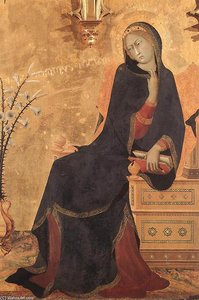
Simone Martini’s “Petrarch’s Virgil,” created in 1336, transcends mere depiction; it embodies the spirit of its time—a confluence of piety, intellect, and artistic sophistication that cemented Martini’s legacy as one of Siena’s most celebrated masters. Executed during a period marked by burgeoning humanist thought and papal patronage, this title page serves not only as an announcement of Virgil's epic poem “Aeneid” but also as a profound meditation on the relationship between faith and reason, virtues central to Petrarch’s philosophical worldview. Martini skillfully captures this duality through meticulous observation and masterful execution—a hallmark of Sienese painting during the Trecento period.- Subject Matter & Composition: The scene portrays Petrarch, a renowned humanist scholar and poet, seated upon a bench beneath a canopy adorned with foliage, accompanied by Virgil, the Roman poet whose “Aeneid” served as inspiration for Petrarch’s own literary endeavors. The inclusion of a sheep—a symbol of innocence and pastoral virtue—further underscores the poem's themes of moral contemplation and spiritual renewal.
- Style & Technique: Martini’s style is characterized by its exquisite delicacy and luminous color palette, reflecting the influence of Giotto di Bondone and Florentine proto-Renaissance aesthetics. He employs tempera paint on ivory panel—a technique favored for its ability to achieve unparalleled brilliance and tonal subtlety—resulting in a surface that glows with ethereal light. The artist’s meticulous attention to detail is evident in every brushstroke, capturing the textures of fabric, foliage, and skin with remarkable accuracy.
Historical Context: Siena Under Papal Influence
Siena during Martini's lifetime experienced a significant resurgence under papal patronage following Gregory XI’s relocation of the papacy from Avignon to Rome. This period witnessed an unprecedented flourishing of artistic activity, fueled by papal commissions aimed at glorifying God and reaffirming papal authority. Martini’s “Petrarch’s Virgil” exemplifies this cultural dynamism—a product of a milieu where intellectual curiosity intersected with religious devotion, shaping artistic sensibilities and elevating the visual arts to new heights.- Symbolism: Beyond its immediate depiction of Petrarch and Virgil, the artwork resonates with broader symbolic meanings. The canopy represents divine protection and contemplation, mirroring Petrarch’s pursuit of spiritual enlightenment. Similarly, the sheep symbolizes purity and pastoral ideals—values championed by Petrarch as reflections of Christian morality.
- Emotional Impact: Martini's masterful rendering evokes a sense of serene solemnity, inviting viewers to contemplate the profound connection between literature and faith. The luminous colors and delicate brushwork convey an atmosphere of tranquility and intellectual reverence—capturing the essence of Petrarch’s humanist spirit.
Legacy & Artistic Significance
“Petrarch’s Virgil” stands as a cornerstone of Sienese painting, demonstrating Martini's unparalleled ability to synthesize stylistic influences from Giotto and Florence into a uniquely expressive idiom. It represents the apex of Trecento elegance—a testament to Martini’s artistic genius and his contribution to the burgeoning Renaissance movement. Today, reproductions of this masterpiece offer art lovers and collectors alike an opportunity to experience firsthand the beauty and intellectual depth of Siena's artistic heritage.よくあるご質問
シモーヌ・マルティニ作「Petrarch's Virgil, title page」 の複製画は、どこに飾るのが最適でしょうか?
Portraitの形状を活かした「Petrarch's Virgil, title page」の複製画は、Living Roomに飾るのがおすすめです。
制作時期から見て、"Petrarch's Virgil, title page"はシモーヌ・マルティニのキャリアにおけるどの時期にあたりますか?
1336年という制作時期は、シモーヌ・マルティニの画業におけるMature Periodに「Petrarch's Virgil, title page」を位置づけています。
シモーヌ・マルティニ作「Petrarch's Virgil, title page」 の技法(画材)は何ですか?
シモーヌ・マルティニ作「Petrarch's Virgil, title page」の技法はAcrylic On Canvasです。複製画は、この技法の質感や風合いを再現することを目指しています。
More about this painting
 設置イメージを確認
 送る
送る シェア
シェア
 詳細情報
詳細情報 ガイドを表示

 画像をダウンロード
 似ている作品
 X線調査
X線調査 スライドショー
 Q&A
Q&A 統計情報
統計情報