Expressionism
Aragon (ラファエル・バラダス)
ラファエル・バラダス (1890–1929)による作品『Aragon』 Expressionism運動に属しています。 Oil On Canvasで制作されています。
- Oil On Canvas

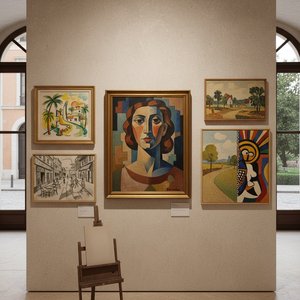
 設置イメージを表示

 手描き油彩画
 シェアする
 シェアする
 解説シート


 ダウンロード
 似ている作品
 X線調査
 スライドショーを表示
 Q&A

 統計情報
Aragonの概要
- 作品名
- Aragon
- 作家
- ラファエル・バラダス (1890–1929)
- 作家の生年
- モンテビデオ, ウルグアイ
- 技法
- Oil On Canvas
- 制作年代
- Modern
- 主題
- portrait, religious figures, expressionism, geometric forms, shadows, texture
Aragonには何が描かれていますか?
The Subject and Artist of Aragon
Aragon is a work by Rafael Barradas, an Uruguayan modernist painter and graphic artist. The piece presents a group portrait of three figures, rendered in a distinctly Expressionistic style. These subjects, appearing as clergymen or religious officials, are defined by bold, angular lines and simplified forms. Their attire, including collars and hats, suggests a position of religious authority.
Barradas, born in Montevideo, Uruguay, in 1890, developed a unique visual language through his immersion in European avant-garde movements. His approach often synthesized the dynamism of Futurism and the structural deconstruction of Cubism. In this work, the artist prioritizes emotional impact over accurate representation, utilizing sharp edges to construct the faces and torsos of the subjects.
The composition focuses entirely on the heads and upper bodies of the three men against a dark, textured background. This tight cropping, combined with the severe and detached expressions of the figures, creates a sense of solemnity. The artist’s method emphasizes the physical presence of the subjects through heavy, layered application of paint.
Composition and Visual Elements
The composition is tightly cropped, focusing exclusively on the heads and upper torsos of the three figures. This close framing eliminates environmental context, pushing the subjects toward the viewer. Bold, angular lines define the faces, utilizing sharp edges to construct the features. The arrangement relies on a geometric vocabulary; squares, rectangles, and triangles are used to build the forms of the figures rather than following naturalistic contours.
A single, unseen light source casts heavy shadows across the subjects. These shadows accentuate the structural planes of the faces, heightening the dramatic tension. The perspective is intentionally flattened, rejecting any sense of receding space or depth. Against this lack of spatial dimension, the background remains dark and heavily textured, providing a stark contrast to the geometric subjects.
Technique and Artistic Materials
The work is executed in oil paints on canvas. The application of pigment is heavy, utilizing a thick impasto that creates a palpable, rough surface. This layered approach builds a physical texture across the pictorial plane, emphasizing the material presence of the paint itself.
Visible brushwork defines the forms, rejecting smooth transitions in favor of direct, gestural marks. These strokes contribute to the structural clarity of the figures, using sharp edges and angularity to construct the subjects. The interplay of light and shadow is achieved through this deliberate, uneven application, which accentuates the planes of the faces and adds a sense of weight to the composition.
Aragonの高解像度画像
ラファエル・バラダス, Aragon. パブリックドメイン
Aragonに関するよくあるご質問
ラファエル・バラダス作「Aragon」 の技法(画材)は何ですか?
ラファエル・バラダス作「Aragon」の技法はOil On Canvasです。複製画は、この技法の質感や風合いを再現することを目指しています。
ラファエル・バラダス作「Aragon」にはどのような主題が描かれていますか?
「Aragon」に描かれている主題はportrait, religious figures, expressionism, geometric forms, shadows, texture, clergy, angularです。
ラファエル・バラダス作「Aragon」の画像は自由に複製できますか?
著作権について、「Aragon」はパブリックドメイン(著作権消滅)です。
「Aragon」の作者は誰ですか?
「Aragon」はラファエル・バラダスによる作品です。このページでは、ラファエル・バラダスのオリジナル作品についてご紹介しています。
「Aragon」はどの様式に属していますか?
「Aragon」は、Expressionismの作品です。この様式は、その作品が属する芸術的伝統を示しています。
Aragonは、ラファエル・バラダスのキャリアにおけるどの時期の作品にあたりますか?
「Aragon」は、ラファエル・バラダスの画業におけるMature Periodに属します。この分類は、作品をアーティストの作風の変遷に関連付けるものです。
ラファエル・バラダスによる「Aragon」はパブリックドメインに含まれますか?また、その理由は何ですか?
ラファエル・バラダスによる「Aragon」はパブリックドメイン(著作権消滅)です。著作権の保護期間は作者の没年から起算されますが、ラファエル・バラダスは1929年に亡くなっています。
「Aragon」には、ラファエル・バラダスの他の作品群とどのような共通点が見られますか?
ラファエル・バラダスの作品群において、「Aragon」はExpressionism様式に属しており、futurist & cubist echoes, uruguayan religious themes, spanish exile reflections, aragon – a stark portrait, barradas' intense vision, early expressionistic style, short career, bold impactというテーマを共有しています。
「Aragon」は、ラファエル・バラダスのこれまでの作風を象徴するものと言えるでしょうか?
ラファエル・バラダスの作品に繰り返し現れるテーマにはfuturist & cubist echoes, uruguayan religious themes, spanish exile reflections, aragon – a stark portrait, barradas' intense vision, early expressionistic style, short career, bold impactがありますが、「Aragon」ではportrait, religious figures, expressionism, geometric forms, shadows, texture, clergy, angularに焦点を当てています。
アーティスト ラファエル・バラダス について

1890–1929, ウルグアイ
ラファエル・バラダス
生誕と初期の芸術的探求 1890年、ウルグアイのモンテビデオに生まれたラファエル・ペレス・ヒメネス・バラダスは、20世紀初頭の隆盛を極めたモダニズム運動において重要な役割を担う人物となりました。彼の人生は、ウルグアイのルーツとヨーロッパのアヴァンギャルドな感性を融合させた、落ち着きのない芸術的探求の物語です。幼少の頃から、ピアニストの姉、詩人の弟、画家の父といった芸術一家に囲まれて育ち、バラダスは生涯の創作活動を定義づける美的感覚を吸収していきました。厳密な意味での正式な教育を受けていたわけではありませんが、モンテビデオやブエノスアイレスの新聞や雑誌のイラストレーターとして才能を開花させ、独自の視覚言語の基礎を築いていきました。1913年のヨーロッパへの旅は、彼の芸術的軌跡を決定的に変える転換点となりました。イタリア・未来派のダイナミックなエネルギーに浸り、パリでキュビズムの過激な解体を経験したバラダスは、革新的でありながら個人的な美的ビジョンを形成し始めました。 振動主義の誕生:影響の統合 主にバルセロナとマドリードに拠点を置いたスペインに移住すると、バラダスはすぐにアヴァンギャルド界の中心人物となりました。スペインの芸術的活気に満ちた知的な環境の中で、彼は自身のシグネチャー・スタイルである振動主義を開発しました。これは未来派のダイナミズムやキュビズムの断片化の模倣ではありませんでした。それは統合であり、強烈な色彩とダイナミックな構成を通して、現代都市生活の本質を捉えようとする意図的な試みでした。振動主義は、目に見えるものだけでなく、加速するペースと感覚過多を経験することがどのように感じられるかを表現しようとしました。*La Esquella de Torratxa*や*Paraninfo*といった出版物の挿絵画家として実験を行い、絵画を超えた卓越した多様性を示しました。振動主義の核心的な要素—強烈な色彩表現への重点、動きを示す断片化された形態、都市の風景の描写—は、伝統的な芸術的慣習からの重要な脱却を意味していました。それは機械時代の容赦ない鼓動に匹敵する視覚的な翻訳を試みたのです。 肖像画から壮麗な作品へ:多様な創作活動 バラダスの芸術的アウトプットは、彼の絶え間ない実験と進化するビジョンを反映して、驚くほど多様でした。「タンゴ」(1913)のような初期の作品には、現代的なテーマへの関心と形態と色彩の習熟が見られます。しかし、「ロス・マグニフィコス」シリーズが彼の名声を確固たるものにしたのです。スペインの人気人物の記念碑的な肖像画は、大胆な幾何学的な形にレンダリングされ、平凡な個人を彼らの時代の象徴的な表現に変えました。この時期には「道化師主義」も登場し、都市生活の鮮やかな描写と人間の感情の遊び心がありながらも痛切な探求が特徴付けられました。これらのシグネチャー・スタイルを超えて、バラダスは著名な人物—ホアキン・トーレス・ガルシアやイгнаシオ・スロアガ—の肖像画を描き、伝統的な肖像画技術とアヴァンギャルド美学をシームレスに融合させる独自の芸術的才能を示しました。彼の能力は、卓越した色彩、構成、感情の深さを示す「ジプシーキャンプ」(1918)や「酒場の中の男」(1922)といった注目すべき作品で例証されています。 短く切られた遺産:影響と歴史的意義 悲劇的に、ラファエル・バラダスの人生は1929年に39歳という若さで病によって断ち切られました。この早すぎる死にもかかわらず、彼はウルグアイの芸術史に消えない足跡を残し、より広範なモダニズム運動に大きく貢献しました。ウルグアイの遺産とヨーロッパのアヴァンギャルドの影響をユニークに融合させた彼の作品は、20世紀初頭の芸術における独特の声として確立されました。バラダスの作品は、同時代のホアキン・トーレス・ガルシアに大きな影響を与え、彼自身も「Constructive Universalism」に振動主義の要素を取り入れました。今日、彼の絵画はモンテビデオ国立美術館などの名門コレクションに収蔵されており、次世代による継続的な認識と評価が保証されています。彼は色彩、形態、主題への革新的なアプローチで称賛され、彼の芸術的ビジョンと永続する遺産の証となっています。彼の作品は、アートの変革力を思い出させ、時代の精神を捉える能力を証明し続けています。 バラダスのスタイルの主な特徴 振動主義: 未来派、オルフィズム、キュビズムを融合させた独自のスタイルで、ダイナミズムの捉え方に焦点を当てています。 強烈な色彩パレット: 色彩を大胆かつ表現豊かに使用し、感情とエネルギーを伝えます。 幾何学的な形態: 現実を解体し再構築するために、幾何学的な形を頻繁に使用します。 都市のテーマ: カフェ、通り、工業地帯などの現代都市生活を描写しています。 肖像画と人物: 個人を巧みに表現し、しばしば様式化され記念碑的な方法でレンダリングされます。
ラファエル・バラダスのその他の作品
 Barcelona Street at 1 pm1918
 The Tango1913
 Playa Ramirez (on the terrace)
 Hospitalet de Llobregat
Aragonをめぐるエッセイ
 Rafael Barradas: Bridging Brazilian Modernism with European InfluencesExplore the life & art of Rafael Barradas, a pioneering Uruguayan modernist who blended European influences with vibrant local heritage. Di…
 20th century Argentine painters20th-century Argentine painters like Lucio Fontana, Antonio Berni, and Marta Minujín defined a movement. Find museum-quality reproductions …
 Spontaneity and Matter: Distinguishing CoBrA from Art InformelMaster the differences between CoBrA and Art Informel with our expert guide. Learn to identify these post-war movements today.