プリント版に切り替え
 詳細を表示
詳細を表示







































 いずれかの辺が105 cm(約41インチ)を超えるアートワークまたは複製画の場合、フレームは分解されたキットの状態でお届けいたします。この方法は、輸送中の破損を防ぎ、安全に配送するために採用しております。


Rachel Ruysch’s “Flower Still Life”: A Window into Dutch Golden Age Beauty
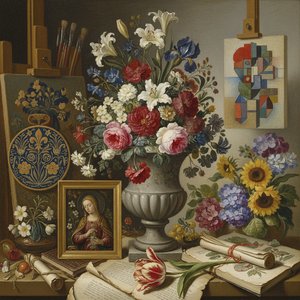
Rachel Ruysch's "Flower Still Life," painted in 1726, isn’t merely a depiction of blossoms; it’s a meticulously crafted meditation on beauty, mortality, and the burgeoning fascination with the natural world that defined the Dutch Golden Age. This exquisite work, now residing at the Toledo Museum of Art, offers a rare glimpse into the studio of one of the most celebrated female artists of her time – a woman who defied convention to establish herself as a master of botanical realism.
Ruysch’s artistic journey was profoundly shaped by her father, Frederik Ruysch, a renowned professor of anatomy and botany. He cultivated within their home not just a household but a living laboratory—a vast collection of preserved specimens, dissected animals, and meticulously documented plants. It was here that young Rachel developed an unparalleled eye for detail, learning to observe the subtle nuances of form, texture, and color with scientific precision. This early immersion instilled in her a deep respect for nature’s fragility and its inherent beauty – themes that would become central to her artistic vision.
The Language of Flowers: Symbolism and Technique
“Flower Still Life” exemplifies Ruysch's signature style, characterized by an almost obsessive attention to detail. The composition is dominated by a profusion of flowers—poppies in vibrant reds and oranges, delicate white roses, hollyhocks reaching for the light, and a host of other blooms arranged within a dark, shadowed niche. Each petal, leaf, and stem is rendered with astonishing accuracy, capturing the velvety texture of petals, the intricate veins of leaves, and the subtle gradations of color. Ruysch’s technique isn't simply about replicating what she sees; it’s about conveying an understanding of the flower’s very essence – its structure, its life cycle, and its inherent beauty.
Beyond mere representation, Ruysch imbues her paintings with symbolic meaning. The inclusion of insects—a bee diligently gathering pollen, a caterpillar crawling along a stem, and a butterfly alighting on a bloom—adds layers of interpretation. These creatures represent the transient nature of life, the cycle of decay and renewal, and the interconnectedness of all living things. The presence of a watch within the arrangement is particularly poignant, serving as a visual reminder of the fleeting passage of time – a hallmark of the *vanitas* genre, which explored themes of mortality and vanity.
A Reflection of its Time: The Dutch Golden Age
“Flower Still Life” is inextricably linked to the cultural context of the Dutch Golden Age. During this period, the Netherlands experienced an unprecedented economic boom fueled by trade and exploration. The nation became a global center for horticulture, importing exotic plants from around the world—including tulips, which had originated in Turkey. The tulip mania of 1637, a speculative bubble centered on these highly prized flowers, demonstrated the Dutch people’s fascination with beauty and their willingness to invest heavily in its pursuit. Ruysch's paintings capture this spirit of extravagance and connoisseurship, reflecting the wealth and sophistication of the era.
Bringing Ruysch’s Vision Home: Reproductions and Interior Design
Today, reproductions of “Flower Still Life” are highly sought after by collectors and interior designers alike. The painting's rich colors, intricate details, and evocative symbolism make it a captivating addition to any space. When selecting a reproduction, consider the quality of the materials used—a fine-art print on archival paper will ensure that the artwork’s beauty endures for generations to come. The dynamic composition and subtle interplay of light and shadow create a sense of depth and movement, adding a touch of elegance and sophistication to any room. Ruysch's masterpiece continues to inspire with its celebration of nature's beauty and its poignant reminder of life's fleeting moments.
Q&A
ラシェル・リュイス作「Flower Still Life」には何が描かれていますか?
ラシェル・リュイス作「Flower Still Life」に描かれているテーマには、flowers, dutch art, rachel ruysch, botanical, seventeenth century, composition, vanitasなどがあります。これらが合わさることで、本作の主題を構成しています。
ラシェル・リュイス作「Flower Still Life」は、有名な作品ですか?
ラシェル・リュイス作「Flower Still Life」 の人気度は Legendary です。この分類は、その作品がどの程度広く知られているかを表しています。
ラシェル・リュイス作「Flower Still Life」の著作権による複製は許可されていますか?
「Flower Still Life」の原画はToledo Museum of Artに所蔵されており、本作品はパブリックドメイン(著作権消滅)です。
More about this painting
 設置イメージを表示
 シェアする
シェアする シェアする
シェアする
 詳細を見る
詳細を見る ガイドを表示

 ダウンロード
 似ている作品
 X線調査
X線調査 スライドショーを表示
 Q&A
Q&A 統計情報
統計情報