

 設置イメージを確認
 送る
送る シェア
シェア
 詳細情報
詳細情報 ガイドを表示

 画像をダウンロード
 似ている作品
 X線調査
X線調査 スライドショー
 統計情報
統計情報REFORM, OR/A, B, C


 続きを読む
続きを読む
このページに掲載されている作品は著作権法によって保護されており、当社の許可なく同一の複製物を制作または販売することは法律で禁じられています。この保護は、以下のような国際条約に基づき執行されます。 ベルヌ条約 および、以下の条項に定められたものを含む各国の法律により、 米国著作権法 第17編。
敬意を払った法的な代替手段として、私たちはオリジナルにインスピレーションを与えられた、カスタムの手描きアートワークを提供しています。私たちの熟練したプロのアーティストは、元の作品が持つスタイル、情緒、そして芸術的なエッセンスを注意深く研究し、独自の創作物でありながら、同じ感性を呼び起こすような、新しくユニークな作品を作り上げます。
この手法は、著作権で保護された作品の複製や複写を伴わないため、著作権法に完全に準拠しています。これは単なる模倣ではなく、創造的な再解釈です。元の作品からインスピレーションを受けつつも、それとは異なる、全く新しい絵画を生み出すものです。
手描き油彩複製画
当社のアーティストが、お客様のご希望のサイズと額縁に合わせて、キャンバスに手描きで制作する油彩画です。 ( プリント版に切り替え デジタル画像販売へ切り替え)




































作品のオリジナル比率に合わせた、当店の規定サイズからお選びください。

フレームや壁のスペースに合わせて、ご希望の幅と高さを入力してください。本作品は手描きのため、異なる比率のサイズをご希望の場合、絵画の周囲を少し広げて描くか、あるいは端を少しカットして調整することが可能です。お客様のご要望に合わせます。制作を開始する前に、仕上がりを確認するためのデジタルモックアップをお送りいたします。このページに表示されている画像は完成品の実物ではなく、あくまでモックアップによるイメージです。
ご注文後、OriginalUniqueArt.com チームより詳細な指示をお送りするとともに、仕上がりイメージ(モックアップ)をご提供いたします。


 ガラスオプションは、110cm未満のサイズでのみご利用いただけます。

REFORM, OR/A, B, C
再現技法
複製画サイズ一覧
-


合計金額
¥ 47215
アーティストについて
Early Life and Architectural Roots
Peter Downsbrough, born in 1940 in New Brunswick, New Jersey, embarked on a creative journey that would ultimately dismantle conventional artistic boundaries. His initial pursuit of architecture at the universities of Cincinnati and New York laid the foundational stones for his later explorations into space, form, and perception. However, this formal training proved to be less an end goal than a catalyst—a starting point from which he diverged, abandoning traditional sculptural practices in favor of a more conceptual approach by 1961. This early shift signaled a nascent desire to move beyond the tangible object and delve into the very conditions that define our experience of place. The seeds of his minimalist aesthetic were sown during these formative years, an inclination towards reduction and essentiality that would become a hallmark of his oeuvre.The Emergence of Conceptual Space
Downsbrough’s artistic breakthrough in the late 1960s coincided with the rise of Conceptual Art, though he occupies a unique position within this movement. While sharing affinities with figures like Robert Barry and Sol LeWitt, his work distinguishes itself through its persistent engagement with language and typography. He began to systematically question the traditional objecthood of art, dismantling it in favor of phenomenological investigations into space. This manifested initially in sculptures that were radically simplified—forms stripped bare to their most fundamental elements. Soon after, these three-dimensional explorations expanded to encompass photography, site-specific interventions, artist’s books, and even audio works. A key characteristic of this period was the use of text, not as a descriptive element but as an integral component of the work itself, often arranged in ways that disrupted conventional reading patterns and forced viewers to reconsider their relationship with both language and space. His early books, such as *Notes on Location* (1972), became crucial platforms for these investigations, establishing parameters that would guide his practice for decades to come.A Language of Lines and Interventions
Throughout the 1980s and beyond, Downsbrough’s artistic vocabulary crystallized around a core set of motifs: lines, words, and spatial interventions. The iconic “Two Lines”—two parallel vertical lines—became a recurring element, appearing in various media as simple placements within space or as fragmented components of larger compositions. These lines weren't merely aesthetic devices; they functioned as markers, defining intersections between construction and perception. Simultaneously, his linguistic experiments intensified. He would often isolate words – conjunctions, prepositions, verbs, nouns—cutting them off, tilting them, or reflecting them to create graphic abstractions that simultaneously retained and lost meaning. This deliberate ambiguity invited viewers into a dialogue with the work, prompting them to actively decode its underlying structure. His interventions in urban landscapes further extended this exploration, inserting word blocks into filmed environments to disrupt spatial coherence and challenge conventional modes of viewing.Global Recognition and Enduring Influence
Downsbrough’s work has been exhibited extensively across the globe, including major institutions such as the Museum of Modern Art in New York, the Centre Pompidou in Paris, and the Tate Modern in London. He received the Prijs van de kritiek (Critics' Prize) from A.B.C.A. in 1981, solidifying his position within the international art community. His influence extends beyond the realm of visual art, impacting fields such as graphic design and typography. The artist’s books—of which he has produced over one hundred—are particularly noteworthy, demonstrating a sustained commitment to this medium as an essential form of artistic expression. He currently resides and works in Brussels, Belgium, continuing to refine his minimalist aesthetic and explore the complex relationship between language, space, and perception. Sadly, Peter Downsbrough passed away on August 10th, 2024, leaving behind a legacy that continues to inspire artists and challenge conventional notions of artistic representation. His work remains a testament to the power of reduction, the beauty of ambiguity, and the enduring importance of conceptual inquiry.Themes and Historical Significance
Downsbrough’s art operates at the intersection of several key historical movements—Minimal Art, Conceptual Art, and experimental poetry—yet it resists easy categorization. His work can be understood as a critical response to both the object-centricity of traditional sculpture and the representational constraints of conventional language. He sought to create works that didn't *describe* space but rather *concretized* it, fragmenting and intervening in the processes of representation itself. His exploration of spatial conditions, combined with his linguistic deconstruction, anticipated many of the concerns that would come to define postmodern art. The artist’s consistent use of black and white photography, simple geometric forms, and a limited color palette reflects a desire for austerity and clarity—a rejection of visual excess in favor of essentiality. Downsbrough's legacy lies in his ability to transform the mundane into the meaningful, challenging viewers to actively engage with their surroundings and question the very nature of perception. His work serves as a powerful reminder that art is not merely about what we see, but how we see it—and the language through which we interpret the world around us.
Peter Downsbrough
1940 - , United States of America
アーティスト情報
- Full Name: Peter Downsbrough
- Nationality: American
- Date Of Birth: 1940
- Place Of Birth: New Brunswick (New Jersey), United States of America
- Notable Artworks:
- Two Lines
- Now With
- Artistic Movement Or Style: Conceptual Art, Minimalism
- Artists Who Influenced This Artist:
- Robert Barry
- Sol LeWitt
関連記事

Beyond the Lens: Photography's Enduring Influence on Modern & Contemporary Art
Explore photography's pivotal role in shaping modern & contemporary art. Discover key movements, influential artists like Stieglitz, and expert collecting advice from OriginalUniqueArt.

Pictorialism: A Search for Artistic Photography's Soul – Aesthetics, Techniques & Legacy
Explore the captivating world of Pictorialism – a pivotal movement that transformed photography into fine art. Discover key artists like Stieglitz & Käsebier, techniques, and collecting tips from experts.
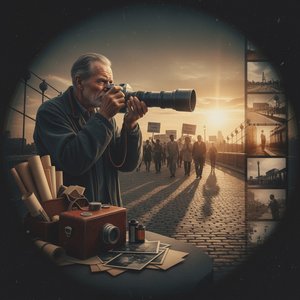
Witnessing History Through Lens & Light: Documentary Photography's Enduring Legacy
Explore the powerful history of documentary photography – from its origins to contemporary masters like Gordon Parks & W. Eugene Smith. Discover how this art form shapes our understanding of society and witness pivotal moments in time.

The Lens of Truth: A Comprehensive History and Legacy of Documentary Photography
Explore the profound history of documentary photography. From early daguerreotypes to social reform movements, discover how the lens captures truth, preserves vanishing cultures, and shapes our global visual narrative through an expert art-historical lens.

Monochrome Visions: Exploring the Aesthetic & Historical Significance of Black & White Photography
Explore the rich history & artistic power of black and white photography. From early techniques to iconic masters like Ansel Adams, discover why monochrome continues to captivate art lovers today. Expert insights for collectors.