 設置イメージを表示
 シェアする
シェアする シェアする
シェアする
 詳細を見る
詳細を見る ガイドを表示

 ダウンロード
 似ている作品
 X線調査
X線調査 スライドショーを表示
 Q&A
Q&A 統計情報
統計情報Color


 詳細を表示
詳細を表示
このページに掲載されている作品は著作権法によって保護されており、当社の許可なく同一の複製物を制作または販売することは法律で禁じられています。この保護は、以下のような国際条約に基づき執行されます。 ベルヌ条約 および、以下の条項に定められたものを含む各国の法律により、 米国著作権法 第17編。
この手法は、著作権で保護された作品の複製や複写を伴わないため、著作権法に完全に準拠しています。これは単なる模倣ではなく、創造的な再解釈です。元の作品からインスピレーションを受けつつも、それとは異なる、全く新しい絵画を生み出すものです。
ジークレー/アートプリント
スピーディーな制作と多彩な仕上げオプションが魅力の、ミュージアムクオリティなジークレー・キャンバスプリント。 ( 手描き複製画を注文する デジタル画像販売へ切り替え)




P118B ¥10

P118H ¥10

P118W ¥10

P438Z ¥10

P508JH ¥12

P508YH ¥12

P805H ¥10

P805Z ¥10

P919BZ ¥10

P919G ¥10

P919XJ ¥10

P959ZH ¥10

P968JZ ¥12

W106C ¥8

W218G ¥10

W218JH ¥8

W218Y ¥10

W307PJ ¥10

W316G ¥10

W316PJ ¥8

W316Y ¥10

W398PJ ¥8

W4111J ¥10

W500HY ¥15

W500JH ¥15

W692G ¥12

W849H ¥8

W940BG ¥15

W953PJ ¥8




作品のオリジナル比率に合わせた、当店の規定サイズからお選びください。

額縁や壁のスペースに合わせて、ご希望の幅と高さを入力してください。プリントはカットすることは可能ですが、元の画像より大きくすることはできないため、異なる比率のサイズを選択された場合は、画像の一部が欠けることになります。印刷を開始する前に、内容を確認していただくためのデジタルモックアップをお送りいたします。このページに表示されている画像は、実際のカット後の状態を示すものではありません。実際の仕上がりはモックアップにてご確認ください。


 ガラスオプションは、110cm未満のサイズでのみご利用いただけます。

Color
ジークレー/アートプリント
複製画サイズ一覧
-


合計金額
¥ 12617
A Symphony of Pigment and Form
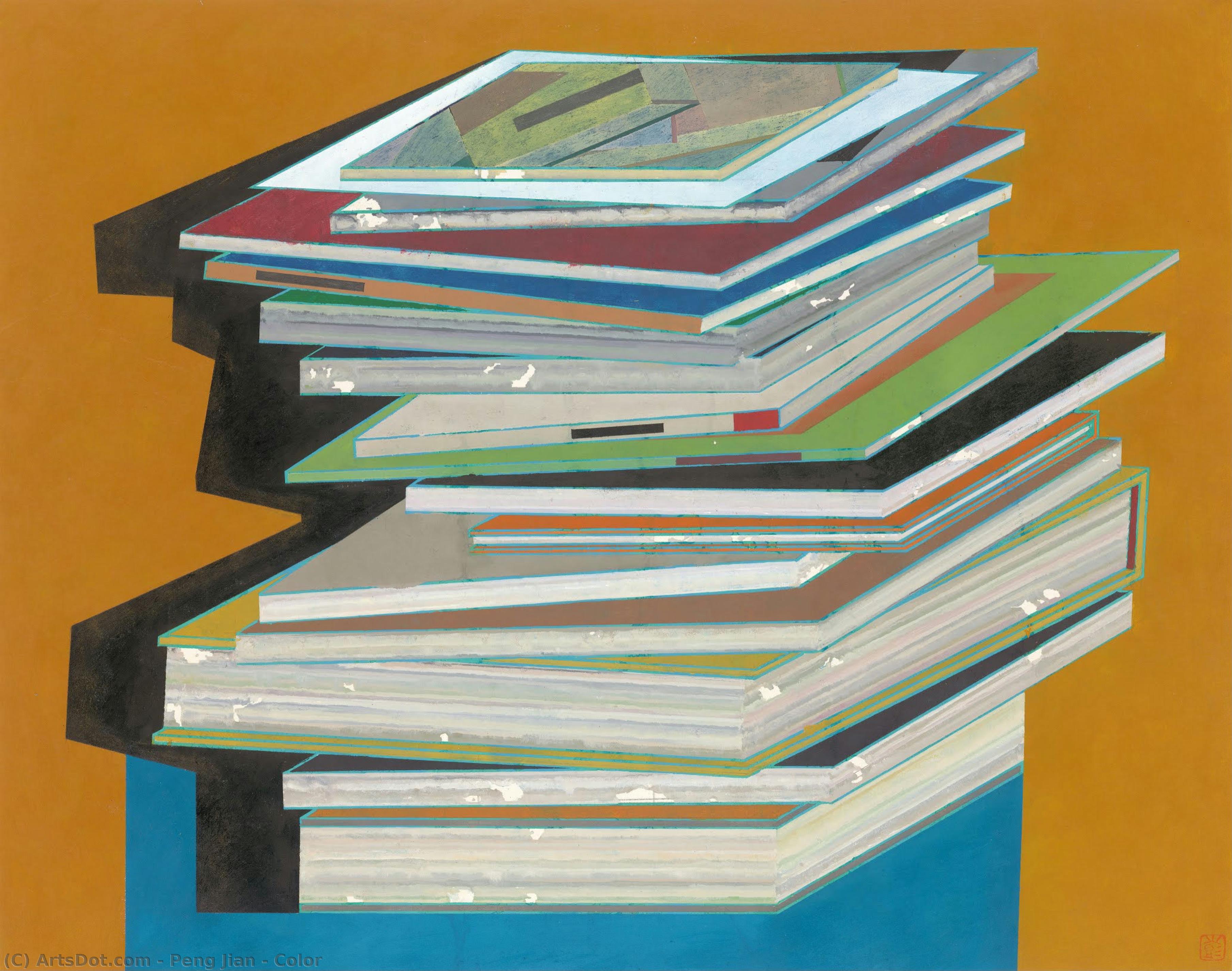
In the mesmerizing painting Color, created in 2016, the artist Peng Jian invites us into a world where the mundane becomes extraordinary through the lens of contemporary abstraction. At first glance, the viewer is met with a captivating arrangement of stacked books, yet this is far from a mere still life. The work functions as a vibrant exploration of depth, weight, and chromatic harmony. Each book, rendered with meticulous attention to detail, serves as a building block in a larger architectural composition. As the eye wanders across the various layers, one notices how the artist plays with the tension between horizontal stability and vertical aspiration, creating a rhythmic dance of shapes that feels both structured and spontaneous.
The technique employed in this piece is a masterclass in utilizing color to define space. Peng Jian utilizes a palette that is as diverse as it is daring, weaving together intense primary hues with subtle, nuanced tones. The way the light seems to catch the edges of the spines and the textures of the covers suggests a tactile reality, pulling the viewer into the physical presence of the objects. Through careful layering and the strategic use of contrast, the artist achieves a sense of three-dimensionality that transcends the flat surface of the canvas. This interplay of light and shadow does more than just define form; it breathes life into the inanimate, transforming a simple collection of literature into a pulsating, living entity.
The Intersection of Tradition and Modernity
To understand the profound impact of Color, one must consider Peng Jian’s unique position within the lineage of Chinese contemporary art. Trained at the prestigious Central Academy of Fine Arts in Beijing, the artist possesses a deep-seated respect for classical foundations, which he masterfully deconstructs through a modern, geometric lens. In this work, the concept of "composition" takes on a new meaning; it is not merely about the placement of objects, but about the balance of energy and the dialogue between different visual weights. The books, often symbols of knowledge and history, are stripped of their literal text and reimagined as pure geometric units—rectangles, squares, and lines that contribute to a larger, abstract symphony.
For the discerning collector or interior designer, this painting offers much more than aesthetic pleasure; it provides a focal point of intellectual and emotional depth. The piece possesses a versatile energy that can anchor a sophisticated gallery space or add a layer of cultured vibrancy to a modern residential setting. It speaks to the beauty of organized chaos and the joy found in the accumulation of color and form. Owning a high-quality reproduction of this work means bringing into one's environment a fragment of Peng Jian’s profound inquiry into how we perceive the world—not just as a collection of objects, but as a continuous, colorful flow of interconnected experiences.
Q&A
Peng Jian作「Color」には何が描かれていますか?
Peng Jian作「Color」に描かれているテーマには、books, still life, geometric, vibrant colors, abstract, stacked books, patternedなどがあります。これらが合わさることで、本作の主題を構成しています。
Peng Jian作「Color」 に近い雰囲気の作品を探すには?
「Color」に似た作品は、こちらの関連作品ページでご覧いただけます。
Peng Jian作「Color」 の技法(画材)は何ですか?
Peng Jianは、「Color」においてPaintingの技法を用いています。この技法が、原画の素材としての性質を決定づけています。
作家プロフィール
Peng Jian: A Symphony of Geometry and Color
Born in Beijing in 1964, Peng Jian’s artistic journey is a fascinating exploration of the intersection between traditional Chinese aesthetics and contemporary abstraction. His work, instantly recognizable for its bold colors, intricate geometric arrangements, and subtle references to classical art, has garnered significant attention within both the domestic Chinese art scene and internationally. From humble beginnings, Peng Jian's career reflects a deliberate evolution, marked by a deep engagement with artistic history while forging a distinctly personal visual language.
Peng Jian’s formal training began at the Central Academy of Fine Arts in Beijing, a prestigious institution that shaped many leading Chinese artists. He graduated with both a Bachelor of Fine Arts degree (1987) and a Master of Fine Arts degree (1990), providing him with a solid foundation in traditional painting techniques while simultaneously exposing him to the burgeoning avant-garde movements within China. This dual influence – the legacy of Song Dynasty landscape painting and the experimentation of later 20th-century abstraction – is central to understanding his artistic approach.
The Language of Geometry
At the heart of Peng Jian’s work lies a fascination with geometry, particularly its capacity to evoke spatial relationships and create dynamic compositions. He frequently employs interlocking grids, repeating patterns, and meticulously arranged shapes—often inspired by the architectural principles found in traditional Chinese art – to construct his paintings. These geometric forms aren't merely decorative; they function as a visual vocabulary, conveying ideas of balance, harmony, and even tension. His early works often featured simple cubes and boxes, gradually incorporating more complex elements like books, bottles, and other everyday objects, creating a layered dialogue between the familiar and the abstract.
A key element in Peng Jian’s process is his deliberate use of color. He eschews bright, saturated hues in favor of a restrained palette—primarily grays, blues, and whites—that lends a sense of quiet contemplation to his paintings. These muted tones are juxtaposed with the sharp angles and precise lines of the geometric forms, creating a compelling visual contrast. This careful orchestration of color and form is not simply aesthetic; it’s deeply rooted in Chinese ink painting traditions, where tonal variations and subtle gradations of value were used to create depth and atmosphere.
Influences and Artistic Development
Peng Jian's artistic development has been shaped by a diverse range of influences. He cites the work of Japanese Mono-ha artists—a movement that emphasized the materiality of objects—as a significant inspiration, particularly their focus on direct observation and the inherent qualities of materials. Furthermore, his engagement with Song Dynasty landscape painting – characterized by its meticulous detail, atmospheric perspective, and emphasis on capturing the essence of nature – is evident in his use of line and space.
His work has evolved considerably over time. Early pieces were largely focused on simple geometric forms, while more recent works incorporate a wider range of subjects—including books, bottles, and other everyday objects—creating a richer and more complex visual narrative. The “Seven Falling Color Pieces” series, for example, demonstrates his willingness to experiment with new techniques and approaches, pushing the boundaries of his established style.
Recognition and Legacy
Peng Jian’s work has been exhibited extensively both in China and abroad, including at prestigious institutions such as the National Art Museum of China, the Today Art Museum in Beijing, and the Museum of Contemporary Art in Shanghai. His paintings are held in numerous private and public collections, reflecting his growing recognition within the art world.
Peng Jian’s contribution to contemporary Chinese art lies in his ability to synthesize traditional aesthetics with modern abstraction. He has created a unique visual language that is both intellectually stimulating and emotionally resonant, inviting viewers to contemplate the relationship between form, color, and meaning. As an artist deeply rooted in Chinese artistic history while simultaneously embracing innovation, Peng Jian continues to be a significant voice within the evolving landscape of contemporary art.

Peng Jian
1964 - , China
プロフィール概要
- Artistic Movement Or Style: Contemporary abstraction and geometry
- Artists Who Influenced This Artist: ['Song Dynasty landscape painters']
- Full Name: Peng Jian
- Nationality: Chinese
- Notable Artworks:
- Color
- Balance
- Place Of Birth: Beijing, China
- Date Of Birth: 1964
関連記事

Neo-Abstract Art: The High-Impact Evolution of Modern Visual Energy and Geometric Sophistication
Discover the power of Neo-Abstract art. Explore how bold geometric forms and high-impact visual energy are redefining modern design. Learn to curate sophisticated, high-energy spaces with the latest trends in contemporary abstraction and structural color.
Beyond Form & Color: Geometric Abstraction's Enduring Legacy in Art History
Explore the captivating world of geometric abstraction! Discover its origins, key artists like Malevich & Mondrian, and why this movement remains highly valued by art collectors today. Expert insights at OriginalUniqueArt.

Beyond Form & Color: Geometric Abstraction's Evolution in 20th/21st Century Art
Explore the evolution of geometric abstraction from Cubism to contemporary art. Discover key artists like Malevich & Mondrian, investment insights, and expert collecting advice at OriginalUniqueArt.

Mastering Abstraction: The 25 Most Iconic Works by Wassily Kandinsky
Explore 25 iconic Kandinsky masterpieces and the birth of abstraction. Discover the full collection online at OriginalUniqueArt.com.

幾何学的抽象絵画を定義した傑作10選|アート、アーティスト、インテリア装飾
モンドリアン、マレーヴィチ…幾何学的抽象絵画を代表する傑作10選。各作品の背景や色彩構成、アーティストの情熱に迫ります。美術館品質の複製画はOriginalUniqueArt.comで。オンラインでアートコレクションをご覧ください。