 設置イメージを表示
 シェアする
シェアする シェアする
シェアする
 詳細を見る
詳細を見る ガイドを表示

 ダウンロード
 似ている作品
 X線調査
X線調査 スライドショーを表示
 Q&A
Q&A 統計情報
統計情報Blue (Moby Dick)


 詳細を表示
詳細を表示
ウェブ上のプレビューを遥かに凌駕する、印刷に最適なファイルをご提供します。当サイトで販売しているすべてのデジタル画像は、弊社のデータベース内にある高解像度のマスターデータ(通常、幅5,000〜15,000ピクセル)から作成されています。そのため、大判印刷や大胆なクロップ、細部まで緻密な再現も、安心してお楽しみいただけます。
当スタジオから送り出される画像は、すべて丁寧に加工されています。デジタルエキスパートが原画と照らし合わせて色調を精査し、必要に応じて補正を行った上で、プロ仕様のリタッチツールを用いて鮮明さと細部を向上させます。その際、アーティストの筆致やスタイルに忠実であることを常に追求しています。その結果、単なるスキャン画像にフィルターをかけたようなものではなく、まるで本物の絵画を見ているかのような仕上がりを実現しています。
仕上がりをご確認いただいてから完了となります。専門スタッフが、ご確認用の画像を72時間以内にメールでお送りいたします。もしご満足いただけない場合は、修正や改善のご要望を承るほか、品質が基準に満たない場合には返金も可能です。
出版社、デザインスタジオ、ギャラリー、そして印刷所から信頼される品質です。
デジタルアート
個人での鑑賞、印刷、クリエイティブなプロジェクトにご利用いただける高解像度ファイルをダウンロードできます。 ( プリント版に切り替え 手描き複製画を注文する)
デジタル画像のご注文に付随する特典
確かな品質による、プロフェッショナルなデジタル配信
OriginalUniqueArt.com を選ぶことは、単に画像を手に入れることではありません。プロの手によって精密に仕上げられ、満足保証が付いた高品質なデジタルアートワークを受け取ることを意味します。ご注文いただいた際に自動的に付随する内容は、以下の通りです:

メールですぐにお届け
ご注文から72時間以内に、高解像度のデジタル画像ファイルをメールでお送りいたします。お手元に届き次第、すぐにご利用いただけます。

AI技術で最適化されたデジタルファイル
お客様の作品は、高度なAI技術と専門家による手作業を組み合わせてプロフェッショナルに最適化されており、細部のディテール、鮮明さ、そして正確な色再現性を最大限に引き出しています。

生涯無料の再送サービス
ファイルを誤って削除したり、紛失してしまったりしましたか?ご安心ください。いつでも無料で再送いたします。

輸入手数料は、いつでも一切かかりません
関税や手数料、配送料を気にすることなく、お気に入りのアートワークをすぐにお楽しみいただけます。デジタルダウンロードは常に免税です。

正確な色彩の保証
プロ仕様のツールとカラーマネジメント技術を用いることで、デジタル画像が元の色を最大限に忠実に再現することを保証いたします。

100日間満足保証
ご購入いただいたデジタル画像にご満足いただけない場合は、100日以内であれば、理由を問わず修正または100%の返金対応をさせていただきます。

100% 返金保証
ご満足いただけない場合は、デジタルファイルを受け取ってから100日以内であれば、理由を問わず全額返金いたします。

まとめ買い割引
3枚購入で10%OFF、5枚購入で15%OFF、10枚以上のご購入で20%OFF。クリエイティブなプロジェクトやギャラリー、エージェンシーに最適です。
The Echoes of Moby Dick: Jackson Pollock’s Blue Abstraction
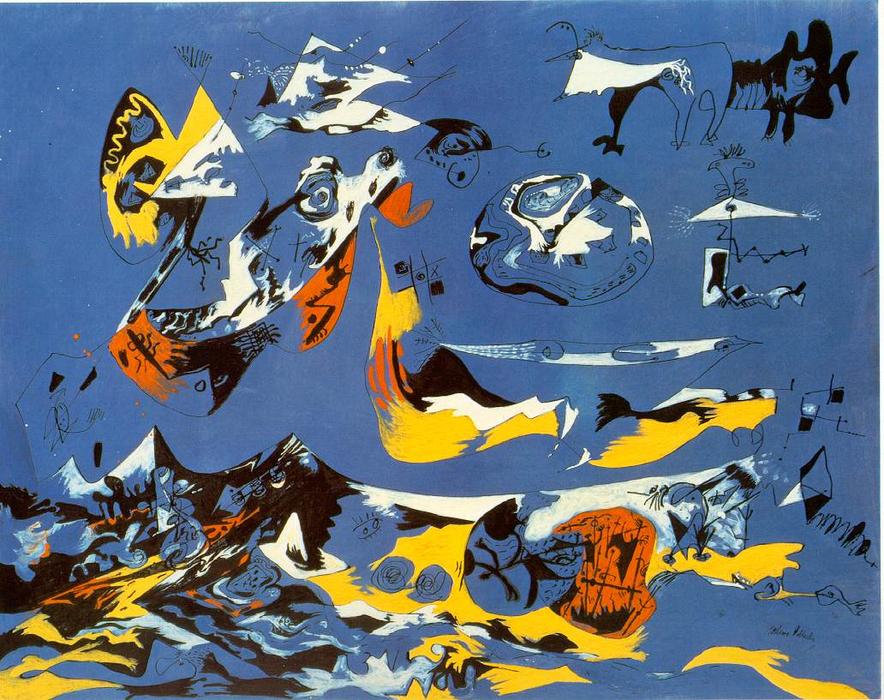
Jackson Pollock's “Blue (Moby Dick),” painted in 1943, isn’t merely a canvas splashed with color; it’s an immersive experience, a visual embodiment of the anxieties and primal forces that fueled Herman Melville’s epic tale. This work, residing within the Ohara Museum of Art in Kurashiki, Japan, stands as a pivotal moment in the trajectory of Abstract Expressionism, revealing Pollock's unique approach to translating complex emotions onto the canvas. It’s a piece that invites prolonged contemplation, rewarding viewers with layers of meaning and a profound sense of unease – mirroring, perhaps, the relentless pursuit of the unattainable.
Initially conceived as “Moby Dick,” the painting quickly underwent a transformation, reflecting Pollock's evolving artistic process and his engagement with psychological theories. The early iteration, a more explicitly figurative work, was deemed too constrained by conventional representation. Pollock, influenced by Jungian psychology and seeking to express raw emotion rather than depict concrete forms, abandoned this initial approach, opting instead for an all-over composition that prioritized the act of painting itself. This shift marked a crucial step toward his signature “drip” technique – a method where paint was poured, dripped, and flung onto the canvas from above, creating a dynamic web of color and texture.
A Symphony in Blue: Technique and Composition
The dominant hue is, unsurprisingly, blue—a deep, resonant shade that immediately establishes a mood of mystery and depth. However, this isn’t a simple monochromatic statement. Pollock masterfully employs a range of complementary colors – vibrant yellows, stark whites, and touches of black and orange – to create a swirling, almost turbulent effect. These contrasting hues aren't juxtaposed in a static manner; instead, they bleed into one another, suggesting movement, chaos, and the relentless power of nature. The composition itself is deliberately ambiguous, featuring amorphous shapes that evoke marine life—fish, whales, perhaps even the ominous form of Moby Dick himself—suspended within a dynamic field of color.
Pollock’s technique is central to the painting's impact. He utilized a mixed medium of gouache and ink on composition board, allowing for both precision and spontaneity. The “drip” method, perfected over years of experimentation, allowed him to bypass traditional brushstrokes, creating an immediate connection between his body and the artwork. The resulting surface is not smooth or polished; it’s textured, layered, and imbued with a palpable energy—a testament to the physicality of the act of painting.
Decoding the Symbolism: Melville and the Unconscious
While Pollock himself remained notoriously reticent about interpreting his work, scholars have identified several symbolic connections between “Blue (Moby Dick)” and Melville’s novel. The recurring motif of the table—a subtle yet persistent element within the composition—can be interpreted as a representation of the human psyche, a space where conflicting forces collide. The figures that populate the painting are not clearly defined; they exist in a state of flux, mirroring the instability and uncertainty inherent in the pursuit of knowledge and understanding – a key theme in *Moby Dick*.
Furthermore, the painting’s intense emotionality—the sense of dread, obsession, and ultimately, futility—resonates with the novel's exploration of human ambition and the limitations of reason. The whale itself, a symbol of both power and destruction, looms large in the subconscious of the viewer, prompting questions about humanity’s relationship to nature and its own destructive tendencies. It is believed that Pollock was influenced by Melville’s work, perhaps even drawing parallels between his own struggles with alcoholism and Ahab's relentless pursuit.
A Legacy of Emotion: Reproductions and Beyond
“Blue (Moby Dick)” stands as a powerful example of Abstract Expressionism’s ability to evoke profound emotional responses. OriginalUniqueArt offers meticulously hand-painted reproductions that capture the essence of this iconic work, allowing you to experience its depth and complexity firsthand. These reproductions faithfully recreate Pollock's dynamic technique and vibrant color palette, bringing the painting’s raw energy into your space. Whether displayed in a contemporary setting or as a thoughtful addition to a classic interior, a reproduction of “Blue (Moby Dick)” serves as a constant reminder of the power of art to challenge our perceptions and connect us to the deepest recesses of human emotion.
Explore OriginalUniqueArt’s collection of Jackson Pollock reproductions today and discover how you can bring this masterpiece into your world. View “Blue (Moby Dick)” reproduction here
Q&A
ジャクソン・ポロック作「Blue (Moby Dick)」は、お部屋にどのような彩りを添えてくれるでしょうか?
Calmな雰囲気を持つ「Blue (Moby Dick)」は、Living Roomに飾るのがおすすめです。
ジャクソン・ポロック作「Blue (Moby Dick)」の活用方法や、おすすめの設置スペースについて教えてください。
ジャクソン・ポロック作「Blue (Moby Dick)」はStatementに最適で、Living Roomに飾るのが特におすすめです。用途と空間の組み合わせによって、複製画を飾るのにふさわしい場所をご提案します。
その色彩から、ジャクソン・ポロック作「Blue (Moby Dick)」 はどの部屋に飾るのがおすすめですか?
Darkの色彩を纏ったジャクソン・ポロック作「Blue (Moby Dick)」は、Living Roomに飾るのがおすすめです。その色使いこそが、この提案の理由のひとつです。
作家略歴
生い立ちと革新の萌芽
1912年、ワイオミング州コーディに生まれたポール・ジャクソン・ポロックは、生まれつき落ち着きのない性格でした。彼の幼少期は、父がアメリカ西部の広大な土地を測量するために頻繁に移住したことで特徴づけられます。この定住しない生活様式は、若いポロックに自然界との深い繋がりと、測量旅行中に遭遇する多様な文化への触れ合いを与えました。特にネイティブ・アメリカンの芸術との出会いは、その後の彼の芸術的ビジョンに微妙に浸透していきます。彼は先住民のスタイルを模倣することはありませんでしたが、初期の経験から得られた生々しいエネルギーと精神的な共鳴は、間違いなく彼の作品に痕跡を残しました。
ポロックの正式な芸術教育は、ロサンゼルスのマニュアル・アーツ高校で始まり、その後ニューヨークのアート・スチューデンツ・リーグでトーマス・ハート・ベントンの指導を受けました。地域主義運動の著名な人物であったベントンは、アメリカの生活に根ざしたリズミカルな構成と物語的なテーマを重視しました。ポロックは当初これらの教訓を取り入れましたが、彼の本質的な傾倒はより抽象的な探求へと向かっていました。また、メキシコの壁画家ホセ・クレメンテ・オロスコの作品にも深く感銘を受けました。オロスコの力強い社会闘争の描写は、彼に深い共鳴を与えました。これらの初期の影響が基礎を築きましたが、台頭しつつあったシュルレアリスムこそが、ポロックの芸術的潜在能力を真に解き放ったのです。
アクション・ペインティングの誕生と革新的な技法
1930年代、ポロックは伝統的な筆致に代わる手法を模索し、様々な実験を行いました。彼は絵具を注ぎ始め、その流動性と予測不可能な性質を探求しました。しかし、1947年頃になると、彼の芸術的軌跡は劇的な変貌を遂げます。ポロックはイーゼルを完全に放棄し、キャンバスを直接床に置き、彼が「ドリッピング技法」として知られるようになるものを開始しました。そして彼は、上からキャンバスに絵具を滴らせ、飛び散らし、投げつけました。
これは単なる絵具の塗布ではありませんでした。それは創造行為そのものを体現することについてでした。ポロックのキャンバスは、アーティスト、媒体、表面とのダイナミックなダンスを描くための舞台となりました。このプロセスは、彼の身振りや感情を捉え、即時性を表現する物理的な表現の場となりました。結果として生まれた絵画は、「オールオーバー」構成によって特徴づけられます。これは中心的な焦点がないため、鑑賞者はエネルギーの統一されたフィールドとしてキャンバス全体を探求することを促します。複雑な線と色のネットワークが絡み合い、魅惑的でありながら挑戦的な視覚的な複雑さを生み出しています。
この革新的なアプローチは、第二次世界大戦後のニューヨーク市で台頭した抽象表現主義運動において、ポロックを中核的な人物として位置づけました。抽象表現主義は、自発的なジェスチャー、大規模なスケール、非代表的なイメージを優先し、伝統的な芸術的慣習から離れたより広範な文化的転換を反映していました。彼とアーティストのリー・クラズナーとの結婚も極めて重要でした。彼女は揺るぎない精神的なサポートを提供し、彼の作品の画期的な性質を認識して、彼の芸術的発展を積極的に奨励しました。
象徴的な作品と永続的な遺産
ポロックの最も有名な作品—Number 1, 1950 (Lavender Mist)、One: Number 31, 1950、Blue Poles: Number 11, 1952、そしてConvergence—は、彼の革命的な技法の証です。これらの絵画は単なるイメージではありません。それらはアーティストの物理的な存在と感情が込められたパフォーマンスの記録なのです。これらのキャンバスから発せられるダイナミックなエネルギーは触知でき、鑑賞者を純粋な抽象の世界へと引き込みます。
彼のスタイルは単なる美学を超越しています。それはプロセスよりも製品を探求するものです。ポロックは、伝統的な構成や表現の概念を拒否し、キャンバスに自身の行動と感情の即時性を捉えようとしました。彼はユング心理学にも深く入り込み、芸術における原型と潜在意識を探求し、普遍的なシンボルと原始的なエネルギーに触れようとしました。
ポロックが芸術史に与えた影響は計り知れません。彼はアーティストが絵画に取り組む方法を根本的に変え、イーゼルベースの方法から脱却し、よりパフォーマンス的なアプローチを受け入れました。彼の作品はニューヨーク市が現代美術の世界の中心地としての地位を確立するのに役立ち、ヨーロッパの優位性から焦点を移しました。彼の影響は、カラーフィールド絵画や抽象表現主義のその後の形態に関連する多くのアーティストの作品に見られます。
当初は賛否両論があり—一部の批評家は彼の作品を混沌としているか、技術に欠けていると一蹴しましたが—ポロックの名声は1956年に44歳で早逝した後、着実に高まりました。今日、彼は20世紀で最も重要かつ影響力のあるアーティストの一人として普遍的に認められています。彼は慣習に挑戦し、芸術的表現の境界を再定義することを敢行した先見者です。彼の革新的な技法と表現豊かなスタイルは、今後何世代にもわたってインスピレーションを与え続け、その永続的な遺産を確かなものとしています。

ジャクソン・ポロック
1912 - 1956 , アメリカ合衆国
プロフィール概要
- Artistic Movement Or Style: 抽象表現主義
- Artists Or Movements Influenced By This Artist:
- カラーフィールド絵画
- 抽象表現主義
- Artists Who Influenced This Artist:
- ホセ・クレメンテ・オロスコ
- アンドレ・マソン
- マックス・エルンスト
- トーマス・ハート・ベントン
- Date Of Birth: 1912年1月28日
- Date Of Death: 1956年8月11日
- Full Name: ポール・ジャクソン・ポロック
- Nationality: アメリカ人
- Notable Artworks (List Of Titles):
- ナンバー1, 1950(ラベンダーミスト)
- One: Number 31, 1950
- Blue Poles: Number 11, 1952
- Convergence
- Place Of Birth (City And Country): アメリカ合衆国、コディ