プリント版に切り替え
 続きを読む
続きを読む







































 いずれかの辺が105 cm(約41インチ)を超えるアートワークまたは複製画の場合、フレームは分解されたキットの状態でお届けいたします。この方法は、輸送中の破損を防ぎ、安全に配送するために採用しております。


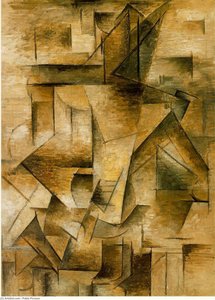
Violin ''Jolie Eva'' – A Fragmented Portrait of Musical Passion
Pablo Picasso’s ‘Violin Jolie Eva’, completed in 1912, stands as a cornerstone of Cubist art and a poignant exploration of artistic innovation amidst personal turmoil. Currently residing at the Staatsgalerie Stuttgart, Germany, this deceptively simple oil painting transcends mere representation, inviting viewers into a complex dialogue about perception, emotion, and the transformative power of geometric abstraction.
- The Movement: Cubism emerged from Picasso’s collaboration with Georges Braque in 1907-1914, rejecting traditional perspective and striving to depict subjects from multiple viewpoints simultaneously. It wasn't merely a stylistic choice; it was a philosophical assertion that reality itself is multifaceted and cannot be captured accurately by conventional artistic conventions.
- Composition & Fragmentation: Picasso meticulously dissects the violin – its form fractured into angular planes—creating an illusion of depth without relying on linear recession. The violin’s parts appear to overlap, mirroring the fragmented nature of experience during this period of Picasso's life and reflecting the broader Cubist preoccupation with breaking down visual hierarchies.
- Symbolism Beyond Form: Scattered around the violin are books—a deliberate inclusion that speaks to intellectual curiosity and perhaps hints at Picasso’s own fascination with literature. The figures flanking the violin contribute to this layered symbolism, suggesting contemplation and observation rather than straightforward depiction. They embody a quiet intensity, mirroring the contemplative mood of the artwork.
Technique & Artistic Vision
Picasso employs loose brushstrokes—characteristic of his early Cubist phase—to convey texture and dynamism. The muted color palette – dominated by earthy tones accented with subtle hints of yellow, orange, and blue – reinforces the painting’s understated elegance. Careful attention to detail is evident in the rendering of the violin's surface, demonstrating Picasso’s unwavering commitment to mastering his craft while simultaneously pushing artistic boundaries.
Historical Context & Influence
'Violin Jolie Eva' was created during a period of intense artistic experimentation and intellectual ferment. Picasso wrestled with grief following the death of his friend Casagemas and sought solace in art—a process that profoundly shaped his creative output. This painting exemplifies the broader cultural shift toward abstraction, foreshadowing developments in Surrealism and Expressionism and cementing Picasso’s position as one of the most influential artists of the 20th century.
Emotional Resonance & Artistic Legacy
More than just a visual representation, ‘Violin Jolie Eva’ communicates an emotional depth that captivates viewers. The painting's stillness juxtaposed with its fractured form invites contemplation on themes of beauty, loss, and the elusive nature of perception. Picasso’s masterful manipulation of space and color ensures that this artwork continues to resonate powerfully with audiences today—a testament to his enduring artistic vision.
よくあるご質問
ご購入前に、パブロ・ピカソ作「Violin ''Jolie Eva''」 をご自身の壁に飾った様子を確認することはできますか?
「Violin ''Jolie Eva''」は、拡張現実(AR)でのプレビューが可能です。対応デバイスで作品のARプレビューページを表示すると、ご自身の空間に作品を配置してご確認いただけます。
パブロ・ピカソ作「Violin ''Jolie Eva''」のコントラストはどの程度強いですか?
パブロ・ピカソ作「Violin ''Jolie Eva''」は、明部と暗部の間にGentleなコントラストを描き出しています。
「Violin ''Jolie Eva''」において、コントラストと調和はどのように組み合わさっているのでしょうか?
パブロ・ピカソ作「Violin ''Jolie Eva''」の色彩構成は、GentleなコントラストとUnified Paletteな調和を併せ持っています。
More about this painting
 設置イメージを確認
 送る
送る シェア
シェア
 詳細情報
詳細情報 ガイドを表示

 画像をダウンロード
 似ている作品
 X線調査
X線調査 スライドショー
 Q&A
Q&A 統計情報
統計情報