プリント版に切り替え
 詳細を表示
詳細を表示







































 いずれかの辺が105 cm(約41インチ)を超えるアートワークまたは複製画の場合、フレームは分解されたキットの状態でお届けいたします。この方法は、輸送中の破損を防ぎ、安全に配送するために採用しております。


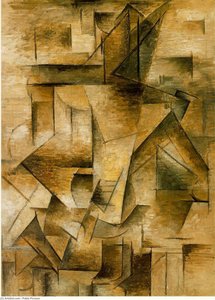
Subject and Composition of "Bottle, Glass, Violin"
"Bottle, Glass, Violin," created by Pablo Picasso in 1912, is a quintessential example of Synthetic Cubism. The artwork presents a still life arrangement featuring a bottle, a glass, and a violin placed upon what appears to be a tabletop. These objects are not depicted realistically but rather fragmented and reassembled into an abstract composition. The background remains muted, allowing the viewer's focus to remain firmly on the interplay of shapes and forms that constitute the subject matter.
Synthetic Cubism: A Revolutionary Style
Picasso’s work exemplifies Synthetic Cubism, a phase within the broader Cubist movement that emerged around 1912. Unlike earlier Analytic Cubism which focused on dissecting objects into their component parts, Synthetic Cubism introduced elements of collage and papier collé. This shift allowed artists to incorporate real-world materials directly into their artwork, blurring the lines between painting and sculpture. Picasso’s use of charcoal and what appears to be cardboard or textured paper in "Bottle, Glass, Violin" demonstrates this innovative approach. The style challenges traditional notions of representation, inviting viewers to actively engage with the artwork and reconstruct its meaning.
Historical Context and Influences
The creation of “Bottle, Glass, Violin” coincided with a period of significant artistic experimentation in Europe. Cubism itself was born from Picasso’s collaboration with Georges Braque, reacting against the conventions of Impressionism and Post-Impressionism. The early 20th century witnessed rapid technological advancements and societal shifts, which influenced artists to explore new ways of depicting reality. Synthetic Cubism reflected this spirit of innovation, embracing abstraction and challenging established artistic norms. The incorporation of everyday objects like a bottle, glass, and violin further emphasized the movement's desire to integrate art with modern life.
Symbolism and Emotional Impact
While seemingly simple in its subject matter, "Bottle, Glass, Violin" carries layers of symbolic meaning. The fragmented forms can be interpreted as representing the instability and complexity of modern existence. The violin, a symbol of music and harmony, is juxtaposed with the more utilitarian objects—the bottle and glass—creating a visual tension that reflects the contradictions inherent in contemporary society. Emotionally, the artwork evokes a sense of intellectual curiosity and invites contemplation. The muted palette and geometric forms create a calm yet stimulating atmosphere, encouraging viewers to actively participate in deciphering its meaning.
Technical Aspects and Artistic Merit
Picasso’s masterful use of charcoal is evident throughout the piece. The lines are bold and decisive, defining the fragmented shapes with precision. The incorporation of collage elements adds texture and depth, further enhancing the artwork's visual complexity. "Bottle, Glass, Violin" stands as a testament to Picasso’s genius and his pivotal role in shaping the course of 20th-century art. Its innovative approach to composition, its exploration of new materials, and its enduring emotional impact solidify its place as a landmark achievement within the Cubist movement.
Q&A
「Bottle, glass, violin」を特徴づける配色と、主役となる色は何でしょうか?
「Bottle, glass, violin」は、流木色 (#cd8b4e)を主軸としたニュートラルカラーなパレットによって構成されています。
パブロ・ピカソ作「Bottle, glass, violin」の制作年はいつですか?
パブロ・ピカソ作「Bottle, glass, violin」は1912年に制作されました。
パブロ・ピカソ作「Bottle, glass, violin」を異なる照明の下で見ることはできますか?
パブロ・ピカソ作「Bottle, glass, violin」のX線ビューは、作品のX線解析ページでご覧いただけます。11層の光学レイヤーを通じて画像をインタラクティブに解析できる、詳細な検証機能です。
この絵画の詳細を見る
 設置イメージを表示
 シェアする
シェアする シェアする
シェアする
 詳細を見る
詳細を見る ガイドを表示

 ダウンロード
 似ている作品
 X線調査
X線調査 スライドショーを表示
 Q&A
Q&A 統計情報
統計情報