プリント版に切り替え
 詳細を表示
詳細を表示







































 いずれかの辺が105 cm(約41インチ)を超えるアートワークまたは複製画の場合、フレームは分解されたキットの状態でお届けいたします。この方法は、輸送中の破損を防ぎ、安全に配送するために採用しております。


A Symphony in Crimson: Decoding Mark Rothko's ‘Black on Maroon’
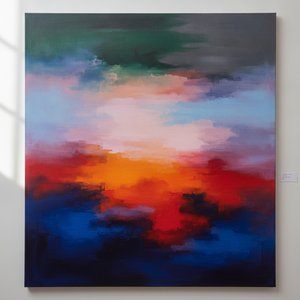
To stand before Mark Rothko’s Black on Maroon is to enter a realm where the boundaries of the physical world begin to dissolve. Painted in 1958, this masterpiece serves as a cornerstone of Abstract Expressionism, offering far more than a mere arrangement of pigment on canvas. It is a deliberate distillation of human intention—a profound quest to capture the intangible, the ephemeral, and the deeply felt. In this work, Rothko eschews all recognizable forms, choosing instead to present three rectangular blocks of color that seem to hover within a state of perpetual transition. The palette, dominated by deep maroons and somber blacks, creates a visual weight that pulls the viewer into a meditative trance, inviting a level of contemplation rarely achieved in modern art.
The technical brilliance of this piece lies in its quiet complexity. As a pioneer of the color field painting movement, Rothko utilized a revolutionary method of layering thin, translucent washes of oil paint, often mixed with glue tempera and pigment. This meticulous process creates a velvety, textured surface that does not merely reflect light but seems to absorb it, generating an internal luminosity. The edges of his rectangular forms are never sharp; instead, they are softly blurred, creating a hazy, atmospheric effect where colors bleed into one another like shadows at dusk. For the discerning collector or interior designer, this technique provides a sense of depth and movement that breathes life into a space, offering a focal point that changes character depending on the light and the angle of observation.
The Weight of History and the Language of Emotion
To fully appreciate the gravity of Black on Maroon, one must consider the turbulent era from which it emerged. Rothko was working within a cultural milieu gripped by the existential anxieties of the post-World War II period. His art became a visual response to a world grappling with loss, trauma, and the search for meaning amidst chaos. The starkness of the black against the warmth of the maroon can be seen as a dialogue between life and void, or passion and mourning. Rothko himself famously viewed his canvases as "windows onto eternity," intending for the viewer to bypass rational thought and connect directly with primal emotional responses.
The symbolism within the work is intentionally open-ended, allowing each observer to find their own truth. While the deep maroon hues may evoke feelings of warmth, vulnerability, or even a grounded sense of earthiness, the encroaching blackness introduces an element of mystery and the unknown. This tension between light and dark, presence and absence, makes the painting an incredibly versatile piece for high-end decor. Whether placed in a quiet study to foster introspection or as a commanding statement in a contemporary living space, a high-quality reproduction of this work brings with it an aura of sophisticated stillness. It is not merely a decoration; it is an invitation to experience the sublime.
Q&A
美術史におけるマーク・ロスコ作「Black on Maroon」の立ち位置とはどのようなものでしょうか。
マーク・ロスコ作「Black on Maroon」は、Modern期におけるColor Fieldの動向に属しています。これらが相まって、本作に美術史における確固たる地位を与えています。
マーク・ロスコ作「Black on Maroon」の複製画は、お部屋にどのような雰囲気をもたらしてくれるでしょうか?
マーク・ロスコ作「Black on Maroon」はDramaticな雰囲気を纏っており、Restaurantに飾るのがおすすめです。作品が周囲の空間にもたらすムードをお楽しみください。
1958年に「Black on Maroon」を制作した際、マーク・ロスコは何歳でしたか?
マーク・ロスコは55歳の時に「Black on Maroon」を制作しました。作家は1903年に生まれ、本作の制作年は1958年です。
この絵画の詳細を見る
 設置イメージを表示
 シェアする
シェアする シェアする
シェアする
 詳細を見る
詳細を見る ガイドを表示

 ダウンロード
 似ている作品
 X線調査
X線調査 スライドショーを表示
 Q&A
Q&A 統計情報
統計情報