プリント版に切り替え
 詳細を表示
詳細を表示







































 いずれかの辺が105 cm(約41インチ)を超えるアートワークまたは複製画の場合、フレームは分解されたキットの状態でお届けいたします。この方法は、輸送中の破損を防ぎ、安全に配送するために採用しております。


A Bicycle Sonata: Duchamp’s Provocative Meditation on Art and Leisure
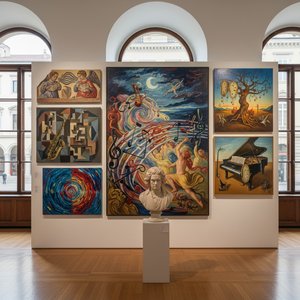
Marcel Duchamp's To Have the Apprentice in the Sun, created in 1914, is not merely a depiction of a man riding a bicycle; it’s a carefully constructed paradox, a deliberate disruption of conventional artistic expectations. This seemingly simple image—a figure on sheet music against the backdrop of a piano—resonates with layers of meaning that speak to Duchamp's core philosophy: challenging the very definition of art and questioning its relationship to everyday life. The year 1914, a period marked by immense global upheaval, provides a crucial context for understanding Duchamp’s work – a world on the brink of war, prompting artists to reconsider established norms and explore new modes of expression.
The Composition: Music, Movement, and the Unconventional Subject
The artwork immediately arrests the viewer with its unusual subject matter. A man, dressed in a helmet – a detail that subtly suggests both protection and a certain vulnerability – is engaged in the act of cycling on what appears to be a sheet of music. The positioning is deliberate; the bicycle isn’t simply placed beside the piano, but actively occupies the space *of* the music itself. This fusion of the mechanical and the musical creates an intriguing tension. Duchamp masterfully utilizes black and white, lending the image a stark, almost photographic quality that emphasizes the geometric forms and the figures' placement. The lack of color further directs attention to the composition’s inherent structure and the interplay between the bicycle and the music.
- The Bicycle: Represents movement, progress, and perhaps even a rejection of traditional artistic conventions.
- Sheet Music: Symbolizes art, creativity, and the established order of artistic practice.
- Piano: Suggests harmony, structure, and the potential for both beauty and rigidity.
Dadaist Roots and a Rejection of Representation
Created during Duchamp’s involvement with the Dada movement, To Have the Apprentice in the Sun embodies Dada's core tenets: anti-art, absurdity, and a rejection of traditional artistic values. Dada artists sought to dismantle established hierarchies and expose the arbitrary nature of aesthetic judgment. Duchamp’s work directly reflects this ethos by presenting an image that defies easy interpretation. It isn’t a portrait, a landscape, or a still life; it's a conceptual arrangement designed to provoke thought rather than provide visual pleasure in the conventional sense. The bicycle, a symbol of modernity and industrial progress, is juxtaposed with the music, representing the artistic realm, creating an unsettling yet compelling dialogue.
Symbolism and Duchamp’s Philosophical Inquiry
Beyond its Dadaist context, the image operates on a deeper symbolic level. The “apprentice” – a term suggesting someone in training or learning – could be interpreted as representing the artist himself, grappling with the challenges of forging his own artistic path. The act of riding a bicycle *on* music suggests an attempt to integrate the mundane and the extraordinary, the practical and the aesthetic. Duchamp wasn’t simply depicting a scene; he was engaging in a philosophical inquiry into the nature of art, its relationship to reality, and the role of the artist within society. The helmet worn by the cyclist adds another layer – is it protection from the world, or a shield against the judgment of established artistic norms?
To Have the Apprentice in the Sun remains a powerfully evocative work, demonstrating Duchamp’s genius for disrupting expectations and inviting viewers to reconsider their assumptions about art. A reproduction captures not only the image's striking composition but also the spirit of intellectual rebellion that defines this pivotal moment in modern art history.
Q&A
マルセル・デュシャン作「To Have the Apprentice in the Sun」 の技法(画材)は何ですか?
マルセル・デュシャン作「To Have the Apprentice in the Sun」の技法はAcrylic On Canvasです。複製画は、この技法の質感や風合いを再現することを目指しています。
マルセル・デュシャン作「To Have the Apprentice in the Sun」では、どのような配色が使われていますか?
マルセル・デュシャン作「To Have the Apprentice in the Sun」は、Pastelsなカラーパレットを使用しています。この配色は、作品全体の色彩的特徴を象徴しています。
マルセル・デュシャン作「To Have the Apprentice in the Sun」の解説ページはありますか?
マルセル・デュシャン作「To Have the Apprentice in the Sun」の解説資料ページでは、印刷して活用できる2枚構成のファクトシートを提供しています。これには、作品の詳細をまとめたデータテーブル、アーティストの生涯における時代背景を示す年代チャート、同アーティストによる他の作品、抽出されたカラーパレット、そしてそのままコピーして使用できる4つの形式の引用文献情報が含まれています。
この絵画の詳細を見る
 設置イメージを表示
 シェアする
シェアする シェアする
シェアする
 詳細を見る
詳細を見る ガイドを表示

 ダウンロード
 似ている作品
 X線調査
X線調査 スライドショーを表示
 Q&A
Q&A 統計情報
統計情報