Jacob Binck: A Renaissance Portraitist of Cologne
Jacob Binck (1497-1568), a name perhaps less familiar than some of his contemporaries, nevertheless stands as a significant figure in the artistic landscape of 16th-century Germany. Born in Cologne during a period of burgeoning artistic innovation, Binck’s career unfolded across Northern Europe, leaving behind a legacy primarily defined by his exquisite portraits of royalty and nobility – most notably Christian II & III of Denmark and Isabella of Austria. His work offers a compelling glimpse into the refined aesthetic sensibilities prevalent within Cologne at the time, reflecting both the influence of Italian Renaissance ideals and the distinctive character of German artistic tradition.
Early biographical details surrounding Binck are somewhat fragmented, shrouded in the typical uncertainties of historical records. While often associated with the renowned Albrecht Dürer, the precise nature of any direct student-teacher relationship remains debated by scholars. It’s plausible that he was exposed to Dürer's groundbreaking techniques and artistic philosophy during his formative years, though evidence is circumstantial. Furthermore, his early residence in Italy – a common trajectory for young artists seeking to hone their skills – introduces an element of speculation regarding potential influences from the Italian Renaissance masters. Accounts also suggest periods spent working under Marcantonio Raimondi in Rome, further expanding his exposure to diverse artistic styles.
A Peripatetic Career and Royal Patronage
Binck’s career was marked by a considerable degree of mobility. He wasn't rooted in one single location but rather traveled extensively throughout Europe, accepting commissions from various courts and patrons. This itinerant lifestyle is particularly evident in his service to the Danish court under King Christian III. He quickly ascended to the position of royal painter, responsible for capturing the likenesses of both the king and his queen, Dorothea. His portraits became valued possessions, reflecting the prestige and power of the Danish monarchy. Beyond Denmark, Binck also found employment with Prince Albrecht of Brandenburg in Prussia, undertaking a significant commission involving the creation of a monument to a deceased princess – a testament to his versatility and artistic skill.
This royal patronage wasn’t merely a source of income; it provided Binck with access to luxurious materials, influential circles, and opportunities to refine his technique. The demands of portraiture required meticulous observation, an understanding of human anatomy, and the ability to convey not just physical appearance but also personality and status. Binck excelled in these areas, producing works characterized by a remarkable degree of realism and a subtle elegance that distinguished him from many of his contemporaries.
Style and Technique: A Blend of Precision and Refinement
Binck’s artistic style is often described as “neat” and “correct,” exhibiting a notable attention to detail. While comparisons are frequently drawn between his work and the art of H. Aldegrever, a prominent Flemish painter known for his refined portraits, Binck's engravings tend to display a slightly less masterful execution compared to his painted works. His drawings demonstrate a strong foundation in perspective and anatomical accuracy, but sometimes lack the same level of dynamism or expressive intensity found in some of his peers.
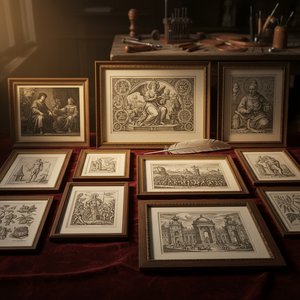
However, it’s crucial to acknowledge the challenges inherent in assessing Binck's style due to the historical complexities surrounding artist attribution during this period. Many artists employed similar stylistic conventions and used cipher markings – such as “C” for Coloniensis – to identify their work. This has led to considerable confusion among scholars, with some engravers mistakenly identified as belonging to the group known as the Little Masters. The meticulous documentation of Binck’s works, particularly his engravings, provides valuable insights into his artistic process and technical capabilities.
Notable Works and Lasting Legacy
Binck's oeuvre primarily consists of portraits, reflecting the prevailing demand for this genre during the 16th century. Among his most celebrated achievements are the portraits of Christian II & III of Denmark and Isabella of Austria – works that showcase his ability to capture regal dignity and convey a sense of timelessness. His self-portrait in the Belvedere, Vienna, offers a rare opportunity to study his artistic approach firsthand. Furthermore, his engravings, including copies of Raphael’s “Massacre of the Innocents,” demonstrate his skill as an engraver and his appreciation for classical art.
Despite not achieving widespread fame during his lifetime, Jacob Binck's contributions to the development of portraiture in Northern Europe are undeniable. His meticulous technique, refined aesthetic sensibilities, and service to prominent royal courts cemented his place as a significant artist of the Renaissance period. His works continue to be studied and admired for their elegance, realism, and subtle portrayal of human character – a testament to the enduring legacy of this often-overlooked Cologne painter.

 プリント版に切り替え
 詳細を表示
詳細を表示







































 いずれかの辺が105 cm(約41インチ)を超えるアートワークまたは複製画の場合、フレームは分解されたキットの状態でお届けいたします。この方法は、輸送中の破損を防ぎ、安全に配送するために採用しております。


 設置イメージを表示
 シェアする
シェアする シェアする
シェアする
 詳細を見る
詳細を見る ガイドを表示

 ダウンロード
 似ている作品
 X線調査
X線調査 スライドショーを表示
 Q&A
Q&A 統計情報
統計情報