プリント版に切り替え
 続きを読む
続きを読む







































 いずれかの辺が105 cm(約41インチ)を超えるアートワークまたは複製画の場合、フレームは分解されたキットの状態でお届けいたします。この方法は、輸送中の破損を防ぎ、安全に配送するために採用しております。


The Weight of Daily Labor
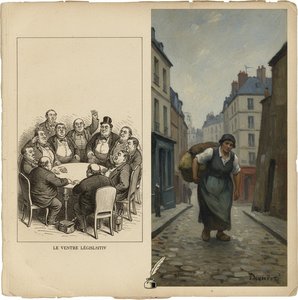
In this 1853 lithograph, a woman moves through a Parisian street, her form defined by the heavy burden she carries. A large basket, filled to the brim with laundry, rests upon her head. She wears clothing characteristic of the mid-nineteenth century, and her gait is steady despite the mass of fabric above her. Following closely at her heels is a young child, whose presence creates a small familial group within the larger urban setting. The background contains several other figures, including passersby moving along the street, which provides a sense of movement to the scene. The composition relies on a black and white palette, using varying tones of grey and deep blacks to establish shape and depth.
The artist utilizes chiaroscuro to sculpt the physical presence of the woman. Light hits the edges of her clothing and the texture of the laundry, while heavy shadows settle into the folds of the fabric and the spaces between the figures. This interplay of light and shadow emphasizes the physical strain of the task. The textures of the woven basket and the heavy cloth are rendered through precise tonal gradations rather than fine lines alone.
Social Realities of the Second Empire
The scene is set during the era of Napoleon III, a period marked by rapid industrialization in Paris and widening economic gaps. The subject matter focuses on the working class, specifically women tasked with domestic labor. The basket functions as a literal and figurative weight, representing the responsibilities required to maintain a household amidst economic hardship. Through the depiction of this woman and her child, the work documents the lived experience of ordinary Parisians during a time of significant social change.
The technique of lithography allows for an expressive draftsmanship that captures the grit of urban life. By avoiding bright colors and focusing on stark contrasts, the artist directs attention to the physical reality of the subject's struggle. The woman’s direct and unwavering gaze provides a point of contact for the viewer, presenting a face of resilience. This approach avoids sentimentalizing the labor, instead offering a factual observation of the endurance required by those in the working class.
よくあるご質問
「Load (Washerwoman)」の色は、どの程度の光を反射しているように見えますか?
オノレ・ドーミエ作「Load (Washerwoman)」 の輝度は Dark です。輝度とは、色がどれほど光を反射しているかを表す指標です。
オノレ・ドーミエ作「Load (Washerwoman)」の雰囲気はどのように表現されていますか?
オノレ・ドーミエ作「Load (Washerwoman)」は、その情緒においてCalmと表現されます。この分類は、作品を空間やシーンに合わせる際の手助けとなります。
オノレ・ドーミエ作「Load (Washerwoman)」において、感情と贈り物のシーンはどのように結びついているのでしょうか?
「Load (Washerwoman)」はReflectiveな情緒を湛えており、おすすめのギフトとしてMother's Dayが挙げられます。
More about this painting
 設置イメージを確認
 送る
送る シェア
シェア
 詳細情報
詳細情報 ガイドを表示

 画像をダウンロード
 似ている作品
 X線調査
X線調査 スライドショー
 Q&A
Q&A 統計情報
統計情報