プリント版に切り替え
 詳細を表示
詳細を表示







































 いずれかの辺が105 cm(約41インチ)を超えるアートワークまたは複製画の場合、フレームは分解されたキットの状態でお届けいたします。この方法は、輸送中の破損を防ぎ、安全に配送するために採用しております。


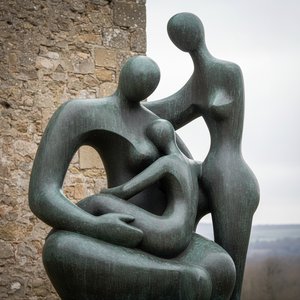
A Universal Bond: Exploring Henry Moore’s ‘Mother and Child 4’
This striking black and white photograph captures a sculpture by one of Britain's most important artists, Henry Moore. The work depicts two abstracted bird-like forms – a larger figure sheltering a smaller one – embodying the timeless theme of motherhood and familial protection. While the material is suggested to be wood or stone, its smooth, organic curves and textured surface speak to Moore’s mastery of form and his deep connection to natural materials. This particular piece, part of a prolific series exploring the mother-and-child motif, exemplifies Moore's signature style developed throughout his long career.Moore’s Sculptural Language: Form & Technique
Henry Moore is renowned for his semi-abstract sculptures, often focusing on the human figure – particularly reclining figures and *mother and child* compositions. He pioneered a technique called “direct carving,” where he worked directly with the material (often stone or wood), allowing the form to emerge organically rather than adhering strictly to a pre-conceived design. This approach is evident in ‘Mother and Child 4’ where the forms appear both monumental and intimately connected. The simplification of shapes, the emphasis on volume, and the interplay of positive and negative space are hallmarks of his style, influenced by prehistoric sculpture, African art, and the works of Michelangelo. Moore wasn't interested in literal representation; instead, he sought to capture the *essence* of form and emotion.Symbolism & Emotional Resonance
The mother-and-child theme held profound significance for Moore throughout his life. Having experienced hardship during World War I while serving as a soldier, he found solace in images of nurturing and protection. The abstracted forms in ‘Mother and Child 4’ transcend specific identities, becoming universal symbols of maternal love, vulnerability, and the enduring bond between generations. The protective gesture of the larger form enveloping the smaller one evokes feelings of safety, comfort, and unconditional care. While seemingly simple, the sculpture resonates with deep emotional power, prompting contemplation on fundamental human experiences. The use of birds as a metaphor adds another layer – suggesting freedom, fragility, and the instinct to nurture offspring.A Lasting Legacy: Moore in Context
Born in 1898, Henry Moore lived through periods of immense social and political change, which profoundly impacted his artistic vision. His work gained prominence in the post-war era, reflecting a desire for renewal and a search for universal values. Moore’s sculptures are now found in public collections and private homes worldwide, celebrated for their beauty, emotional depth, and enduring relevance. ‘Mother and Child 4’, like many of his works, continues to inspire artists and captivate audiences with its powerful simplicity and profound message. A reproduction of this sculpture would bring a sense of serenity, strength, and timeless elegance to any interior space.Q&A
ヒューリー・モアによる「Mother And Child 4」はパブリックドメインに含まれますか?また、その理由は何ですか?
ヒューリー・モア作「Mother And Child 4」は著作権の保護対象ですです。著作権の保護期間は、1986年に亡くなった作家の没年から起算されます。
「Mother And Child 4」の色彩は、どの程度鮮やかですか?
「Mother And Child 4」の色彩は、彩度がMutedです。
ヒューリー・モア作「Mother And Child 4」の画像はどこからダウンロードできますか?
ヒューリー・モア作「Mother And Child 4」は、作品のデジタルイメージをダウンロードページから高解像度デジタル画像のダウンロードとしてダウンロードいただけます。
この絵画の詳細を見る
 設置イメージを表示
 シェアする
シェアする シェアする
シェアする
 詳細を見る
詳細を見る ガイドを表示

 ダウンロード
 似ている作品
 X線調査
X線調査 スライドショーを表示
 Q&A
Q&A 統計情報
統計情報