
 設置イメージを確認
 送る
送る シェア
シェア
 詳細情報
詳細情報 ガイドを表示

 画像をダウンロード
 似ている作品
 X線調査
X線調査 スライドショー
 Q&A
Q&A 統計情報
統計情報Landscape Black and White


 続きを読む
続きを読む
ウェブ上のプレビューを遥かに凌駕する、印刷に最適なファイルをご提供します。当サイトで販売しているすべてのデジタル画像は、弊社のデータベース内にある高解像度のマスターデータ(通常、幅5,000〜15,000ピクセル)から作成されています。そのため、大判印刷やタイトなクロップ、細部まで緻密な再現も、安心してお楽しみいただけます。
当スタジオから送り出される画像は、すべて丁寧に加工されています。デジタルエキスパートが原画と照らし合わせて色調を精査し、必要に応じて補正を行った上で、プロ仕様のリタッチツールを用いて鮮明さと細部を向上させます。その際、アーティストの筆致やスタイルに忠実であることを常に追求しています。その結果、単なるスキャン画像にフィルターをかけたようなものではなく、まるで本物の絵画を見ているかのような仕上がりを実現しています。
仕上がりをご確認いただいてから完了となります。専門スタッフが、ご確認用の画像を72時間以内にメールでお送りいたします。もしご満足いただけない場合は、修正や改善のご要望を承るほか、品質が基準に満たない場合には返金も可能です。
出版社、デザインスタジオ、ギャラリー、そして印刷所から信頼される品質です。
デジタル画像
個人での鑑賞、印刷、クリエイティブなプロジェクトにご利用いただける高解像度ファイルをダウンロードできます。 ( プリント版に切り替え 手描きの複製画を注文する)
デジタル画像のご注文に付随する特典
プロフェッショナルなデジタル配信を、確かな品質で。
OriginalUniqueArt.com を選ぶことは、単に画像を手に入れることではありません。プロの手によって精密に仕上げられ、満足保証が付いた高品質なデジタルアートワークを受け取ることを意味します。ご注文いただいた際に自動的に付随する内容は、以下の通りです:

メールですぐにお届け
ご注文から72時間以内に、高解像度のデジタル画像ファイルをメールでお送りいたします。お手元に届き次第、すぐにご利用いただけます。

AI技術で最適化されたデジタルファイル
お客様の作品は、高度なAI技術と専門家による手作業を組み合わせてプロフェッショナルに最適化されており、細部のディテール、鮮明さ、そして正確な色再現性を最大限に引き出しています。

一生涯無料の再送サービス
ファイルを誤って削除したり、紛失してしまったりしましたか?ご安心ください。いつでも無料で再送いたします。

輸入手数料は、いつでも一切かかりません
関税や手数料、配送料を気にすることなく、お気に入りのアートワークをすぐにお楽しみいただけます。デジタルダウンロードは常に免税です。

正確な色彩の保証
プロ仕様のツールとカラーマネジメント技術を用いることで、デジタル画像が元の色を最大限に忠実に再現することを保証いたします。

100日間満足保証
ご購入いただいたデジタル画像にご満足いただけない場合は、100日以内であれば、理由を問わず修正または100%の返金対応をさせていただきます。

100% 返金保証
ご満足いただけない場合は、デジタルファイルを受け取ってから100日以内であれば、理由を問わず全額返金いたします。

まとめ買い割引
3枚購入で10%OFF、5枚購入で15%OFF、10枚以上のご購入で20%OFF。クリエイティブなプロジェクトやギャラリー、エージェンシーに最適です。
A Geometric Dance of Light and Shadow
In the evocative realm of mid-century abstraction, Landscape Black and White stands as a profound testament to the transformative power of shape and contrast. Created in 1967 by the visionary artist Hale Aspacio Woodruff, this piece invites the viewer into a dreamlike dimension where the boundaries between reality and geometry dissolve. At first glance, the eye is immediately arrested by a striking, luminous yellow square that anchors the left side of the composition, acting as a singular beacon of warmth amidst a sea of monochromatic depth. This bold use of color serves not merely as a focal point but as a rhythmic heartbeat within the painting, disrupting the somber tones of gray and black to create a visual tension that is both unsettling and deeply captivating.
The composition breathes through a sophisticated interplay of forms, where smaller squares in varying shades of charcoal and slate are scattered like celestial fragments across an abstract landscape. This arrangement suggests a structured chaos, a carefully orchestrated movement that guides the viewer's gaze across the canvas. Amidst this geometric dance, the subtle presence of two human figures—one positioned near the center and another toward the periphery—adds a layer of poignant narrative. These figures, though integrated into the abstract architecture of the piece, ground the work in a sense of shared existence, suggesting that even within the most fragmented or abstract environments, the human spirit remains an observant and integral participant.
Technique and the Legacy of Modernism
The technique employed in this 1967 masterpiece reflects a masterful command over balance and spatial perception. Through the deliberate application of flat planes and sharp edges, Woodruff achieves a sense of depth that defies the two-dimensional surface. The interplay between the stark black voids and the soft, misty grays creates an atmospheric quality reminiscent of a fog-swept morning, yet the rigid geometry prevents the work from becoming purely ethereal. This duality—the tension between the organic feeling of a landscape and the mathematical precision of geometric abstraction—is what gives the painting its enduring intellectual weight.
For the discerning collector or interior designer, Landscape Black and White offers an unparalleled opportunity to introduce a piece of historical significance into a contemporary setting. Its monochromatic palette provides a sophisticated foundation for modern decor, allowing it to harmonize with minimalist, industrial, or even classical interiors. As a high-quality reproduction, this artwork preserves the soul of Woodruff’s original vision, offering a window into a pivotal era of American art history. It is more than a mere decoration; it is an emotional experience that evokes contemplation, inviting anyone who dwells in its presence to find beauty in the balance of light and shadow.
よくあるご質問
Hale Aspacio Woodruff作「Landscape Black and White」 の色彩の鮮やかさはどの程度ですか?
Hale Aspacio Woodruff作「Landscape Black and White」の色調は、Monochromaticな強さを持っています。
Hale Aspacio Woodruff作「Landscape Black and White」の原画はどこで見ることができますか?
原画の「Landscape Black and White」はSpelman College Museum of Fine Art, Atlanta, United States of Americaにてご覧いただけます。
「Landscape Black and White」の色彩は、どの程度鮮やかですか?
Hale Aspacio Woodruff作「Landscape Black and White」は、彩度Mutedで記録されています。
アーティスト・プロフィール
A Legacy of Visionary Expression
Hale Aspacio Woodruff stands as a monumental figure in the tapestry of twentieth-century American art, a master whose hands moved between the delicate precision of printmaking and the sweeping grandeur of muralism. Born in Cairo, United States of America, his journey was one of profound movement and cultural synthesis. Growing up in Nashville, Tennessee, within a Black family, Woodruff’s early life was shaped by the segregated realities of the era, yet his artistic spirit sought horizons far beyond local boundaries. His education was as diverse as his palette, spanning prestigious institutions such as the Herron School of Art and Design in Indianapolis, the Art Institute of Chicago, and the Harvard Fogg Art Museum. These formative years provided him with a rigorous technical foundation, but it was his time abroad that truly ignited his creative metamorphosis.
The allure of Paris played a crucial role in his development, as a prize from the Harmon Foundation in 1926 allowed him to spend four transformative years studying in France. This period of immersion in European modernism provided a vital dialogue between classical training and avant-garde experimentation. Later, his artistic evolution was further enriched by a summer spent in Mexico, where he studied the art of mural painting under the legendary Diego Rivera. This encounter with the Mexican muralist movement deeply influenced his approach to public art, instilling in him a belief that art should serve as a powerful, communicative force within the social fabric.
The Soul of the Canvas
Woodruff’s body of work is characterized by an extraordinary ability to weave together history, myth, and identity. He was particularly renowned for his ability to capture the rhythmic pulse of heritage, most notably in his Art of the Negro series. In masterpieces such as Native Forms, Panel One, he invites viewers into a world where ancestral echoes breathe through bold, energetic brushstrokes and a saturated palette. His compositions often act as spiritual gateways, where the boundaries between the physical and the unseen dissolve into a dance of symbolic communication. Through the use of stylized figures and cultural motifs, he constructed narratives that celebrated resilience and the profound complexity of human existence.
As his career progressed, Woodruff’s style demonstrated a remarkable versatility, moving from the narrative depth of his murals to the evocative realms of abstraction. In works like Landscape Black and White, one observes a geometric dance of light and shadow, where the tension between monochromatic depth and sudden, luminous color creates a dreamlike dimension. Whether he was exploring the celestial dialogues of Sentinel Gate or the vibrant gatherings in his panel paintings, his work remained anchored by a commitment to high artistic development and a telling quality that reflected the human condition. His legacy is not merely found in the pigments on canvas, but in his enduring role as an educator and founder, having established the art department at Atlanta University, ensuring that the flame of creativity would continue to burn brightly for generations to come.
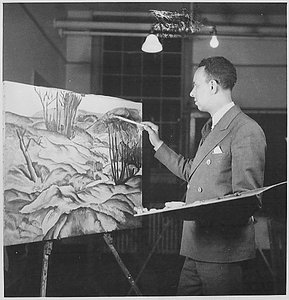
Hale Aspacio Woodruff
1900 - 1980