
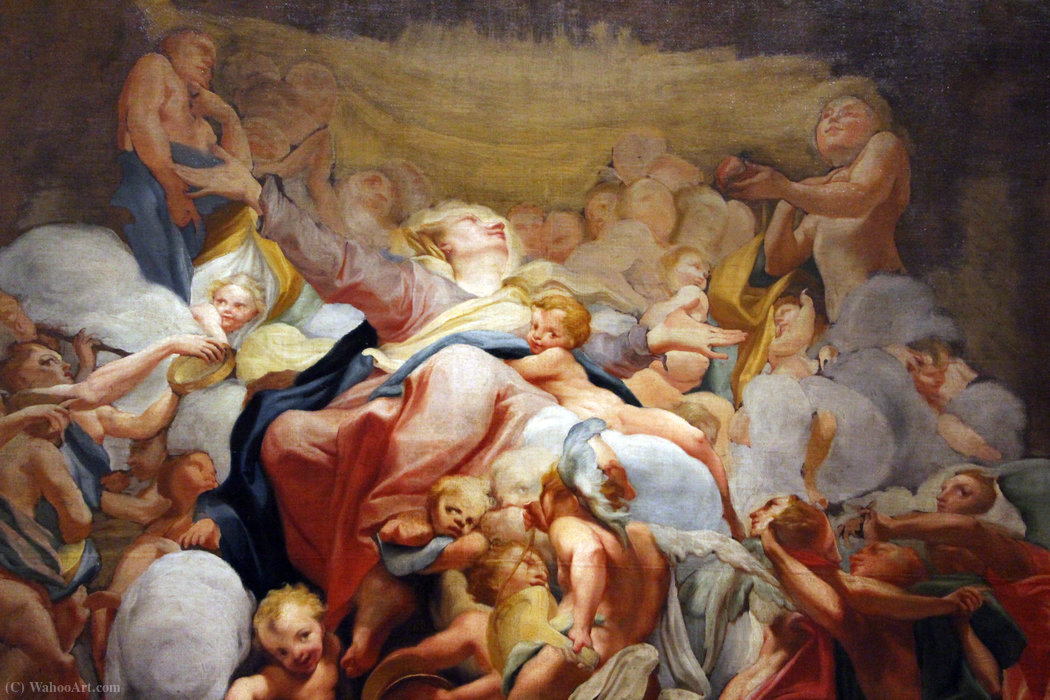
 プレビュー
プレビュー
 シェアする
シェアする シェアする
シェアする
 詳細を見る
詳細を見る

 ダウンロード
 似ている作品
 X線調査
X線調査 スライドショー
 統計情報
統計情報Assumption
 詳細を見る
詳細を見る
ジークレー/アートプリント
迅速な制作と多彩な仕上げオプションを備えた、ミュージアムクオリティのジークレーまたはキャンバスプリント。 ( 手描きの絵画を購入 デジタル画像販売へ切り替え)




































作品のオリジナル比率に合わせた、当店の規定サイズからお選びください。

特定のフレームやスペースに合わせて、ご自身でサイズを指定することも可能です。選択されたサイズが元の画像の比率と一致しない場合、作品をトリミングするか、鏡面反射または単色での塗りつぶしによって画像を拡張いたします。制作を開始する前に、ご確認用のデジタルモックアップをお送りいたします。
画面上のプレビューには、実際のトリミングや拡張は反映されませんのでご注意ください。最終的な構図を正確に確認できるのは、モックアップのみとなります。
カスタムサイズも承っておりますが、元の比率を維持するためには、あらかじめ用意されたリストからサイズを選択することをお勧めいたします。


 ガラスオプションは、110cm未満のサイズでのみご利用いただけます。

Assumption
ジークレー/アートプリント
複製画のサイズ
-


合計金額
$ 80
アーティストの略歴
A Lyrical Voice of Genoa’s Baroque
Gregorio De Ferrari stands as a pivotal figure in the Genoese Baroque, embodying its distinctive blend of grandeur and delicate lyricism. Born in Porto Maurizio in 1647, his artistic journey began with an unlikely pursuit of legal studies. However, the call of the brush proved irresistible, leading him to abandon the courtroom for the studio. This transition was guided by the mentorship of Domenico Fiasella, a master whose monumental style left an indelible mark on De Ferrari’s early works. Through this formative period, the young artist absorbed the stylistic echoes of Giovanni Andrea De Ferrari and Giovanni Battista Casone, establishing a foundation that would eventually support one of the most imaginative visions of the seventeenth century.
The evolution of De Ferrari’s hand was profoundly shaped by his time in Parma. Immersed in the atmosphere of Parma Cathedral, he encountered the breathtaking quadratura frescoes—the art of illusionistic ceiling painting—that had been pioneered by Correggio. This encounter was transformative; rather than merely mimicking Fiasella's imposing scale, De Ferrari began to prioritize a more personal and expressive language. He embraced graceful elongations and spiraling, rhythmic movements of figures, drawing inspiration from the sculptural innovations of Filippo Parodi and Bernardo Schiaffino. His work began to breathe with a new, kinetic energy, moving away from static compositions toward a more fluid, atmospheric experience.
The Mastery of Light and Motion
Upon returning to Genoa, De Ferrari became a central pillar of the Casa Piola studio, working alongside his father-in-law, the legendary Domenico Piola. This collaborative era was marked by an extraordinary output of large-scale decorative projects that transformed the interiors of Genoese palaces and churches. In works such as the decoration of the Basilica della Santissima Annunziata del Vastato, De Ferrari masterfully blended the radiant luminescence of Correggio with the sophisticated stylistic elements of Cortona and Castiglione. His ability to weave light through complex, swirling compositions allowed him to create spaces that felt both infinite and intimately alive.
His technical prowess extended beyond the ceiling to the easel, where he produced works of profound mythological and religious depth. Notable examples include:
- Juno and Argus: A captivating display of tension and classical drama, currently housed in the Musée du Louvre.
- Ascension of Christ: An evocative piece showcasing his ability to handle divine light and celestial movement.
- Hercules and Antaeus: A testament to his skill in depicting muscularity and the raw power of mythic struggle.
The artist’s brushwork was characterized by a free-flowing, exploratory quality that many historians view as a precursor to the Rococo style. His compositions often possessed an airy, weightless elegance that led one critic to famously describe him as "a grander Fragonard," despite the fact that the French master would not be born for decades after De Ferrari's death. This anticipatory spirit gave his work a unique temporal quality, bridging the heavy drama of the High Baroque with the lighthearted grace of the coming century.
Legacy and Historical Significance
The historical significance of Gregorio De Ferrari lies in his ability to synthesize the diverse influences of the Italian landscape into a singular, unmistakable style. He did not merely participate in the Genoese Baroque; he elevated it to a level of poetic sophistication that few could match. Through his prolific collaborations and his mastery of both fresco and canvas, he left an indelible imprint on the architectural fabric of Genoa, decorating landmarks such as the Palazzo Rosso, Villa Balbi, and the churches of San Siro and San Giovanni Battista.
His influence also extended to the next generation, most notably through his son, Lorenzo De Ferrari, who continued the family tradition of excellence. As a painter, draughtsman, and architect, Gregorio De Ferrari’s legacy is one of movement, light, and an enduring sense of wonder. He remains a master of the ephemeral, capturing the fleeting beauty of a spiraling figure or a sun-drenched cloud with a precision that continues to captivate the modern eye.

Gregorio De Ferrari
1647 - 1726 , Italy
基本情報
- Artistic Movement Or Style: Baroque
- Artists Or Movements Influenced By This Artist: ['Casa Piola studio']
- Artists Who Influenced This Artist:
- Giovanni Andrea De Ferrari
- Giovanni Battista Casone
- Correggio
- Date Of Birth: 1647
- Date Of Death: 1726
- Full Name: Gregorio De Ferrari
- Nationality: Italian
- Notable Artworks:
- Juno and Argus
- Summer
- Hercules and Antaeus
- Place Of Birth: Porto Maurizio, Italy