
 設置イメージを確認
 送る
送る シェア
シェア
 詳細情報
詳細情報 ガイドを表示

 画像をダウンロード
 似ている作品
 X線調査
X線調査 スライドショー
 統計情報
統計情報Universal Chart

 続きを読む
続きを読む
このページに掲載されている作品は著作権法によって保護されており、当社の許可なく同一の複製物を制作または販売することは法律で禁じられています。この保護は、以下のような国際条約に基づき執行されます。 ベルヌ条約 および、以下の条項に定められたものを含む各国の法律により、 米国著作権法 第17編。
この手法は、著作権で保護された作品の複製や複写を伴わないため、著作権法に完全に準拠しています。これは単なる模倣ではなく、創造的な再解釈です。元の作品からインスピレーションを受けつつも、それとは異なる、全く新しい絵画を生み出すものです。
ジークレー/アートプリント
スピーディーな制作と多彩な仕上げオプションが魅力の、ミュージアムクオリティなジークレー・キャンバスプリント。 ( 手描きの複製画を注文する デジタル画像販売へ切り替え)




































作品のオリジナル比率に合わせた、当店の規定サイズからお選びください。

額縁や壁のスペースに合わせて、ご希望の幅と高さを入力してください。プリントはカットすることは可能ですが、元の画像より大きくすることはできないため、異なる比率のサイズを選択された場合は、画像の一部が欠けることになります。印刷を開始する前に、内容を確認していただくためのデジタルモックアップをお送りいたします。このページに表示されている画像は、実際のカット後の状態を示すものではありません。実際の仕上がりはモックアップにてご確認ください。


 ガラスオプションは、110cm未満のサイズでのみご利用いただけます。

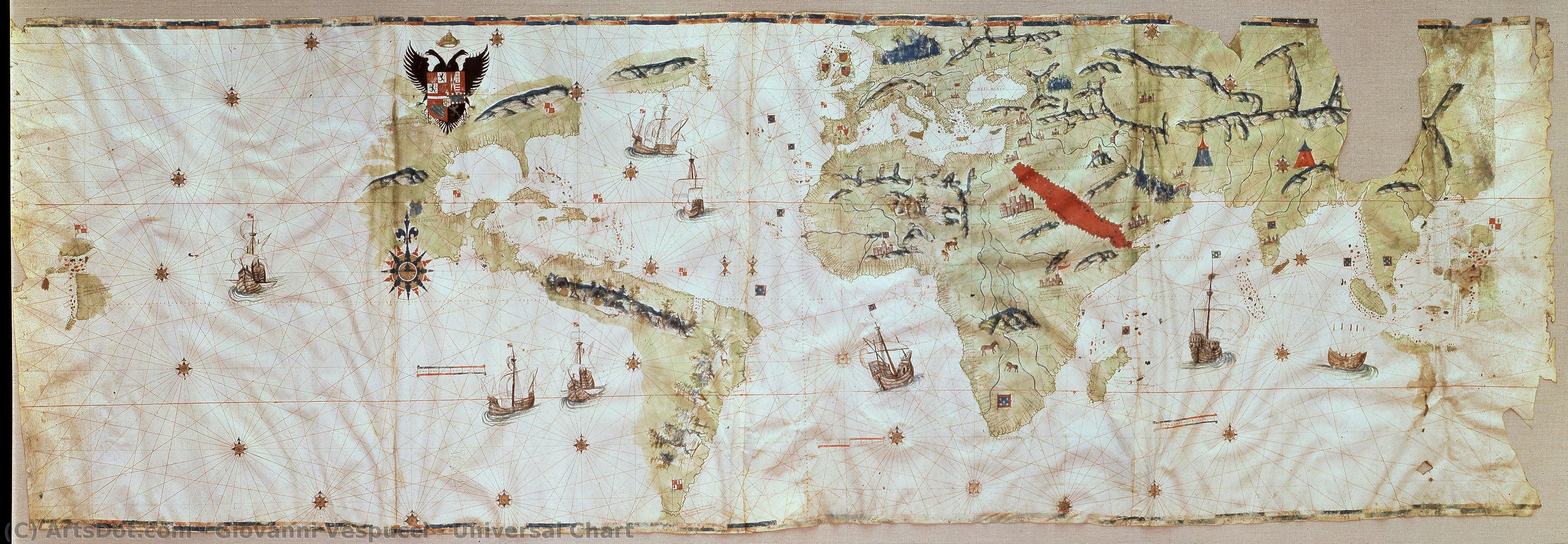
Universal Chart
ジークレー/アートプリント
複製画サイズ一覧
-


合計金額
¥ 12603
よくあるご質問
「Universal Chart」の色使いは、鮮やかでしょうか、それとも淡い感じでしょうか?
「Universal Chart」の彩度はBalancedです。彩度とは、色の鮮やかさの度合いを表します。
「Universal Chart」の色同士は、どのように調和していますか?
Giovanni Vespucci作「Universal Chart」は、Strong Color Unityな色彩の調和を見せています。
「Universal Chart」の原画は、どの美術館に収蔵されていますか?
Giovanni Vespucci作「Universal Chart」は海軍博物館, マドリード, スペインに展示されています。なお、美術館の掲載情報は複製画ではなく、原画に関するものです。
アーティストについて
A Cartographer’s Vision: The Life and Legacy of Giovanni Vespucci
Giovanni Vespucci, born in Florence around 1487, remains a figure shrouded in some historical ambiguity, yet his contributions to the burgeoning field of cartography during the Age of Exploration are undeniable. While often overshadowed by the fame of his uncle, Amerigo Vespucci – for whom the Americas are named – Giovanni carved out his own significant role as an Italo-Spanish geographer and cosmographer. His life unfolded against a backdrop of intense maritime discovery, shifting geopolitical landscapes, and a thirst for knowledge that propelled European exploration to unprecedented heights. Giovanni’s early education in Florence, likely under the tutelage of humanist scholars, provided him with a strong foundation in geography, astronomy, and Latin – skills crucial for his future endeavors. He eventually settled in Seville, Castile (Spain), where his uncle held the prestigious position of pilot major for the House of Indies, an institution responsible for overseeing Spain’s colonial affairs. This familial connection proved pivotal, opening doors to employment as a cartographer within the same organization following Amerigo's death.From Apprentice to Cosmographer: A Career Defined by Maps
Giovanni Vespucci’s career blossomed in Seville during a period of intense mapmaking activity. He wasn’t merely copying existing charts; he actively engaged in creating new representations of the world, informed by the latest discoveries and striving for greater accuracy. Two manuscript maps signed by him have survived to this day: a portolan chart from 1520 and a larger nautical-style planisphere dated 1526. Portolan charts were renowned for their meticulous depiction of coastlines, derived from compass bearings and careful observation – they served as essential navigational tools for sailors. Vespucci’s skill lay in updating these traditional forms with the new geographical information flooding in from voyages across the Atlantic and beyond. Beyond these surviving manuscripts, a world map published around 1524 is attributed to him, existing in several variations. This map, created using a polar azimuthal equidistant projection, demonstrates his willingness to experiment with different cartographic techniques and present a comprehensive view of the known world. His work wasn’t simply about charting landmasses; it was an attempt to synthesize disparate information into a coherent and usable form for explorers, merchants, and policymakers alike.The Badajoz Meeting: A Cosmographer at the Forefront of Geopolitical Debate
In 1524, Giovanni Vespucci found himself thrust into a high-stakes diplomatic arena. He was summoned as an expert to participate in a board meeting held in Badajoz, Spain, tasked with resolving territorial disputes between Spain and Portugal. This gathering brought together some of the most prominent cartographers, navigators, and cosmographers of the era – figures like Hernando Colón (son of Christopher Columbus), Sebastián Caboto, Juan Sebastián Elcano, and Diego Ribeiro. Vespucci’s presence at this meeting underscores his standing within the Spanish court as a respected authority on geographical matters. The discussions centered around clarifying boundaries in the newly discovered lands, a complex undertaking fraught with political implications. His role was to provide expert analysis and contribute to a resolution that would define the respective spheres of influence for both Iberian powers. This event highlights not only his technical expertise but also his ability to navigate the intricate world of international diplomacy.Influences and Techniques: Bridging Tradition and Innovation
Giovanni Vespucci’s cartographic style was deeply rooted in the traditions of the portolan chart, emphasizing accuracy in coastal depictions and reliance on empirical observation. However, he wasn't a mere imitator. He skillfully integrated new discoveries – particularly those made by his uncle Amerigo and other explorers – into his maps, expanding the known world beyond its medieval confines. His experimentation with different map projections, such as the polar azimuthal equidistant projection, demonstrates a willingness to embrace innovation and explore alternative ways of representing geographical data. The influence of Renaissance humanism is also evident in his work, reflected in his meticulous attention to detail, his desire for clarity and comprehensiveness, and his commitment to synthesizing knowledge from diverse sources. He drew upon classical texts, contemporary accounts, and the latest navigational reports to create maps that were both aesthetically pleasing and scientifically informative.Historical Significance: Shaping European Understanding of the World
Giovanni Vespucci’s legacy lies in his contribution to shaping European understanding of the world during a pivotal period of exploration and colonization. His maps weren't simply geographical representations; they were instruments of power, influencing trade routes, colonial ambitions, and geopolitical strategies. By updating existing charts with new discoveries and experimenting with innovative techniques, he played a crucial role in disseminating knowledge about the Americas and other newly encountered lands. While his name may not be as widely recognized as that of his uncle, Giovanni Vespucci’s work stands as a testament to the skill and dedication of the cartographers who painstakingly charted the course of exploration and helped define the modern world map. His maps served as vital tools for navigators, merchants, and policymakers, leaving an indelible mark on the history of European expansion and global interaction.
Giovanni Vespucci
1484 - , Italy
アーティスト情報
- Full Name: Giovanni Vespucci
- Nationality: Italian-Spanish
- Date Of Birth: 1484
- Date Of Death: After 1527
- Place Of Birth: Florence, Italy
- Notable Artworks:
- Portolan Chart
- Universal Chart
- Artistic Movement Or Style: Cartography, Cosmography