プリント版に切り替え
 続きを読む
続きを読む







































 いずれかの辺が105 cm(約41インチ)を超えるアートワークまたは複製画の場合、フレームは分解されたキットの状態でお届けいたします。この方法は、輸送中の破損を防ぎ、安全に配送するために採用しております。


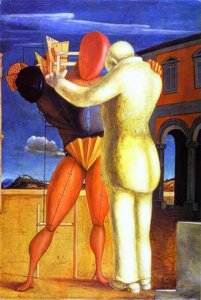
Giorgio De Chirico’s “Il Trovatore”: A Dreamscape of Medieval Echoes
The painting "Il Trovatore," created circa 1950-1955 by Giorgio de Chirico, stands as a cornerstone of Metaphysical Art—a movement that profoundly challenged the conventions of Surrealism and cemented De Chirico’s place among the most influential artists of the 20th century. More than just an image, it's a meticulously crafted illusion designed to unsettle the viewer and invite contemplation on themes of memory, alienation, and the elusive nature of reality. This essay delves into the intricacies of this iconic artwork, exploring its visual language, historical significance, and enduring emotional resonance.- Subject Matter: At first glance, “Il Trovatore” presents a stark juxtaposition between medieval armor and modern architectural elements—a statue or sculpture dominates the composition, embodying an archaic figure amidst a desolate Roman piazza bathed in the fading light of sunset. This deliberate pairing underscores De Chirico’s fascination with reconciling disparate temporal realms, mirroring Nietzsche's exploration of eternal recurrence.
- Style & Technique: De Chirico’s signature style—characterized by flattened perspectives, geometric abstraction, and unsettling stillness—is powerfully evident in “Il Trovatore.” The artist employs a muted palette dominated by ochre hues and deep shadows, creating an atmosphere of profound melancholy and mystery. Precise brushstrokes contribute to the painting's textural richness, emphasizing the sculptural quality of both the statue and the surrounding environment.
- Historical Context: Painted during De Chirico’s “New” Metaphysical period—following a hiatus from Surrealism—the artwork reflects a renewed engagement with his earlier stylistic explorations. Influenced by thinkers like Nietzsche and Schopenhauer, De Chirico sought to capture the psychological landscape of the subconscious mind, mirroring the anxieties of postwar Europe. The painting's formal vocabulary anticipates developments in Pop Art, signaling a rejection of artistic dogma and embracing repetition as a means of conveying profound ideas.
- Symbolism: The statue itself—a nameless figure clad in medieval armor—represents an idealized past confronting the bleak realities of the present. Its facelessness symbolizes the loss of identity and reinforces De Chirico’s preoccupation with existential questions. Furthermore, the geometric forms—triangular supports and measuring instruments—echo classical architectural principles, hinting at a yearning for order amidst chaos. The statue's stance subtly resembles that of the Italian contrapposto as he rests most of his weight on his left foot, suggesting that he is both brave and strong and instilling him with a superhero-like quality.
- Emotional Impact: “Il Trovatore” succeeds in eliciting a visceral response from the viewer—a feeling of disorientation, unease, and profound contemplation. The painting’s luminous sky contrasts sharply with the shadowed piazza, amplifying the sense of solitude and highlighting the statue's enigmatic gaze. Like Picasso’s Guernica, De Chirico’s masterpiece confronts viewers with uncomfortable truths about human existence, prompting reflection on themes of memory, loss, and the elusive nature of time.
Exploring De Chirico’s Metaphysical Vision
Giorgio de Chirico's Metaphysical Art sought to transcend representational illusionism, delving into the realm of psychological experience—a radical departure from prevailing artistic trends. Inspired by Nietzsche’s concept of eternal recurrence and Schopenhauer’s pessimism, De Chirico aimed to depict not what *is*, but what *might be,* capturing fleeting glimpses of subconscious thought and emotion. This approach is powerfully realized in “Il Trovatore,” where the artist abandons conventional perspective and employs geometric abstraction to convey a sense of timelessness and unease—a hallmark of his distinctive artistic vision.The Influence of Nietzsche & Schopenhauer
De Chirico’s intellectual engagement with philosophers like Friedrich Nietzsche and Arthur Schopenhauer profoundly shaped his artistic sensibilities. Nietzsche's assertion that life is an endless repetition of finite moments fueled De Chirico’s fascination with cyclical patterns and the exploration of psychological states—themes central to “Il Trovatore.” Similarly, Schopenhauer’s pessimistic worldview—characterized by a belief in the inherent suffering of existence—influenced De Chirico’s use of muted colors and unsettling imagery. These philosophical currents served as guiding forces for De Chirico's artistic endeavors, informing his stylistic choices and enriching the symbolic depth of his paintings.A Precursor to Pop Art: Embracing Repetition & Challenging Artistic Conventions
“Il Trovatore” represents a pivotal moment in De Chirico’s artistic trajectory—a return to his earlier style after a period of experimentation with Surrealism. Recognizing the limitations of representational illusionism, De Chirico championed repetition as a means of conveying profound ideas—a strategy that foreshadowed developments in Pop Art and signaled a rejection of artistic dogma. Like Andy Warhol's silkscreen canvases, “Il Trovatore” deliberately confronts viewers with familiar images rendered in strikingly simple forms—a deliberate provocation against the prevailing aesthetic sensibilities of the time.よくあるご質問
ジョルジオ・デ・キリコ作「The Troubadour」 の画像はどのようにダウンロードすればよいですか?
ジョルジオ・デ・キリコ作「The Troubadour」の画像は、作品のダウンロードページからダウンロードいただけます:高解像度デジタル画像のダウンロード。
ジョルジオ・デ・キリコ作「The Troubadour」のどのプリントサイズが、推奨されているお部屋に最適ですか?
Living Roomでは、The TroubadourはLargeのプリントサイズでの展示をおすすめします。
ジョルジオ・デ・キリコ作「The Troubadour」の複製画には、どのサイズがおすすめですか?
「The Troubadour」は、Largeのプリントサイズでの印刷をおすすめします。他のサイズについても、同じ比率でご利用いただけます。
More about this painting
 設置イメージを確認
 送る
送る シェア
シェア
 詳細情報
詳細情報 ガイドを表示

 画像をダウンロード
 似ている作品
 X線調査
X線調査 スライドショー
 Q&A
Q&A 統計情報
統計情報