
 プレビュー
プレビュー
 シェアする
シェアする シェアする
シェアする
 詳細を見る
詳細を見る

 ダウンロード
 似ている作品
 X線調査
X線調査 スライドショー
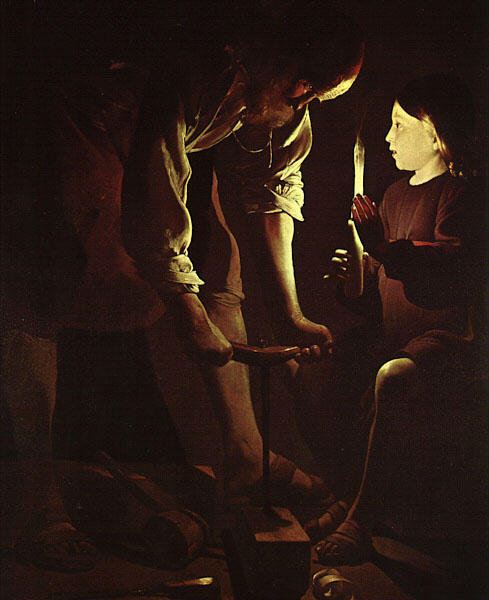
Joseph the Carpenter


 詳細を見る
詳細を見る
ジークレー/アートプリント
迅速な制作と多彩な仕上げオプションを備えた、ミュージアムクオリティのジークレーまたはキャンバスプリント。 ( 手描き画への切り替え 画像に切り替え)




P118B $10

P118H $10

P118W $10

P438Z $10

P508JH $12

P508YH $12

P805H $10

P805Z $10

P919BZ $10

P919G $10

P919XJ $10

P959ZH $10

P968JZ $12

W106C $8

W218G $10

W218JH $8

W218Y $10

W307PJ $10

W316G $10

W316PJ $8

W316Y $10

W398PJ $8

W4111J $10

W500HY $15

W500JH $15

W692G $12

W849H $8

W940BG $15

W953PJ $8




作品のオリジナル比率に合わせた、当店の規定サイズからお選びください。

特定のフレームやスペースに合わせて、ご自身でサイズを指定することも可能です。選択されたサイズが元の画像の比率と一致しない場合、作品をトリミングするか、鏡面反射または単色での塗りつぶしによって画像を拡張いたします。制作を開始する前に、ご確認用のデジタルモックアップをお送りいたします。
画面上のプレビューには、実際のトリミングや拡張は反映されませんのでご注意ください。最終的な構図を正確に確認できるのは、モックアップのみとなります。
カスタムサイズも承っておりますが、元の比率を維持するためには、あらかじめ用意されたリストからサイズを選択することをお勧めいたします。


 ガラスオプションは、110cm未満のサイズでのみご利用いただけます。

Joseph the Carpenter
ジークレー/アートプリント
複製画のサイズ
-


合計金額
$ 81
作品詳細説明
A Quiet Moment of Divine Foreshadowing
Joseph the Carpenter by Georges de La Tour is a profoundly moving depiction of domestic tranquility imbued with subtle religious symbolism. Created around 1642, this oil painting offers a glimpse into the humble workshop of Saint Joseph, presenting a tender scene of mentorship and foreshadowing. The composition centers on Joseph diligently working as a carpenter, while the young Jesus attentively holds a candle, illuminating his earthly father’s task.Masterful Tenebrism & Baroque Style
De La Tour was a leading figure in French Baroque painting, deeply influenced by Caravaggio's dramatic use of light and shadow – a technique known as *tenebrism*. This is powerfully evident here. The scene unfolds within a darkened space, with a single candle providing the primary source of illumination. This stark contrast isn’t merely stylistic; it directs our gaze to the key elements: Joseph’s focused labor, Jesus's gentle offering, and the tools of the trade.- Style: Baroque, Tenebrism
- Technique: Oil on canvas with meticulous layering (glazes) to achieve luminous effects despite the darkness.
- Composition: Intimate and focused, drawing the viewer into a quiet, personal moment.
Symbolism Woven in Wood & Light
Beyond its surface beauty, the painting is rich with symbolic meaning. The auger Joseph uses to drill wood subtly echoes the shape of the cross – a poignant prefiguration of Christ’s crucifixion. The arrangement of the wood itself, laid across the floor, further reinforces this foreshadowing. Jesus holding the candle isn't simply an act of assistance; it represents him as the “Light of the World,” a central tenet of Christian belief. His raised hand can be interpreted as a gesture of blessing or benediction.- The Auger: Symbolizes Christ’s future sacrifice on the cross.
- Candlelight: Represents Jesus as the “Light of the World.”
- Jesus' Gesture: Signifies blessing, acceptance of his destiny, and divine grace.
Historical Context & Artistic Legacy
Georges de La Tour (1593-1652) lived during a period of religious revival in Lorraine. His work reflects this piety, moving increasingly towards purely religious subjects throughout his career. He was appointed “Painter to the King” in 1638, demonstrating his rising status and influence. Interestingly, La Tour’s work fell into relative obscurity after his death, only being rediscovered in the early 20th century. His masterful use of light and shadow continues to inspire artists today.Emotional Resonance & Interior Appeal
Joseph the Carpenter evokes a sense of quiet contemplation, humility, and familial love. The painting’s subdued palette and intimate scale create an atmosphere of serenity and reverence. Its dramatic lighting and compelling narrative make it a captivating focal point for any space. This artwork would be particularly well-suited to interiors seeking a touch of Old World elegance, spiritual depth, or a sophisticated artistic statement. A high-quality reproduction captures the nuances of La Tour’s technique, bringing this timeless masterpiece into your home.アーティストの略歴
Georges de La Tour (1593–1652): French Baroque Master of Dramatic Chiaroscuro & Tenebrism
Georges de La Tour, a name that resonates with the hushed reverence reserved for masters of light and shadow, remains one of the most compelling figures of the French Baroque. Born in 1593 in Vic-sur-Seille, Lorraine—now Moselle—his life unfolded against a backdrop of religious fervor and political upheaval. While details surrounding his early training remain somewhat elusive—scholars speculate about potential journeys to Italy or apprenticeships with local artists like Jacques Bellange—the seeds of his artistic vision were undoubtedly sown in this environment. He wasn’t born into an artistically established family; his father was a baker, yet the circumstances of his mother's lineage hint at a possible connection to nobility, a subtle influence perhaps reflected in the dignity and quiet grace that permeate his work.
Early Life & Artistic Influences
Georges de La Tour’s educational background remains somewhat unclear, but it is assumed that he traveled either to Italy or the Netherlands early in his career. He may possibly have trained under Jacques Bellange in Nancy—the capital of Lorraine—although their styles are very different. His paintings reflect the Baroque naturalism of Caravaggio—the Italian master who revolutionized painting with his intensely realistic and emotionally charged scenes—yet, De La Tour didn’t simply imitate; he filtered Caravaggism through the prism of Dutch Caravaggisti, particularly those from the Utrecht School like Hendrick Terbrugghen. This fusion resulted in a style that was both powerful and restrained, characterized by a muted palette dominated by earth tones and subtle gradations of light. The Utrecht School's emphasis on dramatic lighting—a technique known as *tenebrism*—significantly shaped De La Tour’s artistic approach.
The Style of Lunéville & Major Works
In 1620 he established his studio in Lunéville, where he would spend much of his career serving both the French court and the Dukes of Lorraine. This dual patronage allowed him to flourish, yet it was within the intimate confines of domestic scenes and religious contemplation that his true genius found expression. His distinctive style—marked by a profound simplification of forms and an almost obsessive attention to detail—became synonymous with the Lunéville School. Among De La Tour’s most iconic works are *The Fortune Teller*, painted around 1630, which captures the eerie atmosphere of nocturnal storytelling; *St Joseph Carpenter*, depicting a serene domestic scene illuminated by candlelight—a motif that would become central to his oeuvre; and *The Lamentation over St Sebastian*, rendered with heartbreaking subtlety and realism—demonstrating De La Tour’s unparalleled ability to convey profound emotional truths.
Rediscovery & Legacy
Despite achieving recognition during his lifetime—he was appointed “Painter to the King” by Louis XIII in 1638—De La Tour’s work fell into relative obscurity after his death in 1652. For centuries, many of his paintings were misattributed to other artists, and his name faded from art historical memory. It wasn't until the early 20th century that a concerted effort was made to rediscover and re-evaluate his oeuvre, led by scholars like Hermann Voss. This rediscovery revealed an artist of extraordinary originality and depth—whose work bridged the gap between Caravaggism and French Classicism—solidifying his place as a pivotal figure in the history of European art. His innovative use of light and shadow—combined with his psychological insight into his subjects—continues to captivate audiences today. He remains celebrated for his ability to imbue everyday scenes with profound meaning and emotional depth.

ジョルジュ・ド・ラ・トゥール
1593 - 1652 , フランス
基本情報
- Artistic Movement Or Style: Барокко, Тенебризм
- Artists Who Influenced This Artist:
- Караваджо
- Генрик Тербрюгген
- Date Of Birth: 13 марта 1593 г.
- Date Of Death: 30 января 1652 г.
- Full Name: Georges de La Tour
- Nationality: Французский
- Notable Artworks:
- Пророк Эзекииль
- Поклонение пастухов
- Слезы святого Петра
- Place Of Birth: Вик-сюр-Сейль, Франция
関連記事

Shadows of Drama: Exploring the Artistic Power & Historical Context of Tenebrism
Explore the captivating world of tenebrism! Discover Caravaggio's revolutionary techniques, its spread across Europe, & lasting influence on Baroque art. A comprehensive guide for art enthusiasts.
Baroque Realism: Illusion, Emotion & the Dramatic Transformation of 17th-Century Art
Explore the dramatic world of Baroque Realism! Discover iconic artists like Caravaggio & Rubens, their techniques, and the movement's lasting impact on art history. Expert insights for collectors & enthusiasts.
Chiaroscuro & Emotional Resonance: Exploring Dramatic Light in Western Painting
Explore the captivating world of chiaroscuro & tenebrism! Discover Caravaggio's influence, Baroque masters, and the enduring power of dramatic lighting in art history. Learn about these techniques with OriginalUniqueArt.
Baroque Classicism: Reconciling Drama & Order in 17th-Century Art
Explore the captivating world of Baroque Classicism! Discover its history, key artists like Caravaggio & Rubens, and defining characteristics. Expert insights & high-quality reproductions at OriginalUniqueArt.

Maurice Quentin de La Tour: Light, Shadow & the Rococo Portrait
Explore the captivating world of Maurice Quentin de La Tour, a master of Rococo portraiture. Discover his innovative pastel techniques, intimate depictions of French aristocracy, and lasting artistic legacy. Learn more at OriginalUniqueArt.



