油彩画を購入
 untitled (9288)の詳細







































 いずれかの辺が105 cm(約41インチ)を超えるアートワークまたは複製画の場合、フレームは分解されたキットの状態でお届けいたします。この方法は、輸送中の破損を防ぎ、安全に配送するために採用しております。


Georges Braque’s Still Life Reverie: A Fragment of Cubist Innovation
Georges Braque’s “untitled (9288)” stands as a testament to the transformative power of artistic experimentation during the early years of the 20th century. Executed in 1974, this photolithograph captures a deceptively simple scene—a collection of chairs and vases—yet it embodies the core principles of Cubism, cementing Braque’s position as one of Picasso's most influential collaborators.
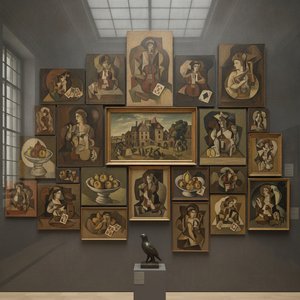
- Subject Matter: The artwork presents an unassuming domestic tableau. Three chairs – varying in size and form – dominate the composition on the left side, while four vases punctuate the space with splashes of color and texture.
- Style & Technique: Braque’s masterful use of photolithography lends a remarkable clarity to the fractured geometric forms characteristic of Cubism. Unlike traditional oil paint, photolithography allows for precise tonal gradations and subtle nuances of color, mirroring the artist's desire to dissect visual perception.
- Historical Context: Created in 1974, decades after the genesis of Cubism alongside Picasso, “untitled (9288)” reflects a retrospective gaze upon the movement’s groundbreaking innovations. It emerged from a period marked by intense intellectual debate about representation and abstraction—a reaction against Impressionistic idealism.
- Symbolism & Emotional Impact: Though seemingly devoid of overt narrative, the arrangement of chairs and vases speaks to broader concerns about spatial relationships and visual fragmentation. Braque’s deliberate simplification aims not merely to depict objects but to convey a sense of stillness and contemplation—a quiet defiance of the turbulent artistic currents of his time.
The Genesis of Cubism: Deconstructing Reality
Braque's contribution to Cubism wasn’t simply stylistic; it was fundamentally conceptual. Alongside Picasso, he challenged the conventions of Western art by rejecting single-point perspective and striving for a more accurate depiction of three dimensions on a two-dimensional surface. This approach involved breaking down objects into geometric planes—cubes, cylinders, cones—and presenting them simultaneously from multiple viewpoints.
- Influences: Braque’s artistic vision drew inspiration from Cézanne's exploration of form and volume, as well as African sculpture’s expressive simplification.
- Collaboration with Picasso: The partnership between Braque and Picasso was pivotal in shaping Cubist aesthetics. Their shared experimentation resulted in artworks that were often indistinguishable for years, demonstrating the power of collaborative creativity.
Photolithography: Precision and Subtle Color
The choice of photolithograph as a medium underscores Braque’s meticulous attention to detail. Unlike oil paint, which blends colors optically, photolithography relies on halftone dots—tiny circles that create the illusion of shading—allowing for exceptional tonal accuracy and nuanced color palettes. This technique reflects Braque's desire to capture the essence of form while minimizing distortion.
- Material Properties: Photolithography utilizes a stone surface treated with acid to etch an image, transferring it onto paper through ink printing.
- Reproductions & Preservation: High-quality reproductions of “untitled (9288)” maintain the artwork’s original vibrancy and textural qualities, ensuring its legacy continues to inspire collectors and interior designers alike.
Q&A
untitled (9288)は手描きですか、それともプリントですか?
手描きによる制作:熟練した画家が、リネンキャンバスに油彩でuntitled (9288)を模写します。
untitled (9288)のサイズはどれを選べばよいですか?
サイズは28.2 x 35.5 cm (¥31567)から196.0 x 246.6 cm (¥279681)まで展開しております。こちらのページ内の表に、主な工程とそれぞれの価格を記載しています。
配送にはどのくらいの時間がかかりますか?
配送には4〜5週間を要し、世界中どこでも速達便にて無料でお届けいたします。また、本ページではお急ぎの方向けの特急制作オプションもご用意しております。商品は、理由を問わず100日以内であれば全額返金での返品が可能です。
ジョルジュ・ブラックはuntitled (9288)の制作にどのような画材(メディア)を使用しましたか?
Lithography
 設置イメージを表示

 シェアする
 シェアする
 詳細を見る
 解説シート


 ダウンロード
 似ている作品
 X線調査
 スライドショーを表示
 Q&A

 統計情報