プリント版に切り替え
 詳細を表示
詳細を表示







































 いずれかの辺が105 cm(約41インチ)を超えるアートワークまたは複製画の場合、フレームは分解されたキットの状態でお届けいたします。この方法は、輸送中の破損を防ぎ、安全に配送するために採用しております。


Fruitdish and Glass: A Cornerstone of Cubism
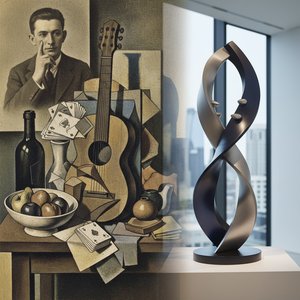
Georges Braque’s Fruitdish and Glass stands as a pivotal work in the history of art, marking a significant milestone in the development of Cubism. Created in 1912, this painting exemplifies the principles of Analytical Cubism, characterized by its use of geometric shapes and overlapping planes to create a fragmented representation of reality. It’s more than just a still life; it's an exploration of perception and form that fundamentally altered the course of modern art.
The Birth of Papier Collé
Fruitdish and Glass is notably recognized as the first attempt at a papier collé painting. Braque ingeniously incorporated textured pieces of wallpaper to create this collage effect, adding depth and visual complexity. This technique, developed collaboratively by Braque and Pablo Picasso, became an essential aspect of Cubism. It allowed artists to break away from traditional perspective and explore new ways of representing form and space, moving beyond the limitations of a single viewpoint.
Significance in the Context of Cubism
This artwork is a prime example of Cubist art, which fundamentally challenged conventional notions of representation. By fragmenting forms into geometric shapes – squares, rectangles, and overlapping planes – Braque sought to convey the essence of an object rather than its surface appearance. The still life elements—the fruit dish, glass, grapes, and pears—are deconstructed and reassembled, creating a dynamic interplay of angles and perspectives. This approach paved the way for future art movements, including Futurism, Constructivism, and Suprematism, demonstrating Cubism’s lasting influence on artistic innovation.
Key Features and Emotional Impact
- Papier Collé Technique: The incorporation of wallpaper adds a unique texture and depth, disrupting the flatness of the canvas and introducing an element of everyday materiality into the artwork.
- Fragmentation and Geometric Forms: The breakdown of objects into geometric shapes is characteristic of Cubism, challenging traditional notions of realism.
- Overlapping Planes: These create a sense of spatial complexity and ambiguity, inviting the viewer to actively engage with the artwork and reconstruct its meaning.
- Monochromatic Palette: The limited color palette—primarily grayscale tones—focuses attention on form and structure rather than vibrant hues. This creates a contemplative and intellectual atmosphere.
Fruitdish and Glass evokes a sense of quiet contemplation and intellectual curiosity. It’s not about depicting a scene realistically; it's about exploring the underlying structures that define our perception of reality. The artwork invites viewers to question their assumptions about representation and appreciate the beauty of abstraction.
Q&A
「Fruitdish and Glass」のCubism様式には、どのような情緒的なトーンが漂っていますか?
Cubismのムーブメントにおいて、「Fruitdish and Glass」はReflectiveなトーンで描かれています。
「Fruitdish and Glass」は、全体的に明るい印象ですか、それとも暗い印象ですか?
ジョルジュ・ブラクエ作「Fruitdish and Glass」 の記録された数値は、明度 brilliant、輝度 Bright Balance です。
「Fruitdish and Glass」の画像はダウンロードできますか?
「Fruitdish and Glass」のダウンロードが可能です。作品のデジタルイメージをダウンロードページにて高解像度デジタル画像のダウンロードいただけます。
この絵画の詳細を見る
 設置イメージを表示
 シェアする
シェアする シェアする
シェアする
 詳細を見る
詳細を見る ガイドを表示

 ダウンロード
 似ている作品
 X線調査
X線調査 スライドショーを表示
 Q&A
Q&A 統計情報
統計情報